Knowledge Chemical Engineering Education How do CVD parameters affect stoichiometry and phase purity? Optimize thin film deposition.
Author avatar

Tech Team · LABPARK

Updated 1 month ago

How do CVD parameters affect stoichiometry and phase purity? Optimize thin film deposition.


Experimental parameters dictate the precise atomic arrangement of your film. In a CVD pilot plant, the stoichiometry and phase purity of materials like titanium carbide or vanadium silicides are primarily controlled by the substrate temperature and the ratio of precursor partial pressures. By mapping these variables onto the system's thermodynamic phase diagram, operators can navigate distinct single-phase regions to avoid unwanted co-deposits, such as free carbon, metal clusters, or competing silicide phases.

The core insight is that phase-pure deposition is a problem of thermodynamic targeting. You must select a temperature and gas-phase composition that places your desired solid compound as the sole thermodynamically stable condensed phase, allowing Gibbs energy minimization to drive the reaction to a clean, single-phase product in your pilot reactor.

The Thermodynamic Foundation of Phase Control

CVD is not merely a kinetic reaction; it's a battle for chemical potential. In a pilot plant, you can't ignore the fundamental thermodynamics that dictate which solids can form.

Why Gibbs Energy Minimization is Your Map

The system will always move toward the lowest possible total Gibbs energy at a given temperature and pressure. For a multi-element system (e.g., V-Si-Cl-H-Ar), multiple condensed phases may be stable simultaneously.

By calculating the Gibbs energy curves for all possible solid phases—VSi₂, V₅Si₃, V₃Si, SiC, free carbon—you create a phase stability map. The pilot plant operator's job is to "steer" the process into a region where only one of these has a negative driving force for deposition.

How Temperature Defines the Single-Phase Window

For vanadium silicides, different phases dominate at different temperature ranges. VSi₂ may be stable at lower temperatures, while V₅Si₃ requires a hotter surface.

  • For titanium carbide (TiC), a wide single-phase region typically exists between roughly 900°C and 1100°C, but the stoichiometric locking point (Ti:C = 1:1) shifts with temperature.
  • Operating just outside a single-phase window can cause co-deposition. A slightly silicon-poor gas feed at high temperature might nucleate a V₅Si₃ layer beneath a VSi₂ film, ruining phase purity.

Translating Thermodynamics into Pilot Plant Knobs

The pilot plant's advanced control systems let you hit these thermodynamic targets with precision. Two parameters dominate: gas composition and deposition temperature.

The Precursor Ratio: Setting the Chemical Potential

The inlet gas-phase ratio of metal-source to co-reactant directly determines the chemical potential of each element at the substrate. In the primary reference example, adjusting the SiCl₄/VCl₄ ratio tunes the silicon activity.

  • For TiC from TiCl₄ and CH₄: The Cl:C ratio in the gas phase is critical. Too much CH₄ leads to free carbon inclusions (C/Ti > 1). Too little carbon results in sub-stoichiometric TiCₓ or free titanium, which is extremely oxygen-sensitive.
  • For vanadium silicides: A high SiCl₄/VCl₄ ratio pushes the system toward silicon-rich phases like VSi₂. A lower ratio favors metal-rich phases like V₃Si. You must experimentally verify this by adjusting the mass flow controllers and analyzing the resulting film composition.

Temperature: The Activator and Selector

Substrate temperature plays a dual role. It activates the precursor chemistry, and it shifts the thermodynamic stability of each phase.

  • Kinetic vs. Thermodynamic Control: At very low temperatures, the reaction rate is slow, and surface kinetics may trap a metastable amorphous phase. As you ramp temperature, you enter the regime where thermodynamics can enforce ordering, crystallizing the desired silicide or carbide.
  • Preventing gas-phase nucleation: In a pilot-scale hot-wall reactor, excessive temperature can cause premature reaction in the gas phase, forming powder that contaminates the film. You must keep the precursor streams cold until they meet the heated substrate, using careful reactor geometry.

Understanding the Trade-offs

Pilot-scale CVD doesn't exist in an ideal, equilibrium-only world. Several real-world factors compete with your thermodynamic model.

  • Mass Transport Limitations: If the gas boundary layer over the substrate becomes depleted, the local reactant ratio may differ from the inlet setting. You might inject a perfect 1:1 Ti:C ratio, but on a large substrate, the center of a wafer could see a carbon-starved condition, leading to a silvery titanium-rich edge and a stoichiometric center.
  • By-product Inhibition: For chlorinated precursors, HCl is a by-product. Its adsorption can block surface sites or even etch the growing film. This can shift the effective deposition rate and alter the local stoichiometry, an effect not captured by simple equilibrium calculations.
  • Purity of the Final Phase vs. Growth Rate: Operating deep inside a single-phase window often requires a more diluted gas mix or a lower temperature, sacrificing deposition rate for absolute purity. A pilot plant study must balance throughput with the phase purity required for the application.

Making the Right Choice for Your Goal

The pilot plant is your experimental sandbox. Use it to build your own phase stability atlas for the specific reactor geometry you're using.

  • If your primary focus is phase identification: Run a matrix of experiments varying the precursor ratio and temperature while keeping total pressure and flow constant. Characterize each film with XRD to map out the empirical single-phase domains.
  • If your primary focus is stoichiometric precision (e.g., TiC with x=0.95): Identify the C/Ti inlet ratio that yields the closest bulk composition at your chosen temperature. Then, fine-tune the temperature to adjust the carbon vacancy concentration without crossing into the free-carbon co-deposition boundary.
  • If your primary focus is scalability: Once a single-phase window is verified in the pilot plant, test its sensitivity to total flow rate and substrate racking density. The robust process window is the one that tolerates the inevitable variations of a production-scale reactor.

Mastery of the pilot plant means moving from simply "making a film" to consistently commanding the exact atomic ratio and crystal structure your application demands.

Summary Table:

CVD Parameter Primary Effect Phase/Stoichiometry Outcome
Substrate Temperature Alters thermodynamic stability & kinetics Shifts stability windows (e.g., TiC vs. sub-carbides; VSi₂ vs. V₅Si₃)
Precursor Ratio Controls chemical potential & activity Prevents co-deposition (e.g., free carbon or metal-rich phases)
Flow Rate & Transport Determines local reactant concentration Avoids spatial stoichiometry gradients across substrates

Achieve Precise Process Control with LABPARK

Are you looking to master complex chemical vapor deposition and scale-up dynamics in your lab? LABPARK provides state-of-the-art Educational and Vocational Unit Operations Pilot Plants in chemical engineering, bioprocess & biotech, and environmental & water treatment. Built for universities, research institutes, and enterprises, our pilot plants empower users to precisely control critical parameters, ensuring high-purity phase deposition and reproducible experimental results.

Contact LABPARK today to discover how our custom pilot plant solutions can elevate your research and educational capabilities!

Related Products

People Also Ask

Related Products

100L Continuous Loop Hydrogenation Educational Unit Operations Pilot Plant

100L Continuous Loop Hydrogenation Educational Unit Operations Pilot Plant

This 100L continuous loop hydrogenation pilot plant is designed for chemical engineering education, featuring 316 stainless steel construction, advanced gas-liquid mass transfer components, explosion-proof safety systems, and a 15.6-inch touchscreen with 5G connectivity, cloud data logging, bridging theory and industry.

Carbon Dioxide Hydrogenation Methanol Synthesis Educational Unit Operations Pilot Plant

Carbon Dioxide Hydrogenation Methanol Synthesis Educational Unit Operations Pilot Plant

Pilot-scale educational system for carbon dioxide hydrogenation to methanol. Designed for unit operations teaching, it features a fixed-bed reactor, three-stage heating, dual mass flow controllers, and a 15.6-inch touchscreen with data acquisition. Perfect for chemical engineering and sustainable energy courses.

Fixed-Bed Chemical Reaction and Gas Dust Tar Removal Unit Operations Pilot Plant

Fixed-Bed Chemical Reaction and Gas Dust Tar Removal Unit Operations Pilot Plant

Integrated educational pilot plant for studying catalytic gas-solid reactions and downstream gas purification. Features dual fixed-bed reactor, three-stage heating, and touchscreen control for hands-on engineering training. Ideal for chemical and environmental engineering curricula.

Constant Pressure Filtration Educational Unit Operations Pilot Plant

Constant Pressure Filtration Educational Unit Operations Pilot Plant

Hands-on educational pilot plant for constant pressure filtration. Classic plate and frame filter press allows students to study kinetics, determine specific cake resistance, perform cake washing and evaluate washing rates. Ideal for chemical engineering curriculum. Mobile, customizable, safety-compliant design.

Carbon Dioxide Hydrogen Methanol Synthesis Educational Unit Operations Pilot Plant

Carbon Dioxide Hydrogen Methanol Synthesis Educational Unit Operations Pilot Plant

Hands-on educational pilot plant for methanol synthesis from carbon dioxide and hydrogen. Enables practical study of high-pressure catalysis, unit operations, and process control. Features real-time data acquisition, safety systems, and customizable experiment modules for undergraduate and graduate chemical engineering laboratories.

Multi-Modal Distillation Unit Operations Training Pilot Plant

Multi-Modal Distillation Unit Operations Training Pilot Plant

Multi-modal distillation pilot plant for practical unit operations training in chemical engineering education. Features real, analog, and semi-physical simulation modes, industrial construction, customizable for university labs. Hands-on fractionation columns, SCADA control, safety systems. Includes sight glasses, sampling ports, closed-loop recycling.

General Purpose Cosmetics Production Unit Operations Training Pilot Plant

General Purpose Cosmetics Production Unit Operations Training Pilot Plant

Integrated pilot-scale cosmetics production training plant for chemical engineering education featuring utility supply emulsification blending and filtration modules with dual touchscreen manual control customizable mobile design ideal for practical hands-on unit operations and advanced process control learning.

Comprehensive Fluid Mechanics Educational Unit Operations Pilot Plant

Comprehensive Fluid Mechanics Educational Unit Operations Pilot Plant

Hands-on fluid mechanics pilot plant for engineering education covering over 13 principles including pipe flow, minor losses, flowmeter calibration, and pump performance with industrial-grade components, smooth and rough piping, venturi and orifice flowmeters, and centrifugal pump testing and analysis.

Three-Tube Heat Transfer Educational Pilot Plant for Unit Operations Training

Three-Tube Heat Transfer Educational Pilot Plant for Unit Operations Training

Three-tube heat transfer pilot plant for studying convective heat transfer enhancement and condensation. Allows comparison of smooth, corrugated, turbulent tubes, verifying empirical correlations. Ideal for chemical engineering education with safety and closed-loop steam recovery.

Multi Pump Fluid Transport Process Piping Unit Operations Training Pilot Plant

Multi Pump Fluid Transport Process Piping Unit Operations Training Pilot Plant

Industrial-scale multi-pump pilot plant for unit operations training in fluid transport and process piping, featuring real-material and semi-physical simulation modes, comprehensive pump and flowmeter calibration, and safety-enhanced two-tier platform, bridging academic theory and industrial practice for chemical engineering education.

Dual-Mode Rectification Pilot Plant for Practical Training Unit Operations

Dual-Mode Rectification Pilot Plant for Practical Training Unit Operations

Industrial-scale dual-mode rectification pilot plant for chemical engineering practical training. Features real-material and simulated-material operation modes, sieve-plate column with sight glasses for visual observation of hydrodynamics, and customizable SCADA control for safe, hands-on learning of unit operations and mass transfer.

Multi-Functional Drying Educational Unit Operations Pilot Plant

Multi-Functional Drying Educational Unit Operations Pilot Plant

Versatile multi-functional drying educational unit operations pilot plant integrating tunnel, fluidized bed, and spray drying. Enables hands-on study of drying curves, psychrometry, and gas-solid separation for chemical engineering curriculum in higher education labs.

Fluid Transport and Piping Dynamics Practical Training Unit Operations Pilot Plant

Fluid Transport and Piping Dynamics Practical Training Unit Operations Pilot Plant

This industrial-scale fluid transport and piping dynamics training pilot plant provides essential hands-on experience with pump operations, cavitation, piping resistance, flow metering, and process control. Customizable to fit specific academic engineering curricula.

Educational Unit Operations Pilot Plant for Intraparticle Diffusion Effective Factor Measurement

Educational Unit Operations Pilot Plant for Intraparticle Diffusion Effective Factor Measurement

Designed for chemical engineering university labs, this pilot plant allows hands-on determination of catalyst particle intraparticle diffusion effective factors and gas-solid reaction kinetics using a fixed-bed tubular reactor with industrial touchscreen control, bridging theory and practical reactor design.

Natural Product Extraction Unit Operations Training Pilot Plant

Natural Product Extraction Unit Operations Training Pilot Plant

Integrated natural product extraction pilot plant for chemical engineering training bridges theory and industrial practice with modular extraction and evaporation/concentration units, hybrid touchscreen and manual control, realistic process simulation, and self-contained softened water and vacuum utilities.

Dual Mode Heat Transfer Pilot Plant for Unit Operations Training

Dual Mode Heat Transfer Pilot Plant for Unit Operations Training

Engineering-scale dual-mode heat transfer pilot plant for hands-on unit operations training in chemical engineering. Features real and simulated modes, multiple heat exchanger types, comprehensive coefficient determination, and advanced process control with data acquisition for engineering students and researchers.

Multi Functional Catalytic Reaction and Reactor Evaluation Educational Unit Operations Pilot Plant

Multi Functional Catalytic Reaction and Reactor Evaluation Educational Unit Operations Pilot Plant

Bench-scale educational pilot plant for catalytic reaction and reactor evaluation, integrating fixed bed, fluidized bed, and stirred tank reactors. Students compare reactor designs, evaluate catalysts, and study reaction kinetics and hydrodynamics. Perfect for unit operations labs in chemical engineering curricula.

Bio-fermentation Ethanol Production Practical Training Unit Operations Pilot Plant

Bio-fermentation Ethanol Production Practical Training Unit Operations Pilot Plant

Bio-fermentation ethanol production pilot plant for hands-on training in unit operations: fermentation, solid-liquid filtration, membrane separation, and distillation. Bridges theory with industrial practice using industrial-grade components, customizable for university labs. Hybrid automated and manual control for comprehensive learning.

Comprehensive Multi-Modal Heat Transfer Unit Operations Pilot Plant for Engineering Training

Comprehensive Multi-Modal Heat Transfer Unit Operations Pilot Plant for Engineering Training

Comprehensive multi-modal heat transfer unit operations pilot plant for engineering training. Features four heat exchanger types, multi-media switching, and three operating modes. Hands-on experience in safety, optimization, and process control. Industrial-grade design with real-time data acquisition for chemical engineering labs.

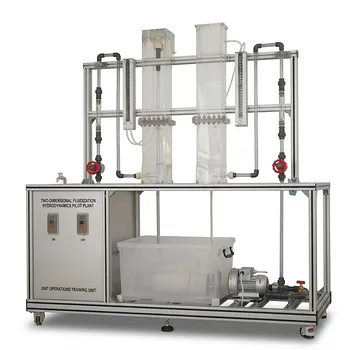
Two-Dimensional Fluidization Hydrodynamics Educational Pilot Plant for Unit Operations Training

Two-Dimensional Fluidization Hydrodynamics Educational Pilot Plant for Unit Operations Training

Explore gas-solid and liquid-solid fluidization hydrodynamics with our transparent 2D educational pilot plant. Ideal for chemical engineering unit operations labs, it demonstrates fixed to fluidized bed regimes, measures pressure drop, and integrates QR-code digital learning for enhanced student training.


Leave Your Message