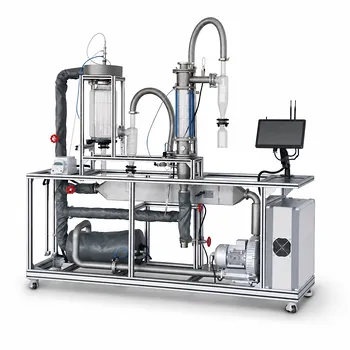
HTST is the answer, but you still have to over-formulate. In bioprocess pilot plants, handling heat-sensitive nutrients during media preparation relies on continuous sterilization using the High-Temperature Short-Time (HTST) method. This process rapidly heats the medium to a lethal temperature (typically 120–135°C), holds it for a very short, precisely controlled time, and then cools it immediately. Because some thermal loss is unavoidable, the initial concentration of fragile compounds like vitamins is deliberately increased to compensate for that degradation.
Every sterilization method involves a trade-off between killing microbes and preserving molecules. Pilot plants solve this by shifting the balance in favor of brief, controlled heat exposure—paired with proactive over-formulation to ensure the final nutrient content meets the bioprocess’s demands. This is a system, not just a temperature setting.
The Challenge of Heat-Sensitive Nutrients
Media for mammalian cells, microorganisms, or enzymes often contains vitamins, amino acids, and growth factors that degrade quickly in the presence of heat. Traditional batch sterilization, where an entire vessel is heated and held at temperature for an extended period, exposes these compounds to damaging conditions for far too long.
Why Batch Sterilization Falls Short
In a batch autoclave cycle, the heating and cooling phases are slow. The liquid sits near its peak temperature for a much longer cumulative time than the nominal hold, creating a harsh thermal history.
This extended exposure breaks chemical bonds, reduces biological activity, and can even generate inhibitory by-products from Maillard reactions or caramelization. For a pilot plant trying to replicate a robust process, this variability is unacceptable.
The Core Dilemma in a Pilot Plant
You need complete sterility—a 12-log reduction of bacterial spores—without destroying the functional components that make the medium effective. The Deep Need is not just sterilization; it is preserving the biochemical potency of a precisely designed formulation at a scale where experimentation and reproducibility matter.
How HTST Continuous Sterilization Preserves Nutrient Integrity
HTST decouples the microbial kill from the degradation of nutrients by exploiting their different reaction kinetics. Simply put, bacterial spores are killed much faster at high temperatures than most vitamins are destroyed.
The Physics of Time vs. Temperature
Microbial death follows first-order kinetics with a high activation energy. That means a small increase in temperature delivers a massive jump in kill rate. Nutrient degradation also follows first-order kinetics, but with a lower activation energy—its rate increases less dramatically with temperature.
This gives you a window of opportunity. By spiking the temperature very high for just seconds or a couple of minutes, you can achieve the required F0 value (lethality) while minimizing the C value (chemical degradation). In practice, 135°C for 3 minutes kills spores far more selectively than 120°C for 15 minutes.
How a Continuous Sterilizer Is Configured
A typical pilot-plant HTST skid includes a plate-and-frame or tubular heat exchanger for rapid heating, a holding tube (the critical residence-time section), and a second heat exchanger for immediate cooling.
- Heating is near-instantaneous: Direct steam injection or high-surface-area exchangers can bring the medium to temperature in seconds.
- Cooling is equally aggressive: The hot medium passes through a regeneration section that transfers heat into the incoming cold stream, slashing the temperature to below 40°C within seconds.
This square-wave thermal profile exposes the nutrients to damaging heat only during the brief hold, unlike the slow ramp-and-cool curve of batch sterilization.
Compensating for the Unavoidable Loss
Even with HTST, some vitamin destruction occurs. The rule in pilot plants is never to hope for perfect survival.
A small-scale HTST system is first characterized by running water or test solutions to determine the exact residence time distribution and F0 delivered. Then, based on published thermal degradation constants for the most labile nutrient (like thiamine or biotin), the formulation is deliberately “overcharged”. If a vitamin shows 10% loss, you add 11% extra. This adjustment is baked into the recipe before sterilization, ensuring the post-sterilization concentration meets the process target.
Where Cold Sterilization Takes Over for Ultra-Labile Molecules
Some specialized nutrients, growth factors, or oxygen-sensitive co-factors cannot survive even 120°C for a few seconds. In those cases, pilot plants move to non-thermal sterilization for that specific component.
Sterile Filtration for Heat-Intolerant Additives
Instead of forcing the entire medium through a heat exchanger, the basal medium (heat-stable salts, sugars, etc.) is sterilized via HTST or batch, and the heat-labile nutrient is sterilized separately by membrane filtration (0.2 µm). It is then aseptically added afterward.
This approach completely avoids thermal exposure for the sensitive component, though it introduces complexity: the filtration step must be validated for the specific solution, and aseptic transfer connections must be flawless. It’s the method of choice when even a 5% loss of bioactivity is unacceptable.
Understanding the Trade-offs
HTST is powerful, but it’s not a universal fix. Pilot-plant teams need to manage side effects that come with this speed.
Fouling and Cleanability
High temperatures can cause protein denaturation and caramelization on heat-exchanger surfaces. This fouling reduces heat transfer efficiency, creates a niche for microbial growth, and demands aggressive CIP procedures. At pilot scale, batch sizes are small, so downtime from cleaning can burn through an entire day.
Equipment Complexity and Hold-Up Volume
A continuous sterilizer requires pumps, back-pressure valves, and careful steam control. More importantly, the system has a minimum hold-up volume. If you are preparing only 20 liters, the fixed volume inside the holding tube and exchangers can represent a significant portion, causing dilution or waste. Batch sterilization is often more practical for very small volumes, despite its harsher thermal profile.
Precise Residence Time Is Non-Negotiable
The kill calculation depends on every fluid element spending at least the required time at temperature. Pilot teams must validate the minimum residence time using dye or tracer tests, accounting for viscous media where flow profiles can cause “tailing.” An oversight here can result in a non-sterile batch—or, paradoxically, over-processing that ruins the nutrients you’re trying to protect.
Making the Right Choice for Your Pilot Plant Goal
The best sterilization strategy depends on what your pilot program is trying to prove.
- If your primary focus is preserving maximum biological activity in a defined medium: Pair HTST continuous sterilization with a pre-calculated over-formulation buffer. Validate a narrow time/temperature window (e.g., 135°C for exactly 3 minutes) and never deviate.
- If your primary focus is working with an extreme heat-labile additive that money can’t replace: Separate the media stream. Sterilize the basal components with HTST and sterile-filter the sensitive nutrient through a 0.2 µm membrane, then combine them aseptically post-sterilization.
- If your primary focus is process simplicity and rapid prototyping with very small batches: Accept the higher nutrient loss of batch autoclaving but compensate with a larger overage in your formulation. This sacrifices elegance for speed and is often the right choice early in development.
Your pilot plant is not just a small factory—it’s an experimental system. The way you handle heat-sensitive nutrients defines the quality of the biological data you generate. Choose the method that protects your process’s signal, not just its sterility.
Summary Table:
| Sterilization Method | Core Mechanism | Nutrient Preservation | Ideal Application |
|---|---|---|---|
| HTST (Continuous) | Rapid heating (120–135°C) & instant cooling | Moderate to High (with over-formulation) | Media containing standard vitamins & amino acids |
| Sterile Filtration | 0.2 µm membrane physical separation | Excellent (zero thermal degradation) | Ultra-labile growth factors & co-factors |
| Batch (Autoclave) | Extended thermal exposure cycle | Low (high risk of degradation) | Simple, heat-stable media or very small volumes |
Optimize Your Bioprocess Scaling with LABPARK
At LABPARK, we specialize in helping universities, research institutes, and enterprises master complex bioprocess scale-ups. We provide high-quality Educational and Vocational Unit Operations Pilot Plants designed for chemical engineering, bioprocess & biotech, and environmental & water treatment applications.
Whether you need to configure precise HTST sterilization skids or integrate sterile filtration systems, our pilot plants ensure maximum nutrient preservation and process reproducibility.
Contact our experts today to discuss your research goals and find the ideal system configuration!
Related Products
- Multi-Modal Distillation Unit Operations Training Pilot Plant
- Green Anhydrous Ethanol Purification Extractive Distillation Unit Operations Training Pilot Plant
- Hot Filtration Educational Unit Operations Pilot Plant Laboratory System
- Solid Waste Pyrolysis and Refining Educational Pilot Plant for Unit Operations
- Natural Product Extraction Unit Operations Training Pilot Plant
People Also Ask
- How can energy balance equations for condensers & reboilers be validated experimentally? Guide
- What are the primary reflux ratio control strategies? Master Distillation Unit Operations
- Why is vacuum operation capability an essential feature for a distillation unit operations pilot plant? Unlock Efficiency
- How does catalyst water concentration affect distillation pilot plant design? Key separation train choices.
- How can real-time carbon number prediction improve distillation pilot plants? Optimize control.