Knowledge Chemical Engineering Education How do HART transmitters enhance pilot plant learning? Improve process control and student hands-on training.
Author avatar

Tech Team · LABPARK

Updated 1 month ago

How do HART transmitters enhance pilot plant learning? Improve process control and student hands-on training.


Smart transmitters turn a basic pressure reading into a teachable moment.
In a chemical engineering pilot plant, smart differential pressure transmitters with HART communication superimpose a digital signal onto the classic 4–20 mA analog loop. This dual‑signal capability lets students and engineers remotely configure, calibrate, and diagnose instruments from a control room—without interrupting the real‑time control signal. The result is more stable process control and a profoundly richer educational experience.

At its core, HART‑enabled transmitters bridge the gap between industrial‑grade process control and hands‑on learning by providing a transparent, bidirectional data stream. They stabilize unit operations by delivering high‑accuracy, remotely tunable measurements, while simultaneously teaching students how modern plants operate, troubleshoot, and optimize.

How HART Elevates the Transmitter’s Role

The Analog Backbone is Still Alive

The 4–20 mA current loop remains the industry standard for transmitting the primary process variable in real time. It is simple, noise‑resistant, and instantly compatible with most controllers.

The Digital Layer Opens a New Dimension

By modulating a high‑frequency Frequency Shift Keying (FSK) signal on top of the same two wires, the HART protocol adds a bidirectional digital channel. This layer does not disturb the analog control signal, but it unlocks remote access to configuration, diagnostics, and secondary measurements—all without additional wiring.

Immediate Process Control Enhancements

Reliable Data Under Chaotic Student Experiments

Pilot‑plant trials are rarely steady‑state; students adjust valves, change setpoints, and sometimes create pressure surges. The capacitive sensor design in smart transmitters provides excellent overload protection, recovering smoothly after high‑pressure spikes. Combined with a typical accuracy of 0.1–0.2 %, this ensures that even novice‑induced upsets do not corrupt critical data.

On‑the‑Fly Range Adjustments Without Crawling Behind a Column

Traditional analog transmitters require physical access for re‑ranging or zero‑point correction. With HART, an instructor or student can use a handheld communicator or a control‑room host to adjust the measuring range, select engineering units, set damping times, and perform zero‑trim. This remote agility keeps the unit operation running while adapting to new experimental conditions—a direct boost to process stability and throughput.

Transforming Student Learning: From Theory to Industrial Practice

Hands‑On Configuration Mirrors Real DCS Operations

When students use a HART handheld communicator or centralized software to reconfigure a transmitter, they are practicing the exact workflows found in modern Distributed Control Systems (DCS). They learn to assign tag identifiers, set alarm limits, and manage device databases—skills that translate immediately to plant operations.

Diagnostics Turn a Simple Sensor into a Teaching Tool

Because the transmitter can report its own health (sensor drift, electronics faults, communication errors), students gain immediate feedback on instrument behavior. This transforms a pressure measurement into a living example of asset management. Debugging a signal issue teaches fault‑finding logic and reinforces the importance of diagnostic data in industrial safety and efficiency.

Enabling Advanced Control Studies

When a smart transmitter feeds its digital data into an intelligent control system, students can explore adaptive control strategies. The learning and adaptability functions described in modern control systems rely on reliable, reconfigurable inputs. Because HART allows parameters to be updated remotely, students can experiment with self‑tuning controllers, disturbance rejection, and condition‑based maintenance without physically rewiring the plant.

Understanding the Trade‑offs

Speed vs. Information Density

The HART digital signal travels at only 1.2 kbit/s, making it unsuitable for time‑critical fast loops. The analog 4–20 mA channel remains the primary control signal; HART serves as a secondary “information overlay.” For purely high‑speed applications, digital fieldbuses like Foundation Fieldbus may be more appropriate.

Loop Resistance Requirement

A minimum loop resistance of 250 ohms is often needed for handheld communicators to work. In older pilot plants, this may require adding a resistor, which can be a minor inconvenience during initial setup.

The Learning Curve

While invaluable, the first encounter with HART configuration menus can distract students if not introduced systematically. Instructors must balance the time spent on software tools with the core unit‑operations concepts the lab is meant to teach.

Limited Cybersecurity in Basic Setups

HART signals are typically confined to the local plant network, but opening digital access always introduces theoretical cybersecurity risks. For isolated pilot plants this is rarely a problem, but it should be part of the safety discussion in advanced courses.

Making the Right Choice for Your Educational Pilot Plant

Your selection and integration strategy should align with your primary educational goals and plant constraints. Below are concrete recommendations:

  • If your primary focus is exposing students to modern industrial practice: Prioritize HART transmitters with handheld communicators and simple DCS interfaces. The protocol is ubiquitous in legacy plants and serves as a stepping stone to full digital networks.
  • If your primary focus is demonstrating advanced control algorithms: Combine HART transmitters with a PLC or DCS that can exploit the digital data for adaptive tuning and learning functions. The transmitter’s remote adjustability will support rapid iterative experimental design.
  • If your primary focus is maintaining a robust, low‑maintenance lab: The capacitive sensor’s overload recovery and guaranteed accuracy (0.1–0.2 %) will reduce downtime and bad data during student trials. Even if the digital features are initially underused, you invest in a durable, reliable measurement chain.

Smart differential pressure transmitters with HART are not merely sensors—they are interactive learning stations that fortify process control and prepare students for the digital reality of chemical plants.

Summary Table:

Feature Process Control Value Educational Value
Dual-Signal (4-20mA + HART) Noise-resistant, real-time control loop Hands-on DCS configuration & remote diagnostics
Remote Agility On-the-fly range and zero adjustments Direct practice with device calibration
Capacitive Sensors High accuracy (0.1–0.2%) & overload protection Visualizing sensor durability under upset conditions

Bring Industrial-Grade Technology to Your Lab

Equip your students and researchers with the exact tools used in modern industry. LABPARK provides premium Educational and Vocational Unit Operations Pilot Plants across chemical engineering, bioprocess & biotech, and environmental & water treatment for universities, research institutes, and enterprises.

Our systems integrate advanced HART-enabled instrumentation to ensure robust process stability while providing a rich, interactive learning environment.

Contact LABPARK today to discuss your laboratory configuration and request a tailored quote.

Related Products

People Also Ask

Related Products

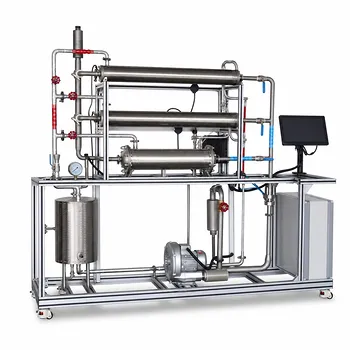
Comprehensive Heat Transfer Coefficient Determination Educational Unit Operations Pilot Plant

Comprehensive Heat Transfer Coefficient Determination Educational Unit Operations Pilot Plant

Advanced industrial-grade educational pilot plant for comprehensive heat transfer coefficient determination. Enables quantitative convective heat transfer analysis, evaluates double-pipe and shell-and-tube exchanger configurations, and includes digital data acquisition. Customizable for engineering curriculum. Ideal for engineering unit operations labs.

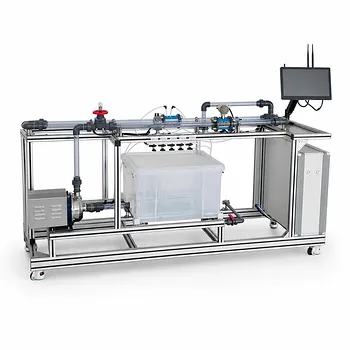
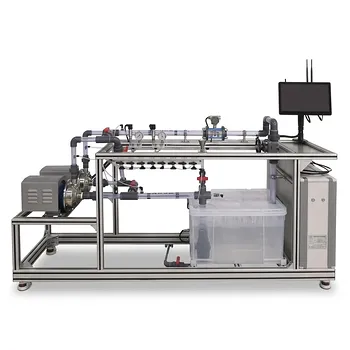
Orifice and Venturi Flowmeter Calibration Educational Pilot Plant for Fluid Mechanics Laboratory

Orifice and Venturi Flowmeter Calibration Educational Pilot Plant for Fluid Mechanics Laboratory

Enhance fluid dynamics education with the Orifice and Venturi Flowmeter Calibration Educational Unit Operations Pilot Plant, featuring transparent orifice and Venturi meters, industrial sensors, touchscreen interface for real-time data analysis and automatic coefficient calculations in engineering student laboratories.

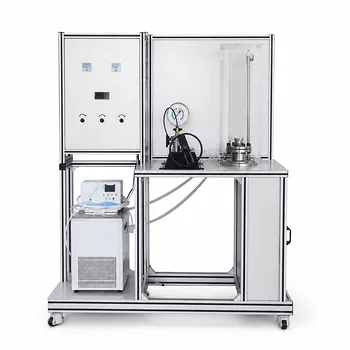
Carbon Dioxide PVT Curve Determination Educational Unit Operations Pilot Plant

Carbon Dioxide PVT Curve Determination Educational Unit Operations Pilot Plant

Enable hands-on learning of thermodynamic principles with this carbon dioxide PVT curve determination pilot plant. Students visualize critical opalescence, phase transitions, and generate P-V isotherms across liquid, gas, and supercritical regions. Robust safety features, adaptable for university engineering labs.

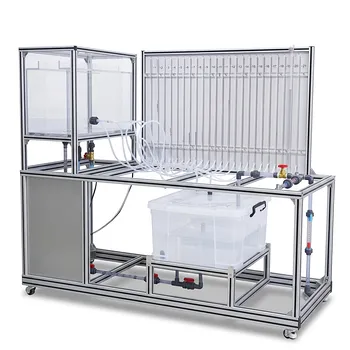
Bernoulli Equation Demonstration Unit Operations Pilot Plant

Bernoulli Equation Demonstration Unit Operations Pilot Plant

Laboratory pilot plant for Bernoulli's equation demonstration with transparent PVC pipes, 23 piezometer tubes for pressure measurement, and hands-on experiments. Designed for engineering education to study energy conservation, hydraulic grade line, and localized losses in fluid steady-flow systems.

100L Continuous Loop Hydrogenation Educational Unit Operations Pilot Plant

100L Continuous Loop Hydrogenation Educational Unit Operations Pilot Plant

This 100L continuous loop hydrogenation pilot plant is designed for chemical engineering education, featuring 316 stainless steel construction, advanced gas-liquid mass transfer components, explosion-proof safety systems, and a 15.6-inch touchscreen with 5G connectivity, cloud data logging, bridging theory and industry.

Centrifugal Pump Performance Determination Educational Unit Operations Pilot Plant

Centrifugal Pump Performance Determination Educational Unit Operations Pilot Plant

This lab system determines centrifugal pump performance curves for unit operations. Students configure dual pumps in series or parallel for hands-on learning. Includes industrial controls, clear piping, and data logging. Customizable for chemical, mechanical, and environmental engineering programs.

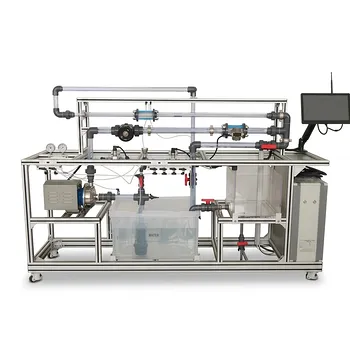
Centrifugal Pump Performance and Orifice Flowmeter Calibration Educational Pilot Plant

Centrifugal Pump Performance and Orifice Flowmeter Calibration Educational Pilot Plant

This versatile educational pilot plant enables engineering students to conduct centrifugal pump performance tests, orifice flowmeter calibration, and fluid mechanics experiments using a transparent flow loop, industrial HMI, and 3D virtual simulation for a comprehensive hands-on learning experience.

Educational Compression Refrigeration Performance Determination Unit Operations Pilot Plant

Educational Compression Refrigeration Performance Determination Unit Operations Pilot Plant

This educational pilot plant for compression refrigeration performance determination offers dual COP evaluation, regenerative cycle comparison, and calorimeter calibration. Customizable for curriculum integration, it features environmentally conscious design. Supports thermodynamic mapping on pressure-enthalpy diagrams and synchronous monitoring with centralized instrumentation.

Shell and Tube Heat Exchanger Heat Transfer Coefficient Determination Educational Pilot Plant

Shell and Tube Heat Exchanger Heat Transfer Coefficient Determination Educational Pilot Plant

LABPARK's shell and tube heat exchanger pilot plant enables students to investigate heat transfer coefficients, LMTD, co-current vs counter-current flow, bridging theory and industrial practice. Customizable for chemical, mechanical, environmental engineering curricula. Ideal for unit operations and process engineering labs.

Educational Unit Operations Pilot Plant for Intraparticle Diffusion Effective Factor Measurement

Educational Unit Operations Pilot Plant for Intraparticle Diffusion Effective Factor Measurement

Designed for chemical engineering university labs, this pilot plant allows hands-on determination of catalyst particle intraparticle diffusion effective factors and gas-solid reaction kinetics using a fixed-bed tubular reactor with industrial touchscreen control, bridging theory and practical reactor design.

Constant Pressure Filtration Educational Unit Operations Pilot Plant

Constant Pressure Filtration Educational Unit Operations Pilot Plant

Hands-on educational pilot plant for constant pressure filtration. Classic plate and frame filter press allows students to study kinetics, determine specific cake resistance, perform cake washing and evaluate washing rates. Ideal for chemical engineering curriculum. Mobile, customizable, safety-compliant design.

Chemical Pipeline Assembly and Fluid Transport Practical Training Unit Operations Pilot Plant

Chemical Pipeline Assembly and Fluid Transport Practical Training Unit Operations Pilot Plant

Integrated skid-mounted engineering training pilot plant for university labs offers hands-on experience in chemical pipeline assembly, fluid transport, centrifugal pump operation, and pressure testing. Customizable system bridges academic theory and industrial practice with digital pre-lab resources and comprehensive tools.

Tubular Reactor Flow Characteristics Determination Educational Unit Operations Pilot Plant

Tubular Reactor Flow Characteristics Determination Educational Unit Operations Pilot Plant

Educational pilot plant for investigating tubular reactor flow characteristics and residence time distribution Features adjustable recycle for plug flow and backmixing studies industrial touchscreen interface and real-time data acquisition Ideal for chemical engineering unit operations laboratory training and education

Two Phase Flow Pattern Velocity Resistance Measurement Educational Pilot Plant

Two Phase Flow Pattern Velocity Resistance Measurement Educational Pilot Plant

Benchtop educational pilot plant for university labs studying gas-liquid two-phase flow patterns, velocity, and resistance across circular, square, and rectangular conduits. Features 15.6-inch touchscreen, 5G connectivity, differential pressure sensors, safe water-air operation. Supports chemical engineering curricula.

Water Electrolysis Hydrogen Production and Storage Educational Pilot Plant

Water Electrolysis Hydrogen Production and Storage Educational Pilot Plant

Integrated pilot-scale training system for higher education engineering labs. Features AWE/PEM electrolysis, adjustable DC power, PLC controls, gas-liquid separation, and pressurized hydrogen storage. Hands-on learning in green hydrogen, process control, and safety, ideal for chemical and energy departments.

Multi-Component Gas Pressure Swing Adsorption Pilot Plant for Unit Operations Education

Multi-Component Gas Pressure Swing Adsorption Pilot Plant for Unit Operations Education

Multi-component gas pressure swing adsorption pilot plant designed for unit operations education. Features four-tower configuration, IoT touchscreen control, dual regeneration, and real-time breakthrough curve analysis for engineering training with safety interlocks and mobile frame simulates industrial PSA processes.

Cavitation Phenomenon Demonstration and Analysis Educational Unit Operations Pilot Plant

Cavitation Phenomenon Demonstration and Analysis Educational Unit Operations Pilot Plant

Advanced educational pilot plant for demonstrating and analyzing cavitation phenomena in fluid systems. Features a transparent acrylic Venturi test section, high-precision pressure and flow sensors, digital data acquisition, and integrated safety relief valves for engineering curricula.

Fluid Friction Resistance Determination Educational Unit Operations Pilot Plant

Fluid Friction Resistance Determination Educational Unit Operations Pilot Plant

Engineered bench-scale system for university engineering labs. Provides hands-on fluid mechanics experience: quantitative energy loss analysis, flow regime observation, friction coefficient determination. Features four-point pressure measurement, transparent sections, industrial touchscreen PLC, 3D virtual simulation. Ideal for chemical, mechanical, civil engineering.

Dual Mode Heat Transfer Pilot Plant for Unit Operations Training

Dual Mode Heat Transfer Pilot Plant for Unit Operations Training

Engineering-scale dual-mode heat transfer pilot plant for hands-on unit operations training in chemical engineering. Features real and simulated modes, multiple heat exchanger types, comprehensive coefficient determination, and advanced process control with data acquisition for engineering students and researchers.

Dual-Mode Rectification Pilot Plant for Practical Training Unit Operations

Dual-Mode Rectification Pilot Plant for Practical Training Unit Operations

Industrial-scale dual-mode rectification pilot plant for chemical engineering practical training. Features real-material and simulated-material operation modes, sieve-plate column with sight glasses for visual observation of hydrodynamics, and customizable SCADA control for safe, hands-on learning of unit operations and mass transfer.


Leave Your Message