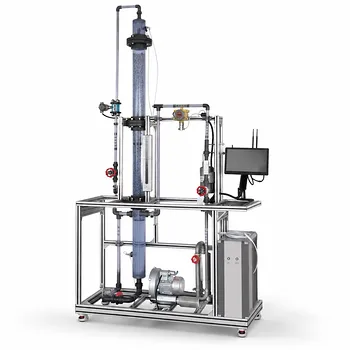
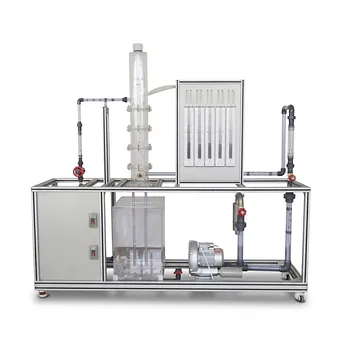
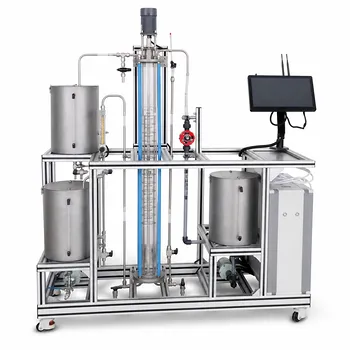
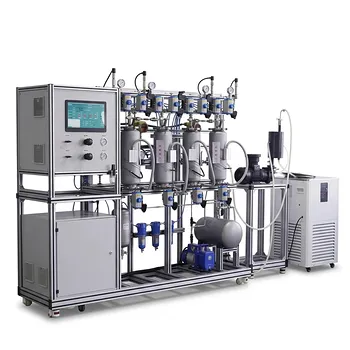
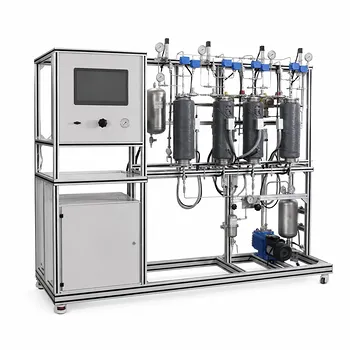
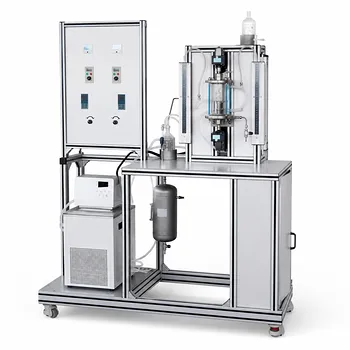
Packed columns and plate columns deliver fundamentally different performance in gas-liquid absorption and reaction pilot plants—and the right choice hinges on whether your process is limited by mass transfer rate or reaction kinetics. Packed columns use continuous contact over packing materials to achieve high separation efficiency with very low pressure drop, making them the go‑to for gas‑film‑controlled absorption and heat‑sensitive materials. Plate columns, with their stage‑wise contact and higher liquid holdup, give the longer residence times needed when a slow liquid‑phase reaction must reach equilibrium.
The core distinction: packed columns excel when you need rapid, efficient mass transfer at low pressure drop; plate columns are essential when a reaction demands liquid residence time and stage‑wise equilibrium. Selecting the wrong contactor can starve a pilot‑plant reaction of the hold‑up it needs, or burden an absorption study with unnecessary pressure loss.
Understanding the Two Contact Mechanisms
Before comparing performance metrics, you must recognize how these columns manage the gas‑liquid interface. This determines everything from their efficiency to their sensitivity to flow disturbances.
Continuous Contact in Packed Columns
In a packed column, liquid flows downward as a film over a random or structured packing, while gas rises through the voids. There are no discrete separation stages.
The result is a continuous concentration gradient along the column height. Mass transfer happens everywhere, not just on specific trays. Because the liquid is spread into a thin film, the bulk liquid volume is very small—typically less than 6% liquid holdup. This translates into exceptionally short residence times, rapid stabilization, and minimal risk of thermal degradation for sensitive feeds.
Stage‑wise Contact in Plate Columns
Plate columns force the gas to bubble through a liquid layer held on each tray, then separate before passing to the next tray. This creates discrete concentration steps from one plate to the next.
Each tray holds a significant pool of liquid. Liquid holdup ranges from 8% to 12%, providing a substantial buffer volume. That extra liquid means the column responds more slowly to disturbances, but it also gives a slow reaction the residence time it needs to approach equilibrium. For pilot‑plant work, the visible stepwise action is also a powerful teaching tool.
Performance Factors in Absorption and Reaction Pilot Plants
Pressure Drop
Pressure drop directly impacts energy costs and can limit the use of vacuum or thermally sensitive materials.
- Packed columns offer a dramatically lower pressure drop, typically 0.01–0.27 kPa per theoretical stage. This is ideal for vacuum‑distillation demonstrations and for absorption towers where adding a blower is expensive.
- Plate columns impose a pressure drop of 0.4–1.1 kPa per theoretical stage, mainly because gas must overcome the liquid head on each tray. For an absorption pilot plant operating near atmospheric pressure, this extra loss is often acceptable, but it becomes a real penalty under vacuum.
Separation Efficiency
Efficiency determines the column height needed to achieve a given separation—a critical design variable in a pilot plant.
- Packed columns can deliver more than 10 theoretical stages per meter when properly wetted. This compactness stems from the continuous contact and high interfacial area. However, efficiency collapses at low liquid loads if the packing surface is not fully wetted, which makes liquid distribution a critical design requirement.
- Plate columns rarely exceed 2 stages per tray in industrial or pilot‑scale designs. The staged nature means the overall height is a multiple of tray spacing. While the per‑stage efficiency is lower, it remains remarkably stable over a wide range of throughputs because each tray holds a fixed liquid inventory.
Liquid Holdup and Reaction Time
This is where the two designs diverge most sharply for reaction studies.
In a gas‑liquid reaction pilot plant, the bulk liquid volume relative to film volume (quantified by a dimensionless ratio $\alpha_1$) dictates how much of a slow reaction can complete inside the column. Packed columns operate with low bulk liquid, giving $\alpha_1$ values typically between $10$ and $100$. A plate column, with its tray holdup, offers a much larger bulk liquid pool—and a correspondingly longer liquid residence time. This makes it capable of hosting slow or moderate reactions that would never reach completion in a packed bed. Bubble columns, as an extreme, push $\alpha_1$ to $10^4$, but plate columns occupy the practical middle ground for many pilot plants.
For absorption processes, however, a long liquid residence time is usually a liability. Most absorption is gas‑film‑controlled, so extending the liquid hold‑up merely increases the risk of thermal degradation without improving mass transfer. That is why packed columns dominate absorption pilot plants—their low holdup accelerates startup and control response while protecting the liquid.
Operating Flexibility and Robustness
Pilot plants often see fluctuating feed rates and operator‑in‑training errors. The column’s ability to handle these disturbances matters.
- Plate columns provide a wide turndown ratio and remain stable at low throughputs because the liquid head on each tray acts as a buffer. Students find them forgiving—a sudden surge in liquid feed causes a temporary rise in tray holdup without immediately flooding the column.
- Packed columns are more sensitive. At low liquid loads, the packing surface is not fully wetted, and transfer efficiency drops sharply. They demand well‑designed liquid distributors and steady flows. On the plus side, their low liquid inventory means the column reaches steady state much faster after a control change—an advantage in research labs where data collection is the goal.
Material Compatibility and Cleanliness
- Packed columns can be fabricated from a wide range of corrosion‑resistant materials, including ceramics, glass, and exotic alloys. This makes them the default choice for highly corrosive gases or liquids. However, they are not recommended for slurries or polymerizing substances because suspended solids can plug the void spaces.
- Plate columns are relatively easy to clean and inspect because each tray can be accessed individually. They handle small amounts of solids better than packed beds, though significant fouling can still block perforations or valves. For pilot plants that must be reconfigured frequently or used with sticky materials, the maintainability of plate columns is a decisive advantage.
Understanding the Trade‑offs
No contactor is universally superior. You must weigh these limitations before committing to a pilot‑plant design or experiment plan.
- Packed column limitations: They suffer from poor efficiency at low liquid rates due to incomplete wetting, carry a higher packing cost, and cannot handle fouling. Their extremely low liquid holdup makes them unsuitable for slow reactions—a reaction that needs minutes will simply see its reactants pass through unconverted. They also require meticulous liquid distribution to avoid channeling, where gas and liquid find separate, preferential paths and nearly stop mixing.
- Plate column limitations: The higher liquid hold‑up means longer startup times, more thermal exposure of the feed, and a greater weight of liquid in the column. The pressure drop per stage is far higher, which can be unacceptable in vacuum service or when a fan’s energy budget is tight. Entrainment between trays also limits the maximum gas velocity before efficiency collapses.
A further trade‑off appears in pilot‑plant calculations: packed column performance is often expressed in transfer units ($N_{og}$, $H_{og}$), which directly speaks to mass‑transfer kinetics. Plate column performance is reduced to plate efficiency and a count of actual trays. If your research objective is to measure kinetic constants, a packed column provides a richer data stream. If your objective is to validate a stage‑by‑stage equilibrium model, a plate column is the natural choice.
Making the Right Choice for Your Goal
Use these heuristics to align the column type with your pilot plant’s primary purpose.
- If your primary focus is continuous mass‑transfer kinetics with minimal pressure drop: Choose a packed column for its high efficiency per height and very low pressure drop.
- If your primary focus is studying a slow, liquid‑phase reaction that requires residence time: Choose a plate column. The tray holdup gives the bulk liquid time to react, and the stage‑wise concentration profile lets you sample progress at each step.
- If your primary focus is student training with visual stages and stable operation: Choose a plate column. The visible trays and forgiving hydraulic behaviour reduce operator errors and make stage‑by‑stage principles tangible.
- If your primary focus is handling corrosive fluids without solids: Choose a packed column. Ceramic or PTFE packings eliminate corrosion risk without the complexity of constructing an entire tray‑column from exotic metal.
- If your primary focus is rapid startup and fast experimental turnaround: Choose a packed column. Its low liquid holdup allows the unit to stabilise in minutes, not hours.
An optimally designed gas‑liquid pilot plant puts the contactor type at the service of the chemistry—not the other way around. Match the column’s holdup, pressure drop, and mass‑transfer characteristics to the reaction or absorption you intend to study, and you’ll turn the hardware itself into a reliable experimental instrument.
Summary Table:
| Feature | Packed Columns | Plate Columns |
|---|---|---|
| Contact Mechanism | Continuous contact | Stage-wise contact |
| Pressure Drop | Low (0.01–0.27 kPa/stage) | High (0.4–1.1 kPa/stage) |
| Liquid Holdup | Low (< 6%) | High (8%–12%) |
| Efficiency | High (>10 stages/m) | Low (≤ 2 stages/tray) |
| Best Suited For | Fast mass transfer, vacuum, corrosive fluids | Slow reactions, visual training, fouling feeds |
Optimize Your Pilot Plant Operations with LABPARK
Choosing the right column is critical to the success of your chemical engineering curriculum or research projects. LABPARK provides state-of-the-art Educational and Vocational Unit Operations Pilot Plants in chemical engineering, bioprocess & biotech, and environmental & water treatment for universities, research institutes, and enterprises.
Whether you need to demonstrate mass transfer principles in packed columns or study reaction kinetics in plate columns, our robust, high-precision pilot plants are engineered to deliver reliable data and hands-on learning.
- Tailored Solutions: Customized setups to match your specific academic curriculum or R&D requirements.
- Industrial Replicas: Give your students and researchers realistic experience with industry-grade equipment.
- Expert Support: From system design to installation and training.
Ready to upgrade your lab's capabilities? Contact LABPARK today to discuss your pilot plant needs!
Related Products
- Packed Bed Absorption Educational Unit Operations Pilot Plant
- Absorption and Desorption Educational Unit Operations Pilot Plant
- Multimodal Absorption and Desorption Pilot Plant for Unit Operations Training
- Plate Column Hydrodynamics Tray Demonstration Educational Pilot Plant
- Bench Scale Dual Column Gas Separation and Capture Educational Pilot Plant
People Also Ask
- How Do Flow Regimes Transition in Packed Bed Pilot Plants? Key Scale-up Insights
- How does reactant concentration determine absorption column control? Gas-film vs. dual-film.
- How is the packing height of an absorption column calculated? Master HTU & NTU Concepts
- How does the wall effect impact packed-bed conversion? Essential pilot plant scale-up tips.
- How does static vs. operating holdup affect pilot plant calibration? Avoid Critical Scale-Up Errors