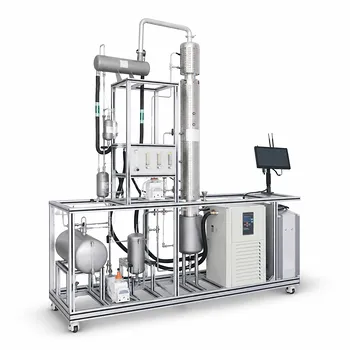
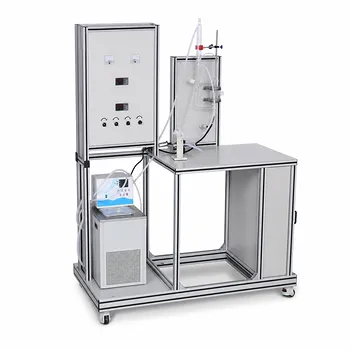
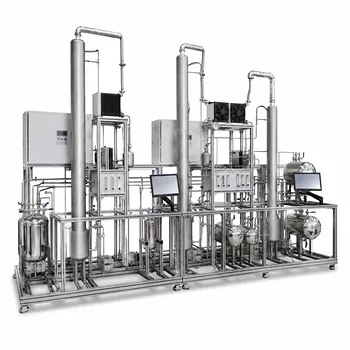
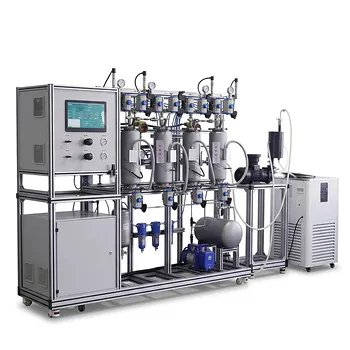
In a distillation pilot plant, every temperature reading tells a story—if you know the language of vapor pressure.
Operators use the Antoine equation to convert real-time column temperatures into pure-component vapor pressures. These calculated pressures are then fed into thermodynamic models to determine the mixture’s bubble point (where boiling begins) and dew point (where condensation starts). By correlating these calculated thresholds with actual temperature and pressure readings along the column, operators directly adjust the reboiler heat duty and reflux ratio—keeping the system inside the vapor – liquid coexistence region and driving separation to the target purity.
The Antoine equation transforms a simple temperature measurement into precise vapor pressure data, which defines the boiling and condensation boundaries that govern separation. Operators treat these calculated bubble and dew points as a live navigational map, using them to control heat input, reflux, and column pressure in real time—and to diagnose when real mixtures deviate from ideal predictions.
The Thermodynamic Compass: Vapor Pressure and the Antoine Equation
Decoding Temperature with the Antoine Equation
The Antoine equation ( log₁₀ p⁰ = A – B/(t + C) ) links a pure component’s saturation vapor pressure to temperature through three empirical constants.
When an operator reads a thermocouple on tray 15, they can instantly calculate the vapor pressure of each pure component at that temperature.
This calculation is the first step in answering the critical question: “Is the fluid on this tray boiling, condensing, or out of equilibrium?”
Why Vapor Pressure is the Engine of Separation
Separation by distillation relies on relative volatility, which is essentially the ratio of the vapor pressures of the key components at a given temperature.
A larger difference in vapor pressure makes separation easy; when vapor pressures converge, the driving force for separation collapses.
Operators therefore work to maintain a temperature profile along the column that keeps the vapor pressure ratio as high as possible between the light and heavy components.
Turning Calculations into Column Control
Setting the Operating Envelope: Bubble and Dew Points
For a liquid mixture of known composition, the bubble point is the temperature at which the sum of the partial pressures ( Σ xᵢ p⁰ᵢ ) equals the total system pressure.
In a binary system, this reduces to a direct equation such as xₐ = (P – p⁰_B) / (p⁰_A – p⁰_B); operators solve it iteratively using Antoine-derived vapor pressures to find the boiling temperature.
The dew point is calculated similarly for the vapor phase, giving the temperature at which condensation begins. Together, these two points bracket the vapor-liquid coexistence region through which the column must operate.
Mapping the Temperature Profile
A correctly functioning column exhibits a smooth temperature gradient from bottom (hottest) to top (coldest).
Operators compare measured tray temperatures against Antoine-predicted bubble and dew points for the expected compositions.
If the top temperature drifts above the calculated dew point, the vapor may not be condensing fully, threatening distillate purity—and signalling a need for more reflux or cooling.
The Control Levers: Reboiler Duty and Reflux Ratio
With the target temperature windows defined, the operator adjusts the two main thermal levers: reboiler heat input and the reflux ratio (liquid returned to the column).
Raising the reboiler duty increases boil‑up, pushing more vapor up the column and shifting the temperature profile downward; increasing reflux sends more cold liquid down, cooling the upper trays and improving stripping of heavy components.
Antoine‑based VLE models tell the operator the expected temperature at each stage for a given distillate purity, so they can decide exactly how far to move these levers—not just that a change is needed.
The Flash Distillation Shortcut
In a continuous flash (equilibrium) distillation pilot plant, feed is preheated under pressure and then throttled into a separator.
Operators use the Antoine equation to compute the vapor pressures at the feed preheater temperature, then calculate the liquid fraction q remaining after flashing.
The slope of the operating line — y = –q/(1‑q) x + x_F/(1‑q) — is directly set by this liquid fraction, so adjusting heater temperature and pressure drop gives precise control over the vapor‑liquid split without a full column.
From Ideal Models to Real‑World Fluids
When Predictions Meet Actual Product
VLE data and computer simulations provide a starting point, but they are usually based on pure solvents and ignore the influence of real reaction mixtures or trace impurities.
Distillation pilot plants let researchers run real feeds and observe where actual tray temperatures diverge from the Antoine‑based ideal.
A measured temperature that consistently runs hotter than the predicted bubble point often reveals an unexpected high‑boiler, while a departure near the top may signal a previously unseen azeotrope.
Navigating Azeotropes with Vapor Pressure Insight
An azeotrope is the point where the liquid and vapor compositions become equal—the Antoine‑derived relative volatility hits 1.0, and no further enrichment by simple distillation is possible.
Operators use the Antoine equation to model how the VLE envelope shifts with column pressure (pressure‑swing distillation); a change in total pressure alters the saturation pressures differently for each component, breaking the azeotrope.
When pressure changes are insufficient, the same vapor pressure concepts guide the selection of an entrainer that modifies relative volatility—but the foundation remains the operator’s ability to predict p⁰ at any temperature.
Understanding the Trade‑offs and Practical Limitations
Ideal VLE Is Rarely the Whole Truth
The Antoine equation combined with Raoult’s law assumes an ideal liquid phase. Many real mixtures exhibit strong non‑idealities, requiring activity coefficients that cause actual bubble points to deviate from the calculated values.
Pilot plant operators must treat the Antoine‑based predictions as a baseline, then validate and correct them using measured top‑and‑bottom compositions and pressure drops.
The Energy Cost of Tight Purity Control
Demanding 99.9 % purity often forces a very high reflux ratio, which multiplies reboiler steam and condenser cooling water consumption.
Antoine‑spawned VLE curves allow operators to plot the minimum reflux ratio and find the knee where a small purity gain demands an exponential energy increase—so they can balance process economics against separation quality.
Sensor Accuracy Defines Control Fidelity
A temperature measurement error of just 1 °C can translate into a 5‑10 % error in vapor pressure, leading an operator to misjudge the column’s thermodynamic state.
In pilot plants where every tray’s reading feeds the control logic, maintaining calibrated thermocouples and pressure transmitters is non‑negotiable—otherwise the Antoine equation gives a false compass.
Turning Vapor Pressure Insight into Operational Excellence
- If your primary focus is achieving target purity: Use Antoine‑based calculations to set explicit temperature setpoints at the reboiler and condenser. Adjust the reflux ratio until the steady‑state temperatures lock onto the predicted bubble and dew points for the desired distillate and bottoms compositions.
- If your primary focus is energy efficiency: Find the minimum reflux from the VLE pinch point and operate just above it. Monitor the temperature profile for stability—a profile that holds within 0.5 °C of the predicted pinch indicates you are not over‑purifying and wasting steam.
- If your primary focus is troubleshooting separation problems: Compare actual top and bottom temperatures against Antoine‑predicted dew and bubble points. A smaller‑than‑expected temperature gradient often points to flooding or weeping, while a sudden shift in the bottom temperature can warn of a composition upset or azeotrope formation.
- If your primary focus is validating a scale‑up candidate: Run the pilot plant with the exact target feed and use the Antoine‑based control framework to map the real VLE behavior. Quantify how much the actual tray temperatures deviate from the ideal model, and feed that deviation data into the design of tray efficiencies, column pressure, and heater sizing for the production unit.
By grounding every control decision in rigorous vapor pressure fundamentals, operators transform a pilot plant from a simple test rig into a precision separation tool that predicts—and then proves—exactly how a mixture will behave at scale.
Summary Table:
| Key Concept | Thermodynamic Role | Operational Control Action |
|---|---|---|
| Antoine Equation | Calculates pure-component vapor pressure ($p^0$) | Establishes the baseline VLE calculations |
| Bubble Point | Temperature where liquid mixture begins to boil | Guides reboiler heat input adjustments |
| Dew Point | Temperature where vapor mixture begins to condense | Controls reflux ratio and cooling duty |
| Relative Volatility | Ratio of vapor pressures of light vs. heavy keys | Balances product purity and energy consumption |
Bring Thermodynamic Theory to Life with LABPARK
Looking to train the next generation of chemical engineers or validate your scale-up models? LABPARK provides state-of-the-art Educational and Vocational Unit Operations Pilot Plants in chemical engineering, bioprocess & biotech, and environmental & water treatment for universities, research institutes, and enterprises.
Equip your lab with precision distillation systems that turn vapor pressure calculations into hands-on learning. Contact LABPARK today to request a quote or custom design consultation!
Related Products
- Multi-Modal Distillation Unit Operations Training Pilot Plant
- Continuous Sieve-Plate Distillation Pilot Plant for Unit Operations Laboratory Education
- Dual-Mode Rectification Pilot Plant for Practical Training Unit Operations
- Binary System Vapor Liquid Equilibrium Data Determination Educational Unit Operations Pilot Plant
- Multi-Functional Special Distillation Educational Pilot Plant
People Also Ask
- How can energy balance equations for condensers & reboilers be validated experimentally? Guide
- How can real-time carbon number prediction improve distillation pilot plants? Optimize control.
- Why is vacuum operation capability an essential feature for a distillation unit operations pilot plant? Unlock Efficiency
- How does catalyst water concentration affect distillation pilot plant design? Key separation train choices.
- What are the primary reflux ratio control strategies? Master Distillation Unit Operations