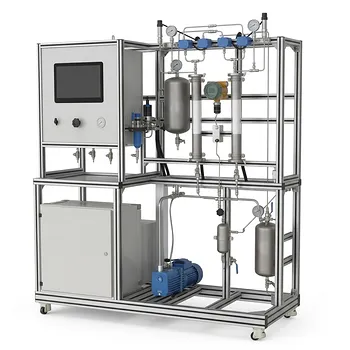
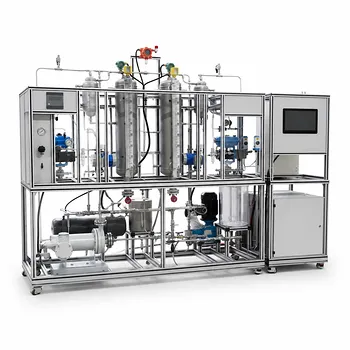
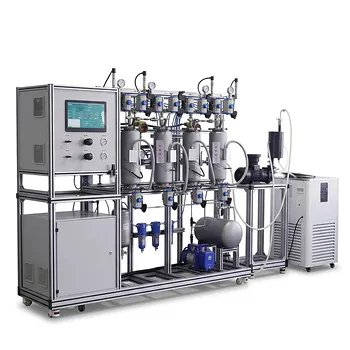
For an organic vapor membrane separation unit, the key to optimization is counter-intuitive: you must run it cold.
Unlike permanent gases, organic vapor flux is driven by solubility, which increases as temperature decreases. Therefore, lowering the operating temperature simultaneously maximizes both organic vapor flux and selectivity. Regarding pressure, a higher organic vapor partial pressure dramatically increases flux by swelling the membrane, while leaving the permeation of permanent gases like nitrogen virtually unchanged. Mastering these two levers is how you move from simply running experiments to designing efficient, scalable separation processes.
The core insight is that in rubbery polymer membranes, organic vapor transport is solubility-controlled. Low temperature boosts this solubility, and high partial pressure boosts it further through plasticization. The optimal operating strategy is a low-temperature, high-vapor-pressure environment, which flips the conventional high-temperature gas separation logic on its head.
The Thermodynamic Foundation: Solubility vs. Diffusivity
To understand how temperature and pressure bend the performance curve, you must first separate the two fundamental mechanisms of gas transport through a dense polymer membrane: solubility and diffusivity. Their interplay defines everything.
The Two-Step Transport Mechanism
Gas molecules must first dissolve into the polymer matrix (solubility) before they can diffuse across it (diffusivity). The overall permeation rate is the product of these two factors.
For permanent gases like nitrogen, transport is usually dominated by diffusivity. For organic vapors in rubbery membranes like PDMS, the opposite is true—their permeation is deeply controlled by how well they dissolve in the polymer.
Why Temperature Favors the Cold Side
The rule for permanent gases is simple: higher temperature increases diffusivity, so gas flux goes up. But for organic vapors, this logic is inverted. Their flux is ruled by solubility, and solubility follows a thermodynamic principle: it increases as temperature decreases.
So, when you lower the operating temperature, you force more organic vapor molecules to sorb into the membrane. This surge in solubility overpowers any drop in diffusivity, leading to a net increase in organic vapor flux. Simultaneously, the flux of the permanent gas decreases because its diffusivity drops. This dual action is the source of the selectivity gain.
The Role of Partial Pressure and Membrane Plasticization
The flux of a permanent gas is practically independent of its partial pressure—it’s an inert bystander. The story for an organic vapor is entirely different.
Higher organic vapor partial pressure directly drives more sorption into the rubbery polymer. This sorbed vapor acts as a plasticizer, swelling the polymer chains and dramatically increasing the diffusion coefficient of the organic vapor itself. This creates a powerful, self-reinforcing cycle: more pressure leads to more sorption, which leads to more swelling, which enables even faster permeation. The membrane becomes a turbo-charged highway, but only for the condensable vapor.
Translating Principles to Performance Metrics
In the pilot plant, these thermodynamic effects are not abstract concepts; they are directly measured through flux and selectivity, the two vital signs of a separation.
The Profound Pressure-Dependency of Flux
The flux of the organic vapor is highly sensitive to its own partial pressure due to the plasticization effect. You will see a non-linear, exponential-like increase in organic vapor flux as you raise its upstream concentration or total system pressure.
The flux of the permanent gas, however, will remain nearly flat. This asymmetric response means the separation factor, alpha, can skyrocket. The calculation for alpha, (yA/yB) / (xA/xB), directly reflects this improved ratio, giving you a clear, quantitative measure of performance enhancement.
The Selectivity Maximization Principle
The highest possible selectivity is achieved at the lowest possible operating temperature. The experiment is almost binary: a cooler membrane will reject permanent gas more effectively while welcoming organic vapor with open arms.
You can design pilot plant experiments to find this “sweet spot” by systematically measuring separation efficiency as a function of temperature. This allows you to plot performance curves and calculate empirical activation energies for permeation, grounding your process optimization in fundamental data rather than guesswork.
Understanding the Trade-offs and Common Pitfalls
Manipulating temperature and pressure is powerful, but it is not a blank check. Blindly pushing these levers will lead you into traps that destroy both your data and your equipment.
The Low-Temperature Limits
You cannot simply drop the temperature indefinitely. The deep need is not just separation, but a viable, stable process. If you go too low, you risk condensing the organic vapor on the membrane surface or feed lines, which blocks active area and causes a catastrophic flux collapse.
Furthermore, the drop in permanent gas diffusivity is beneficial for selectivity, but at some point, the overall throughput may drop below what is practical for a scaled-up system. You are balancing maximum selectivity with minimum economic productivity.
The Risks of High-Pressure Operation
Excessive plasticization is a real material threat. Over-swelling the rubbery polymer can permanently alter its free volume, leading to a loss of its intrinsic selectivity and potentially causing plastic deformation or delamination of the thin-film composite structure.
The membrane’s mechanical support layer has pressure limits. Spiral-wound modules are rated for a maximum differential pressure. Exceeding this, even in the pursuit of higher flux, will cause membrane compaction or rupture, ending your experiment and potentially contaminating your gas streams.
Making the Right Choice for Your Pilot Plant Goal
Your specific research or production target dictates how you navigate the temperature-pressure landscape. The controls on your unit operations pilot plant allow you to prioritize one outcome over another.
- If your primary focus is maximizing selectivity for product purity: Lower the operating temperature as much as possible without inducing condensation. This is your primary lever. Use the pressure setting to maintain the required driving force without overshooting into the plasticization damage zone.
- If your primary focus is maximizing organic vapor flux for throughput: Raise the organic vapor's partial pressure by increasing its concentration or the total feed pressure. The self-reinforcing sorption-swelling cycle is your most powerful tool. Keep temperature moderate to balance solubility with a practical diffusion rate.
- If your primary focus is studying mass transfer fundamentals: Systematically vary temperature while holding partial pressure constant, and then vice-versa. This isolation allows you to accurately decouple the sorption and diffusion phenomena and calculate the Arrhenius activation energies for each species in your PDMS or POMS membrane.
By seeing temperature and pressure not just as machine settings but as direct dials for solubility and diffusivity, you gain predictive control over an organic vapor membrane unit’s most critical performance outputs.
Summary Table:
| Parameter | Adjustment | Effect on Flux | Effect on Selectivity | Underlying Mechanism |
|---|---|---|---|---|
| Temperature | Decrease (Cold) | Increases | Increases | Boosts organic vapor solubility in rubbery polymers (PDMS) |
| Partial Pressure | Increase (High) | Increases (Non-linear) | Increases | Induces membrane plasticization and chain swelling |
Accelerate Your Chemical Engineering Research with LABPARK
Looking to optimize membrane separation processes or train the next generation of engineers? LABPARK provides state-of-the-art Educational and Vocational Unit Operations Pilot Plants in chemical engineering, bioprocess & biotech, and environmental & water treatment.
Designed specifically for universities, research institutes, and enterprises, our pilot plants deliver precise control over critical variables like temperature and pressure, allowing you to translate theoretical thermodynamic principles into reliable, hands-on learning and research outcomes.
Ready to elevate your lab's capabilities? Contact us today to request a quote or custom consultation!
Related Products
- Multifunctional Membrane Separation Educational Pilot Plant with Ultrafiltration, Nanofiltration, Reverse Osmosis
- Ultrafiltration Membrane Separation Educational Pilot Plant
- Photocatalytic Membrane Separation and Degradation Unit Operations Pilot Plant
- Multi-Functional Membrane Separation Educational Pilot Plant for Unit Operations Lab
- Hollow Fiber Ultrafiltration Membrane Separation Educational Pilot Plant
People Also Ask
- How do PEI, PVDF, and PSU membranes compare in pilot plants? Find the best fit.
- Pervaporation vs. Vapor Permeation: Handling Suspended Solids in Membrane Pilot Plants
- What are the trade-offs of polymer vs inorganic membranes in teaching pilot plants? Key laboratory comparison.
- What are the advantages of membrane separation in pilot plants? Efficient Organic Vapor Recovery
- How can operators optimize operating conditions and cleaning protocols in membrane separation pilot plants to mitigate fouling?