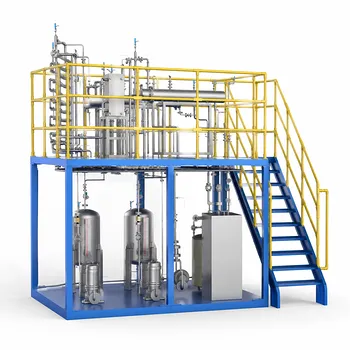
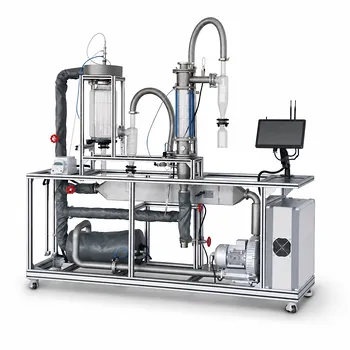
Intensified safety isn’t a compromise—it’s the design. Microreactor-based pilot plants allow researchers to safely run notoriously dangerous reactions like direct hydrogen peroxide synthesis or ozonolysis by shrinking the reactor volume to a fraction of a conventional system and boosting heat transfer by orders of magnitude. This combination quenches runaway temperature spikes, prevents the accumulation of explosive mixtures, and gives operators real-time control over a process that would be a bomb in a standard batch vessel.
The core reason microreactors make these hazardous chemistries studyable is physics and geometry: sub-millimeter channels provide an enormous surface-to-volume ratio that removes heat almost instantaneously, while the tiny hold-up volume means that even if something does go wrong, the total energy release is negligible. It’s process intensification applied directly to safety.
The Root of the Danger: Thermal Runaway and Explosive Volumes
Why Exothermic Reactions Turn Catastrophic
Highly exothermic reactions, such as the direct synthesis of hydrogen peroxide from H₂ and O₂, release enormous amounts of heat. In a conventional batch or large-scale continuous reactor, that heat concentrates in localized hot spots because the bulk fluid cannot conduct it away fast enough.
A hot spot accelerates the reaction rate exponentially—chemistry follows Arrhenius kinetics. This creates a self-reinforcing loop: more heat → faster reaction → more heat, until the reactor either relieves itself violently or detonates.
The Explosive Regime Problem
Reactions like ozonolysis or direct H₂O₂ synthesis operate within flammable or explosive fuel-oxidant mixtures. In a stirred tank, you’re intentionally mixing a hydrocarbon with ozone or hydrogen with oxygen in a large headspace and liquid volume, often inside the explosion envelope.
Any spark, hot surface, or inadequate mixing can trigger a runaway homogeneous free-radical chain reaction. That’s not an academic concern—it’s the reason these processes are almost impossible to pilot safely with traditional equipment.
How Microreactor Pilot Plants Neutralize the Threat
1. Exceptional Heat Transfer Quenches Thermal Runaway
Microchannel reactors are built with gaps typically under 1 mm, often in a sandwich-like multi-layer structure. This design collapses the distance that heat must travel to reach a cooling surface.
The result is heat transfer coefficients of 10,000 to 35,000 W/m²K—dwarfing the 100 to 700 W/m²K typical of conventional jacketed reactors. The system can absorb the entire heat of reaction virtually at the point of generation.
This means the reaction temperature follows the thermostat, not its own runaway kinetics. There is no thermal lag, no hotspot accumulation, and no trigger for a thermal explosion.
2. Tiny Hold-Up Volumes Cap the Possible Damage
Every microreactor channel holds only a few microliters to milliliters of reactive mixture. Even if you provoke the worst-case scenario—a full decomposition or detonation—the total energy release is minuscule.
The pilot plant becomes inherently safe not because you’ve eliminated all failure modes, but because the consequence of failure is too small to cause harm. This shifts the safety philosophy from “prevent explosion” to “make explosion irrelevant.”
3. Controlled Gas-Liquid Mixing Prevents Dangerous Composition Build-Up
In direct hydrogen peroxide synthesis, you need to contact hydrogen and oxygen with a liquid catalyst phase. In a conventional bubbler, bubble sizes are large and coalescence creates oxygen-rich pockets.
Microreactor unit operations use micromixers and microchannels to produce uniform, sub-millimeter gas bubbles and exceedingly high interfacial area. This ensures that the dissolved gas concentrations stay low and uniform, favoring the desired heterogeneous catalytic pathway over the hazardous homogeneous radical chain reaction.
For ozonolysis, the same principle applies: ozone dissolves and reacts in the liquid so quickly that the gaseous headspace never contains a flammable concentration of organic vapor and ozone simultaneously.
4. Membrane Integration Adds a Second Safety Layer
The primary reference focuses on heat transfer and hold-up, but supplementary insights highlight membrane reactor strategies. In some microreactor-based pilot plants, a membrane distributes one reactant gradually along the reactor length.
This keeps the concentration of oxygen or ozone lean at every point, never crossing the explosive limit. It also suppresses over-oxidation—which itself generates extra heat—so both safety and selectivity improve together.
Understanding the Trade-offs
Throughput Limitations Are Real
The same tiny channels that provide safety also limit production rates per unit. A single microreactor module processes a few milliliters per minute, not liters. For study purposes, that’s perfect—but you won’t replace a production line with one chip.
Scaling is achieved by numbering up, not scaling up. This means running hundreds or thousands of identical parallel channels, which introduces flow distribution challenges. Uneven distribution can create local hot spots or gas-liquid maldistribution, partially eroding the safety advantage.
Susceptibility to Fouling and Blockage
Highly exothermic reactions can produce solids, polymerize, or decompose to tarry byproducts. In a sub-millimeter channel, even a slight deposition can block flow, create dangerous pressure build-up, and force a shutdown.
Operating safely requires rigorous filtration and, often, solvent choices that limit fouling. The reward is extreme safety, but the price is high sensitivity to the chemistry’s side products.
Pressure Drop and Pumping Costs
Microchannels force fluid through very small hydraulic diameters, generating high pressure drops. While this doesn’t compromise safety, it does demand robust pumps and increases energy consumption—a factor to weigh when moving from demonstration to commercial thinking.
Making the Right Choice for Your Research Goal
Your decision to use a microreactor-based pilot plant for a dangerous reaction should match your specific objectives. Here’s how to navigate the options:
- If your primary focus is mechanistic understanding and kinetic model validation: Start with a microreactor. You’ll get isothermal, highly reproducible data across a wide temperature rangewithout the noise of thermal gradients, enabling precise rate constant extraction for reactor design and relief system sizing.
- If your primary focus is demonstrating an industrial production concept safely: Use a numbering-up approach with parallel microchannel modules. This validates process intensification and demonstrates that the explosive regime can be managed continuously, giving confidence for scale-up.
- If your primary focus is exploring inherently unstable chemistries like direct H₂O₂ synthesis or ozonolysis: A microreactor with an integrated membrane dosing unit offers the most robust safety umbrella by simultaneously controlling heat, hold-up, and reactant concentration.
- If your primary focus is teaching thermal safety and reactor engineering principles: A microreactor pilot plant lets students observe real-time temperature profiles, measure heat transfer rates, and witness the consequences of parameter changes in a safe, tangible way that batch autoclaves can’t provide.
The physics are uncompromising: a reaction can’t run away if heat escapes ten times faster than the chemistry can produce it, and it can’t explode if there’s nothing to explode. That’s the profound engineering insight microreactor pilot plants deliver, turning a once-unthinkable experiment into a routine, controlled investigation.
Summary Table:
| Safety Feature | Mechanism | Key Benefit |
|---|---|---|
| High Heat Transfer | Sub-millimeter channels boost coefficient to 10,000–35,000 W/m²K | Quenches thermal runaway & hot spots |
| Tiny Hold-Up Volume | Micro-to-milliliter reaction volume | Minimizes total energy release if failure occurs |
| Controlled Mixing | Micromixers produce uniform sub-millimeter gas bubbles | Prevents explosive gas concentration build-up |
| Membrane Integration | Distributes reactants gradually along reactor length | Keeps reactant levels lean and suppresses over-oxidation |
Empower Your Research Safely with LABPARK
Are you looking to study hazardous chemistries or train the next generation of engineers without risk? LABPARK provides state-of-the-art Educational and Vocational Unit Operations Pilot Plants in chemical engineering, bioprocess & biotech, and environmental & water treatment designed for universities, research institutes, and enterprises.
Our systems deliver:
- Inherently Safe Design: Mitigate thermal runaways with microreactor technology.
- High-Precision Data: Achieve isothermal conditions for accurate kinetic modeling.
- Hands-On Learning: Provide students and researchers with safe, real-world operational experience.
Ready to elevate your research or educational programs? Contact LABPARK today to explore our pilot plant solutions!
Related Products
- Multi-Reactor Educational Pilot Plant for Reaction Engineering Unit Operations
- Educational Unit Operations Pilot Plant for Intraparticle Diffusion Effective Factor Measurement
- Multimodal Absorption and Desorption Pilot Plant for Unit Operations Training
- Three-Tube Heat Transfer Educational Pilot Plant for Unit Operations Training
- Methanol Synthesis and Catalyst Performance Evaluation Educational Unit Operations Pilot Plant
People Also Ask
- How do educational unit operations pilot plants address safety and waste management when scaling up?
- How do educational unit operations pilot plants bridge theory and design? Bridge the Engineering Gap
- Why Compare Predicted and Experimental Excess Enthalpy? Key to Accurate Pilot Plant Scale-up
- Why Use PTFE & Hastelloy in Chemical Pilot Plants? Prevent Corrosion & Ensure Safety
- How to study gasification in pilot plants? Compare exit gas composition & efficiency