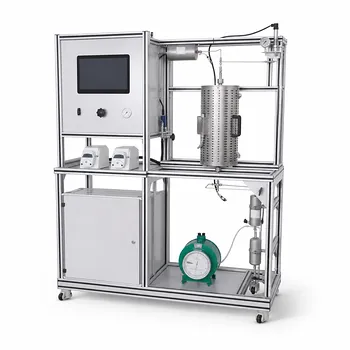
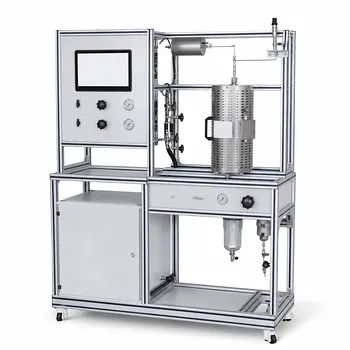
Mass transfer and diffusion limitations are not just rate-limiting steps—they fundamentally reshape the outcome of heterogeneous polymerizations.
In systems like emulsion, precipitation, or Ziegler–Natta catalysis, the active sites sit inside droplets or growing polymer particles. Monomers must diffuse through a surrounding boundary layer and often through a thickening polymer shell to reach those sites. When this diffusion is slow relative to the reaction rate—captured by a high Thiele modulus—monomer starvation at the catalyst surface broadens the molecular weight distribution and masks the true chemical kinetics. Chemical reactor pilot units give you the controlled environment needed to tease apart these intertwined effects by systematically varying agitation, particle size, temperature, and the operating phase.
The real danger of diffusion limitation in heterogeneous polymerization is not just lower productivity—it is invisible distortion. It changes the polymer’s molecular architecture and makes the reaction appear to follow the wrong kinetics. A pilot reactor equipped with fine-grained controls over mass transfer parameters lets you quantify these distortions, correct your kinetic models, and design a robust scale‑up strategy.
The Hidden Influence of Diffusion on Polymer Structure and Kinetics
How Diffusion Limitations Broaden Molecular Weight Distribution
In Ziegler–Natta and related catalyzed systems, the catalyst particle fragments and becomes encased in growing polymer.
Monomer molecules must now traverse a tortuous polymer layer before reaching the buried active centers.
When diffusion is sluggish, the monomer concentration at different catalytic sites becomes highly non‑uniform.
Some sites starve while others are relatively rich, causing chains to grow at different rates—directly widening the molecular weight distribution.
This loss of uniformity cannot be corrected by kinetic adjustments alone; it is a physical transport problem that must be addressed by reactor design.
The Disguising Effect on Apparent Kinetics: Activation Energy and Reaction Order
Diffusion limitations do more than slow the reaction; they alter the very numbers you measure in the lab.
In a diffusion‑controlled regime, the apparent activation energy drops to approximately half the true intrinsic value.
Similarly, the apparent reaction order shifts toward unity: a genuine second‑order reaction will masquerade as a 1.5‑order process.
These shifts occur because the observed rate is now governed by the temperature sensitivity of diffusion coefficients, not the chemical step.
If you unknowingly fit a kinetic model to diffusion‑disguised data, you will embed a systematic error that fails catastrophically at larger scales.
Diagnosing Mass Transfer Limitations in Pilot Reactors
The Thiele Modulus and Effectiveness Factor: Your Diagnostic Compass
The Thiele modulus (Φ or Λ) directly compares the intrinsic reaction rate to the rate of diffusion inside a catalyst or polymer particle.
A small Thiele modulus signals kinetic control, where every active site sees nearly the same monomer concentration.
A large Thiele modulus signals diffusion control; the inner core of the particle is starved and contributes little.
The effectiveness factor (η) quantifies this loss—it is the ratio of the observed rate to the rate that would occur if diffusion were infinitely fast.
By measuring η at different particle sizes in a pilot unit, you create a map that reveals exactly where mass transfer begins to choke the reaction.
The Wheeler–Weisz Modulus: A Practical Experimental Check
The Wheeler–Weisz modulus (M_w) is an experimentally accessible cousin of the Thiele modulus.
It is calculated directly from pilot data: Mw = (observed rate × characteristic length²) ⁄ (surface concentration × effective diffusivity).
When Mw < 0.15, internal diffusion resistance is negligible (η ≈ 1)—you are safely in the kinetic regime.
When Mw > 7, strong diffusion limitations dominate, and your measured kinetics are no longer intrinsic.
Running the same reaction in the pilot unit with two or more catalyst particle sizes lets you watch this transition and isolate the true kinetic parameters.
Designing Pilot Unit Experiments to Uncover the True Kinetics
Mastering Agitation: Balancing Dispersion and Shear
Agitation speed is the most direct lever you have over external mass transfer.
Increasing impeller rpm boosts the mass transfer coefficient at the particle‑liquid interface, shrinking the stagnant boundary layer.
However, excessive shear can break apart catalyst particles or polymer particles, introducing a new morphology variable that complicates the analysis.
The pilot unit must therefore offer variable‑speed, high‑torque agitation so you can sweep a range of conditions and find the threshold where physical effects level off.
Temperature and Phase Control: From Slurry to Gas‑Phase
Temperature changes alter both the intrinsic reaction rate and the diffusion coefficients.
Because the activation energy of diffusion is much lower than that of a chemical reaction, an Arrhenius plot from the pilot unit will show a distinct break when diffusion takes over—a clear diagnostic.
Varying the diluent phase—slurry vs. gas‑phase operation—also changes the monomer concentration gradient and the effective diffusivity profile.
In gas‑phase polymerizations, the monomer must first dissolve in the polymer coating, adding an extra resistance that can be isolated by comparing rates in a slurry pilot run under otherwise identical conditions.
Trade‑offs and Pitfalls in Pilot‑Scale Studies
One common mistake is to run pilot experiments at one particle size and assume the kinetics are intrinsic.
Without a size‑variation study, you cannot distinguish between kinetics and diffusion, and you risk scaling up a flawed model.
Another pitfall is ignoring the 10% rule of thumb for external mass transfer: the reactor’s mass transfer capability must be at least ten times the maximum possible reaction rate divided by the saturated monomer concentration.
If your pilot plant’s agitation or gas‑liquid dispersion cannot meet this target, dissolved monomer will be depleted near the particles, and selectivity will shift unpredictably.
Finally, accurate pilot work demands rigorous temperature control, because local hot spots inside a particle accelerate local kinetics and further distort the effectiveness factor—creating a runaway feedback loop that is easy to miss until it triggers an exotherm at scale.
Making the Right Choice for Your Reactor Study
Your pilot plant strategy should be tailored to what you are trying to avoid—molecular weight drift, runaway exotherms, or incorrect scale‑up kinetics.
- If your primary focus is maintaining a narrow molecular weight distribution: Vary agitation speed and diluent viscosity in the pilot unit. Look for the point where further increases in mass transfer no longer sharpen the distribution, then operate just beyond that threshold.
- If your primary focus is extracting true intrinsic kinetics for scale‑up: Run the reaction with at least three different catalyst or polymer particle sizes. Use the Wheeler–Weisz modulus to identify the size below which η ≈ 1, and only use those data to fit your kinetic model.
- If your primary focus is avoiding hot spots and thermal runaway: Implement a pre‑polymerization step (15–25 % conversion) to raise viscosity and improve heat transfer before the main reaction. Multistage temperature ramps in the pilot unit can then keep the local Thiele modulus in check as conversion climbs.
- If your primary focus is transferring a laboratory recipe to a different reactor phase: Compare slurry and gas‑phase runs in the pilot unit at identical temperatures. The difference in apparent activity directly measures the extra mass transfer resistance of the gas‑phase system, guiding you on whether a different catalyst morphology or a higher monomer partial pressure is needed.
Understanding and controlling mass transfer in heterogeneous polymerization is not an academic exercise—it is the difference between a polymer design that works in the pilot plant and one that fails at production scale.
Summary Table:
| Parameter | Definition / Formula | Diagnostic Threshold & Meaning |
|---|---|---|
| Thiele Modulus (Φ) | Ratio of intrinsic reaction rate to diffusion rate | Small Φ: Kinetic control (uniform concentration) Large Φ: Diffusion control (monomer starvation) |
| Effectiveness Factor (η) | Ratio of observed reaction rate to rate with infinite diffusion | η ≈ 1: No diffusion resistance η ≪ 1: Strong mass transfer limitations |
| Wheeler–Weisz Modulus ($M_w$) | $(Observed Rate \times L^2) / (C_s \times D_{eff})$ | $M_w$ < 0.15: Safe kinetic regime (η ≈ 1) $M_w$ > 7: Strong diffusion limitations dominate |
Ready to eliminate mass transfer bottlenecks and scale up your polymerization processes with precision? LABPARK provides state-of-the-art Educational and Vocational Unit Operations Pilot Plants in chemical engineering, bioprocess & biotech, and environmental & water treatment. We empower universities, research institutes, and enterprises to master chemical kinetics and optimize reactor designs. Contact us today to find the perfect pilot plant solution for your lab!
Related Products
- Fixed-Bed Chemical Reaction and Gas Dust Tar Removal Unit Operations Pilot Plant
- Fixed Bed Gas Solid Catalytic Reaction Educational Pilot Plant
- Tubular Reactor Flow Characteristics Determination Educational Unit Operations Pilot Plant
- Multi-Reactor Educational Pilot Plant for Reaction Engineering Unit Operations
- 100L Continuous Loop Hydrogenation Educational Unit Operations Pilot Plant
People Also Ask
- When to transition from PID to adaptive control in pilot plants? Key process indicators.
- How do deviations in estimating latent heat impact pilot plant thermal systems? Avoid hardware mis-sizing.
- Why Compare Predicted and Experimental Excess Enthalpy? Key to Accurate Pilot Plant Scale-up
- How to study gasification in pilot plants? Compare exit gas composition & efficiency
- Why Use PTFE & Hastelloy in Chemical Pilot Plants? Prevent Corrosion & Ensure Safety