A pilot plant’s price tag is not just about equipment—it’s a product of geography.
Location factors directly scale a benchmark cost to a local reality, and the blend of imported versus domestically sourced components is the lever that adjusts that factor. More local fabrication pulls the location factor downward, shrinking the Inside Battery Limits (ISBL) capital expense; heavy reliance on imports does the opposite. The result is a budget that can swing significantly before you even start detailing piping, engineering, or contingency reserves.
A pilot plant budget begins with a baseline number, typically referenced to a region like the US Gulf Coast. That number is then multiplied by a location factor that reflects local labor, logistics, duties, and—most importantly—the ratio of imported to domestic equipment. Choosing more locally manufactured components reduces this factor, directly lowering upfront capital outlay. However, a realistic budget must also account for disproportionately high design fees, OSBL infrastructure, material-grade premiums, and installation method choices that can make or break a research facility’s financial plan.
How Location Factors Translate Regional Conditions into Costs
The Basic Cost-Estimation Logic
Standard cost databases assume a specific baseline—historically, the US Gulf Coast. Everything else is a multiple. That multiple is the location factor (LF).
Local Site Cost = Benchmark Cost × Local Location Factor
If the factor is 1.30, a $80,000 baseline plant becomes $104,000 on the ground. If it’s 0.80 for a country with strong local supply chains and lower labor costs, the same plant drops to $64,000. The factor itself is not a guess; it encapsulates labor productivity, freight, taxes, duties, and the cost of engineering services in that region.
When Exchange Rates Distort the Picture
A location factor derived from historical data must be adjusted for currency shifts.
Adjusted Location Factor = Base Location Factor × (Current Exchange Rate / Base Exchange Rate)
Skipping this step can lead to significant over- or underestimation in multi-year planning. The local currency cost does not equal the dollar cost until you correct for forex drift.
The Import-Domestic Equation: The Hidden Tuning Knob
Why Sourcing Mix Changes the Number
The primary reference shows that location factors for the same country can range dramatically—for example, China historically spans 0.6 to 1.1. The difference comes down to the proportion of imported versus domestically produced equipment.
When you import specialist vessels, instruments, and control systems, you add freight, insurance, import duties, and vendor margins tied to foreign overheads. The location factor climbs because the procurement behaves partly like a high-cost-region purchase. When you source from local manufacturers who can deliver a pressure vessel, heat exchanger, or pump with equivalent performance, those added costs disappear. The factor drops toward the lower end of the regional range.
Beyond the Purchase Price: Lifecycle and Support
Choosing local components isn’t just about the initial check. It typically means shorter lead times, easier spare parts access, and service technicians who don’t need international travel. That lower operational friction is real budget protection. Conversely, an all-import strategy might lock the project into a single foreign vendor’s timeline and pricing, inflating both contingency needs and schedule risk.
The Full Budget Framework: ISBL Is Just the Beginning
The OSBL and Soft Cost Reality
Once the ISBL equipment cost is localized, you must layer on:
- Outside Battery Limits (OSBL): utilities, storage, site preparation—typically around 40% of ISBL.
- Engineering design fees: the primary reference cites approximately 10% (of ISBL+OSBL) for large plants, but for smaller, education-oriented pilot plants, this can balloon to 30% due to detailed customization, complex control integration, and the need for one-off process simulations.
- Contingency: a reserve of 10–15% for standard projects, but up to 50% when the design is novel or uses exotic materials. This is not a buffer for mistakes; it’s a recognition that pilot plants inherently contain unknowns.
The Material Factor and Installation Correction
Selecting alloys (e.g., 304 SS with (f_m = 1.3), Hastelloy C with (f_m = 1.55)) raises the bare equipment cost. But a common budgeting error is applying standard installation multipliers to these elevated equipment numbers, which can falsely inflate piping, civil, and electrical estimates.
The correction is simple: divide installation factors by the material factor (f_m). This prevents a $10,000 alloy pump from generating the same installation cost as a $10,000 carbon-steel pump, when the real installation effort is similar. For pilot plants that are often specification-heavy, this refinement keeps the budget grounded.
Indirect Costs and the Cost of Money
The total installed cost isn’t the end. You must add project-wide indirect costs—sales tax, freight (often ~10% of materials), client supervision (~5%), engineering overheads (~12%), and that crucial contingency (~10%).
Then comes the cost of capital. If the pilot plant is funded through a mix of debt and equity, the hurdle rate is the weighted average (i_c = DR \times i_d + (1-DR) \times i_e). With equity costs often in the 25–30% range, a poorly estimated budget that forces a second funding round can become economically unsustainable. The accuracy of the initial estimate, therefore, directly affects whether the investment returns are ever realized.
Installation Method: A High-Leverage Cost Multiplier
The Skid-Mounted Advantage
Not all equipment is field-assembled equal. A skid-mounted, preassembled module might carry an installation factor around 3.0, whereas a field-fabricated vessel can blow past 7.0, and a shop-fabricated distillation tower still lands near 5.9.
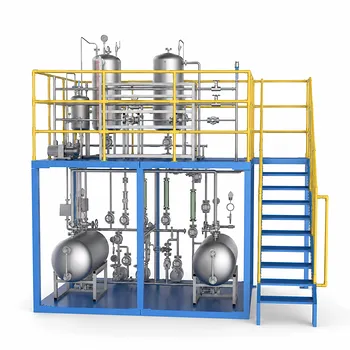
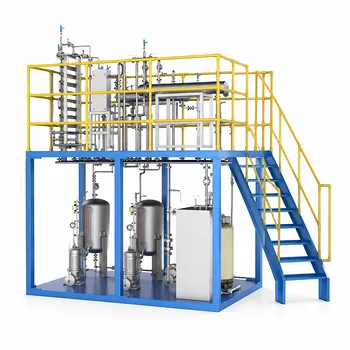
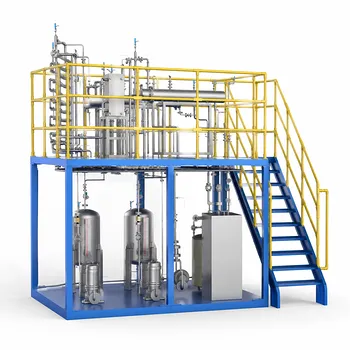
For universities and research institutes, the implication is clear. Pre-engineered, skidded pilot plants remove onsite piping, welding, and instrumentation integration—activities that are expensive, error-prone, and require specialized craftspeople. Choosing a skid-based design can slash the installation cost by nearly half compared to a field-built arrangement, making the overall budget far more predictable.
The Design Fee Paradox for Small Plants
Small-scale pilot plants suffer from a scale heuristic that works in reverse. On a billion-dollar facility, 10% design fees are adequate. On a $200k unit ops setup, custom P&ID development, control system programming, and utility tie-in design can consume 25–30% of the (ISBL+OSBL) total. Budget estimators must resist the temptation to apply industrial rules of thumb blindly. The design effort for a one-off teaching or research platform is fundamentally different.
Understanding the Trade-offs and Hidden Risks
The Domestic Sourcing Conundrum
Local sourcing reduces the location factor, but it’s not free of risk. Local workshops may lack the precision required for a highly specialized catalytic reactor or the expertise to weld exotic alloys. A cheaper up-front cost can lead to rework, longer commissioning, or compromised experimental data. The right answer is often a hybrid: import the core high-tech item and source the tanks, structures, and standard heat exchangers locally. This balances the location factor without sacrificing performance.
Contingency Creep and the Accuracy Trap
Overestimating can kill a project just as easily as underestimating. In early-phase factored cost analysis (±20–25% accuracy), planners might lean toward higher contingency. But as design progresses to definitive (±10–15%) or detailed design (±0–5%) stages, the contingency must adjust downward to reflect real knowledge. Failing to do so inflates the required capital and can make the project appear financially unattractive for the wrong reasons.
The OSBL Oversimplification
Using a flat 40% OSBL adder is convenient, but if the pilot plant requires a new building extension, gas cylinder storage with special ventilation, or a dedicated chilled-water loop, actual OSBL can far exceed the reference percentage. Every pilot plant should have a quick utility infrastructure checklist before the first dollar is committed to the budget spreadsheet.
Making the Right Choice for Your Institution’s Goals
Pilot plant budgeting is a series of deliberate trade-offs. The optimal approach depends on your primary driver.
- If your primary focus is hard cost minimization: Prioritize local manufacturing to drive the location factor as low as possible, adopt a skid-mounted design to curb installation multipliers, and reserve imports only for irreplaceable core technology. Use the corrected installation-factor method for alloys.
- If your primary focus is timeline and schedule certainty: Accept a slightly higher location factor to use a proven pre-engineered system from an international vendor with a fixed delivery date, and incorporate aggressive contingency reserves (20%+) to absorb freight and customs delays.
- If your primary focus is research performance and material integrity: Start with the detailed design estimate method early, budget for the higher engineering design fees (25–30%), and source specialty materials and instrumentation from the best suppliers globally—even if it pushes the location factor upward, because data quality is non-negotiable.
- If your primary focus is securing internal funding approval: Build a transparent, factor-based model that explicitly shows the impact of the chosen import ratio on the location factor, includes a line-item for the cost of capital, and demonstrates that the investment clears the institutional hurdle rate. A rigorous estimate builds credibility.
By treating location factors and the import/domestic split not as afterthoughts but as central design variables, you transform the budget from an uncertain burden into a strategic tool that aligns engineering ambition with financial reality.
Summary Table:
| Cost Driver | Budget Impact / Key Factor | Optimization Strategy |
|---|---|---|
| Location Factor | Scales baseline costs (e.g., 0.6 to 1.3+) | Adjust for current exchange rates |
| Import vs. Domestic | High imports increase freight, duties & margins | Use local sourcing for non-core components |
| Installation Method | Skid-mounted (~3.0 multiplier) vs. Field-built (~7.0) | Choose skid-mounted systems to cut onsite costs |
| Design Fees | Up to 25–30% of total costs for small plants | Use pre-engineered systems to avoid custom design fees |
Optimize Your Pilot Plant Budget with LABPARK
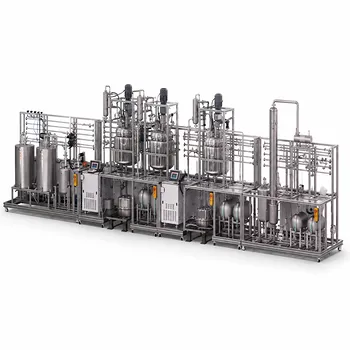
Planning a new laboratory or training facility? LABPARK provides state-of-the-art Educational and Vocational Unit Operations Pilot Plants in chemical engineering, bioprocess & biotech, and environmental & water treatment. Designed specifically for universities, research institutes, and enterprises, our skid-mounted, pre-engineered solutions help you minimize high design fees and installation costs while ensuring superior performance.
Ready to build an efficient, cost-effective pilot plant? Contact LABPARK today to discuss your project requirements with our experts!
Related Products
- Carbon Dioxide Hydrogen Methanol Synthesis Educational Unit Operations Pilot Plant
- Multi Pump Fluid Transport Process Piping Unit Operations Training Pilot Plant
- Natural Product Extraction Unit Operations Training Pilot Plant
- Multi-Modal Distillation Unit Operations Training Pilot Plant
- Multi-Reactor Educational Pilot Plant for Reaction Engineering Unit Operations
People Also Ask
- How do temp & pressure affect methanol synthesis pilot plants? Optimize equilibrium and catalyst performance.
- Why is a purge system necessary when operating a gas recirculation loop in a methanol synthesis pilot plant? (Guide)
- Why do modern methanol pilot plants operate at lower pressures? Catalyst & Feed Requirements Explained
- What are the operational requirements for catalyst activation? Safe Methanol Pilot Plant Operation
- Why is the chemical plant startup schedule crucial? De-risk scale-up with pilot plants.