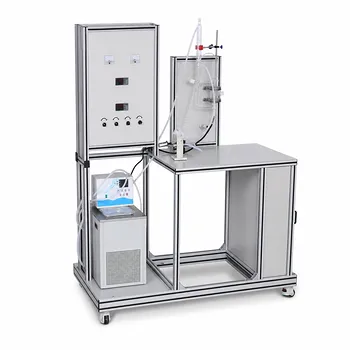
Linear outflow produces a fixed first-order model, while nonlinear outflow makes the model operating-point dependent. For a liquid level unit operation, the governing balance is (A,dh/dt=F_i-F_o). If (F_o=\alpha h), the system can be modeled directly with constant gain and time constant; if (F_o=\beta\sqrt{h}), the model is nonlinear and usually must be linearized around a chosen steady-state level for control and small-disturbance analysis.
The key distinction is whether the outlet response remains proportional to level across the operating range. Linear outflow gives one model that is broadly reusable, whereas square-root outflow gives a local model whose gain and time constant change as the operating level changes.
Why Outflow Characteristics Determine the Dynamic Model
The liquid balance is the starting point
For a tank with constant cross-sectional area, the dynamic balance is:
[ A\frac{dh}{dt}=F_i-F_o ]
Here, (A) is the tank cross-sectional area, (h) is liquid level, (F_i) is inlet flow, and (F_o) is outlet flow.
The outlet relationship determines whether this balance is a linear differential equation or a nonlinear one.
Linear outflow gives a direct first-order model
With a linear outlet relationship,
[ F_o=\alpha h ]
the balance becomes:
[ A\frac{dh}{dt}+\alpha h=F_i ]
This is a standard first-order linear system. No approximation is required, and the same mathematical form applies throughout the modeled operating range, provided (\alpha) remains constant.
Its process parameters are:
[ \tau_p=\frac{A}{\alpha} ]
and
[ K_p=\frac{1}{\alpha} ]
where (\tau_p) is the process time constant and (K_p) is the steady-state gain from inlet flow to liquid level.
Nonlinear outflow changes the governing equation
For gravity drainage through an orifice or comparable restriction, the outlet often follows:
[ F_o=\beta\sqrt{h} ]
The balance then becomes:
[ A\frac{dh}{dt}+\beta\sqrt{h}=F_i ]
Because the level appears inside a square-root function, the equation is nonlinear. Superposition and standard linear transfer-function methods do not apply globally.
The physical implication is important: increasing the level increases the outlet flow, but the increase is not proportional to the level itself.
How Linear and Nonlinear Models Respond to Disturbances
Linear systems have constant dynamic characteristics
For the linear model, a given change in inlet flow produces a response characterized by the same gain and time constant at every operating level.
The level approaches its new steady state exponentially. A disturbance that is doubled produces a response that is also doubled, assuming the system remains within the same physical constraints.
This makes linear models convenient for pilot-plant analysis, controller tuning, simulation, and transfer-function development.
Nonlinear systems respond differently at different levels
For the square-root model, the steady-state relationship is:
[ F_{i0}=\beta\sqrt{h_0} ]
or equivalently:
[ h_0=\left(\frac{F_{i0}}{\beta}\right)^2 ]
The relationship between inlet flow and level is therefore nonlinear. The same inlet-flow change can produce different level changes depending on the initial operating point.
A disturbance around a low level does not have the same dynamic effect as an equal disturbance around a high level.
The process gain varies with operating point
Linearizing the outlet around (h_0) gives:
[ \beta\sqrt{h}\approx \beta\sqrt{h_0} +\frac{\beta}{2\sqrt{h_0}}(h-h_0) ]
The local slope of the outlet characteristic is:
[ \left.\frac{dF_o}{dh}\right|_{h_0} =\frac{\beta}{2\sqrt{h_0}} ]
Using deviation variables (h'=h-h_0) and (f_i'=F_i-F_{i0}), the linearized model is:
[ A\frac{dh'}{dt} +\frac{\beta}{2\sqrt{h_0}}h'=f_i' ]
Therefore, the local process gain is:
[ K_p=\frac{2\sqrt{h_0}}{\beta} ]
As the operating level increases, the local gain increases. A given change in inlet flow consequently causes a larger level change around a higher operating point.
The time constant also varies with operating point
The local time constant for the nonlinear system is:
[ \tau_p= \frac{A}{\beta/(2\sqrt{h_0})}
\frac{2A\sqrt{h_0}}{\beta} ]
Thus, both (K_p) and (\tau_p) increase with the square root of the operating level.
This means a controller tuned at one level may respond too aggressively or too slowly at another level, even though the physical tank and valve have not changed.
How Linearization Supports Pilot-Plant Modeling
Linearization creates a usable local model
Linearization replaces the nonlinear outlet curve with its tangent at the selected operating point. The resulting model accurately represents small deviations around that point.
This is particularly useful for:
- Estimating response to small inlet-flow changes.
- Deriving a local transfer function.
- Tuning a level controller.
- Comparing measured and simulated step responses.
- Teaching first-order process dynamics in a pilot plant.
The approximation is strongest immediately after a small disturbance and near the level at which the model was derived.
The linearized transfer function is local
Taking Laplace transforms of the deviation-variable model gives:
[ \frac{H'(s)}{F_i'(s)}
\frac{K_p}{\tau_p s+1} ]
with:
[ K_p=\frac{2\sqrt{h_0}}{\beta}, \qquad \tau_p=\frac{2A\sqrt{h_0}}{\beta} ]
This has the familiar first-order form, but its parameters are not universal constants. They describe only the neighborhood of (h_0).
Large excursions require the nonlinear model
If the level moves substantially away from (h_0), the tangent-line approximation no longer represents the actual square-root curve well.
For large disturbances, a nonlinear simulation or a sequence of updated local models is more appropriate. The model must account for the changing outlet slope as the liquid level evolves.
Implications for Control and Experiment Design
Controller tuning depends on the operating level
A controller designed from a low-level linearization may not perform consistently at a high level. Since both the local gain and time constant change, the closed-loop response can vary across the tank operating range.
Pilot-plant studies should therefore identify the intended operating region before selecting controller parameters.
Step tests should be performed near the target condition
A step test provides the most useful model when the test is conducted close to the operating point where the model will be used.
For a nonlinear tank, tests at multiple levels can reveal how gain and time constant vary. This is more informative than fitting one global first-order model to data covering a wide level range.
Adaptive or gain-scheduled models may be necessary
When the plant operates over a broad range, one practical strategy is to update the local model as the level changes.
This can be implemented through:
- Several linear models identified at different operating levels.
- Gain scheduling based on measured level.
- Short-interval models with continuously updated (K_p) and (\tau_p).
- Direct nonlinear simulation and control.
These approaches preserve the simplicity of linear models while recognizing the physical nonlinearity.
Understanding the Trade-offs
Linear models are simple but may hide important behavior
A linear model is easy to solve, simulate, and use for controller design. Its limitation is that it can give misleading predictions when the real outlet characteristic is strongly nonlinear or when the operating range is wide.
Using a constant gain and time constant outside their identification range can produce incorrect settling times, steady-state levels, and controller responses.
Nonlinear models are more representative but more demanding
A nonlinear model better captures the relationship between level and outlet flow across a broad range. However, it requires nonlinear numerical simulation, more careful parameter identification, and potentially more advanced control methods.
The additional complexity is justified when disturbances are large or when the pilot equipment must operate across substantially different levels.
The square-root model is an approximation of the hydraulic hardware
The relation (F_o=\beta\sqrt{h}) is appropriate for many gravity-driven restrictions, but the actual coefficient can depend on valve characteristics, piping, discharge conditions, and flow regime.
A real pilot plant may also exhibit actuator saturation, dead zones, pump limitations, changing cross-sectional area, or measurement noise. These effects should be included when they materially influence the observed dynamics.
Linearization becomes problematic near zero level
The derivative
[ \frac{\beta}{2\sqrt{h_0}} ]
becomes very large as (h_0) approaches zero. This makes the local linear model sensitive and can signal that the assumed operating-point approximation is unsuitable near an empty tank.
Physical constraints and the actual valve or outlet behavior should be considered in that region.
Making the Right Choice for Your Goal
Choose the modeling approach according to the operating range and the size of the expected disturbances.
- If your primary focus is small-disturbance control near one operating level: Use a linearized first-order model, with (K_p) and (\tau_p) calculated from that level.
- If your primary focus is accurate prediction across a broad level range: Use the nonlinear mass-balance model with the actual outlet-flow relationship.
- If your primary focus is controller performance across several operating points: Identify local models and use gain scheduling or adaptive parameter updates.
- If your primary focus is pilot-plant experimentation or education: Begin with the linear model for basic dynamics, then compare it with the nonlinear model as the disturbance size and operating range increase.
Understanding whether outflow is linear or nonlinear lets you choose a model that is both mathematically appropriate and useful for the real operating decisions in the pilot plant.
Summary Table:
| Modeling approach | Governing relationship | Key characteristics | Best application |
|---|---|---|---|
| Linear outflow | Fₒ = αh | Constant gain and time constant; easy to simulate and tune | Small disturbances and basic process control |
| Nonlinear outflow | Fₒ = β√h | Gain and time constant vary with operating level | Broad operating ranges and large disturbances |
| Local linearization | Model around h₀ | Provides a first-order approximation near one steady state | Controller tuning and step-response analysis |
| Nonlinear simulation | Full mass-balance model | Captures changing outlet behavior across the level range | Detailed prediction and advanced control |
| Multiple local models | Models identified at several levels | Supports gain scheduling and adaptive updates | Pilot plants with variable operating conditions |
Need reliable equipment for liquid-level modeling, control experiments, and process education? Contact LABPARK to discuss your requirements. LABPARK provides Educational and Vocational Unit Operations Pilot Plants for chemical engineering, bioprocess and biotech, and environmental and water treatment applications. Our systems help universities, research institutes, and enterprises compare linear and nonlinear process behavior, perform step tests, validate control strategies, and build practical operator skills with configurable pilot-scale equipment.
Related Products
- Binary System Vapor Liquid Equilibrium Data Determination Educational Unit Operations Pilot Plant
- Two-Dimensional Fluidization Hydrodynamics Educational Pilot Plant for Unit Operations Training
- Comprehensive Fluid Mechanics Educational Unit Operations Pilot Plant
- Chemical Pipeline Assembly and Fluid Transport Practical Training Unit Operations Pilot Plant
- Quantitative Dosing and Liquid Flow Control Educational Unit Operations Pilot Plant
People Also Ask
- How can pilot plants assist in validating VLE models? Bridge theory and physical reality.
- Why Collect Isothermal vs. Isobaric VLE Data? Key Pilot Unit Advantages
- How Do Equations of State Predict VLE in Pilot Plants? Optimize Your Separation Design
- How do intermolecular forces and molecular kinetic energy govern gas liquefaction and vaporization? Explore VLE pilot plants
- For VLE Experiments: Fugacity vs. Activity Coefficient Method Selection Criteria