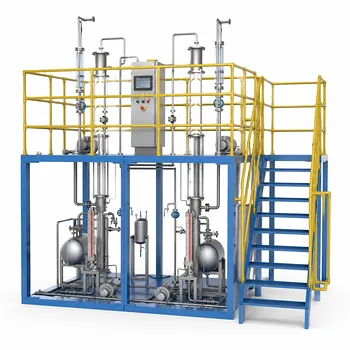
Viscosity and surface tension are not passive properties you measure once and forget—they are the dynamic drivers that can make or break your tray efficiency analysis in a fractionation pilot plant.
Higher liquid viscosity directly raises the liquid-side mass transfer resistance, reducing the rate at which components diffuse and lowering Murphree tray efficiencies. Surface tension governs the froth structure on the tray, controlling the interfacial area available for separation; subtle gradients in surface tension—the Marangoni effect—can either stabilize the froth into an ideal mass-transfer surface or cause early film rupture and significant efficiency loss. In pilot-scale experiments, these physical properties are the raw inputs that let you compute the equilibrium curve slope and the number of transfer units, turning raw column data into a clear picture of true separation performance.
Tray efficiency in a pilot plant is fundamentally a story of competing time scales: the time a bubble of vapor spends in contact with the liquid versus the time it takes for the slowest molecules to diffuse. Viscosity stretches that diffusion time, while surface tension gradients can either preserve or destroy the contact surface. The complete analysis therefore demands you look beyond bulk viscosity and single-point surface tension—you must account for how these properties change with composition and how they interact within the froth regime.
How Liquid Viscosity Controls Tray Efficiency
The Liquid-Phase Mass Transfer Resistance
In most fractionation trays, the liquid film controls the mass transfer rate. Viscosity is a direct physical barrier to molecular diffusion. Higher viscosity means molecules move more sluggishly, so the concentration gradient between the vapor and the liquid cannot equalize as rapidly.
This manifests in pilot plant data as a lower Murphree tray efficiency. For hydrocarbon systems, viscosity typically ranges from 0.05 to 2.0 cP; even a modest increase within that window can produce a measurable drop in tray efficiency. Students and researchers can see this clearly when comparing distillation (near the boiling point, where viscosity is low) against room-temperature absorption, where much higher viscosities choke mass transfer.
Bubbles, Froth, and the Lost Interfacial Area
Viscosity also changes the fluid dynamics on the tray itself. High-viscosity liquids resist bubble breakage, so the vapor disperses as larger, fewer bubbles. That reduces the total gas-liquid interfacial area per unit froth height.
The result is a double penalty: you get slower diffusion through thicker liquid films and a smaller contact surface for that diffusion to take place. This interactive effect is why pilot-plant correlations for gas holdup and interfacial area must include viscosity corrections to remain predictive.
The Overlooked Role of Surface Tension in Froth Dynamics
Froth Structure and Initial Bubble Formation
Surface tension determines how easy it is to form small, stable bubbles when vapor enters the liquid. Lower surface tension permits finer dispersion and a taller, honeycomb-like froth that maximizes contact time. That is why many pilot experiments show that a modest reduction in surface tension—within the typical 20 dyn/cm range for hydrocarbons—can improve tray efficiency.
But there is a catch. The froth’s behavior is not set by a single surface tension value; it evolves as liquid flows down the tray and its composition changes.
Marangoni Effects: When Surface Tension Gradients Dictate Efficiency
The surface tension gradient along the tray is often the hidden variable. Systems are classified by how surface tension changes with composition (the gradient dσ/dx).
- Positive systems (dσ/dx < 0): Surface tension increases as you move down the column (toward the heavier component). This creates a self-healing film. Any thin spot that forms has a lower surface tension than the surrounding liquid, which pulls fresh liquid into the thin region and stabilizes the froth. For bubble-cap and sieve trays, this means a large, stable interfacial area and high efficiency.
- Negative systems (dσ/dx > 0): Surface tension decreases down the column. Now a thin spot has higher surface tension; it contracts, pulling liquid away and rupturing the film. Froth collapses quickly into large droplets, shrinking the contact area and sharply lowering tray efficiency. In these cases, a spray regime on the tray may actually be preferable.
- Neutral systems: Surface tension stays nearly constant, giving intermediate froth stability.
A pilot plant operator who only measures the bulk surface tension of the feed and ignores this gradient will be completely blind to why two chemically similar mixtures produce dramatically different tray efficiencies. The Marangoni effect explains the difference.
Bridging the Properties to Transfer Unit Calculations
From Physical Properties to the Operating Line
In pilot plant analysis, tray efficiency is not just a number you read off a chart—it is computed. The liquid viscosity and surface tension feed into mass transfer coefficients and the specific interfacial area, which in turn determine the height of a transfer unit (HTU) or the number of transfer units (NTU) required for a given separation.
The slope of the equilibrium curve (M) is a function of the relative volatility, but the effective M on a real tray is influenced by how efficiently mass can transfer. Higher viscosity pushes the operating and equilibrium lines further apart, requiring more trays or more efficient internals to achieve the same separation. Pilot plants let you manipulate fluid temperature (thereby viscosity) and observe the direct impact on the number of theoretical stages needed.
Understanding the Trade-offs and Common Pitfalls
When a Simpler Model Leads to Misdiagnosis
The most common mistake is to treat tray efficiency as a function of bulk viscosity and a single surface tension value alone. You might think the column is flooding due to excessive froth height, when the real culprit is a negative Marangoni system that causes unstable froth and weeping, not flooding. Or you might attribute a sudden efficiency drop to tray damage when it is simply a temperature shift that raised viscosity by 30%.
The Balancing Act of Froth Stability
A highly stable froth (favored by low surface tension and positive gradients) improves mass transfer, but too much stability leads to froth overflow, liquid entrainment, and flooding. On the other hand, a froth that collapses too quickly gives poor efficiency but higher hydraulic capacity. Pilot plant analysis must therefore weigh the gain in tray efficiency against the loss of throughput. There is no universal “right” surface tension; the optimum depends on the column’s hydraulic design and the required separation duty.
Making the Right Choice for Your Pilot Plant Goal
Whether you are teaching concepts or troubleshooting a real separation, tailor your focus on these properties to the outcome you need.
- If your primary focus is demonstrating fundamental mass transfer principles: Manipulate liquid viscosity by changing the column’s operating pressure or temperature while keeping the feed composition constant. Compute the liquid-side mass transfer resistance and show how it directly scales with viscosity in the measured Murphree efficiency.
- If your primary focus is diagnosing an unexplained tray efficiency shift: Determine the surface tension gradients. A simple test is to measure surface tension of the overhead and bottoms streams. If you have a negative system, you can expect inherently lower froth stability on standard sieve trays—consider switching to a spray regime or using valve trays that are less dependent on film stability.
- If your primary focus is designing a robust instructional pilot plant experiment: Use a binary system where one component dramatically alters surface tension (e.g., adding a small amount of a surfactant). Students can observe the froth transition from stable to unstable, collect efficiency data, and directly connect the Marangoni effect to column performance—making abstract theory tangible.
Physical properties are not just boundary conditions for your pilot plant; they are the variables you dial in to teach the column how to perform. Master the interplay of viscosity and surface tension gradients, and you move from collecting data to truly engineering the separation.
Summary Table:
| Physical Property | Effect on Froth & Interfacial Area | Impact on Tray Efficiency | Recommended Action / Solution |
|---|---|---|---|
| High Viscosity | Reduces bubble breakage; creates larger bubbles and smaller contact area | Lowers efficiency (increases mass transfer resistance) | Adjust column temperature or operating pressure |
| Positive Marangoni (dσ/dx < 0) | Stabilizes froth (self-healing film prevents thin spots) | Increases efficiency | Suitable for standard sieve or bubble-cap trays |
| Negative Marangoni (dσ/dx > 0) | Causes rapid froth collapse and film rupture | Decreases efficiency (risk of weeping/spray regime) | Utilize valve trays or operate in a spray regime |
Elevate Your Chemical Engineering Lab with LABPARK
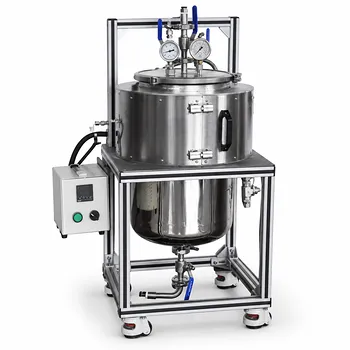
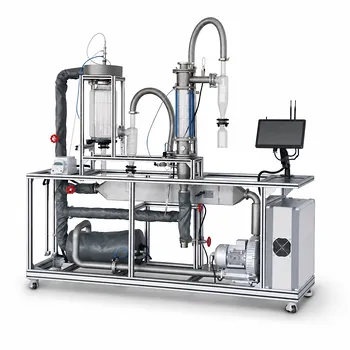
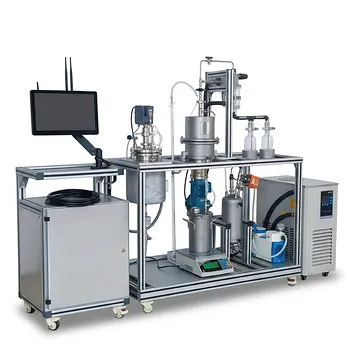
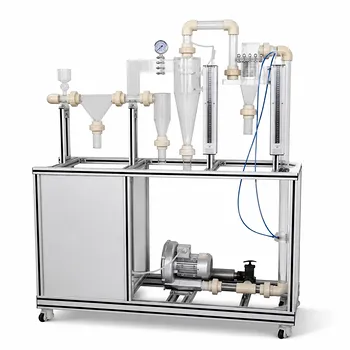
At LABPARK, we design and manufacture premium Educational and Vocational Unit Operations Pilot Plants in chemical engineering, bioprocess & biotech, and environmental & water treatment. Engineered specifically for universities, research institutes, and enterprises, our pilot plants allow students and researchers to hands-on analyze critical phenomena like viscosity resistance and surface tension gradients.
Gain precise, reproducible data to bridge classroom theory and industrial reality. Contact us today to find the ideal pilot plant solution for your lab!
Related Products
- Multi-Modal Distillation Unit Operations Training Pilot Plant
- Multi-Functional Membrane Separation Educational Pilot Plant for Unit Operations Lab
- Multimodal Absorption and Desorption Pilot Plant for Unit Operations Training
- Natural Product Extraction Unit Operations Training Pilot Plant
- Dual Mode Heat Transfer Pilot Plant for Unit Operations Training
People Also Ask
- How can energy balance equations for condensers & reboilers be validated experimentally? Guide
- What are the primary reflux ratio control strategies? Master Distillation Unit Operations
- How can real-time carbon number prediction improve distillation pilot plants? Optimize control.
- Why is vacuum operation capability an essential feature for a distillation unit operations pilot plant? Unlock Efficiency
- How does catalyst water concentration affect distillation pilot plant design? Key separation train choices.