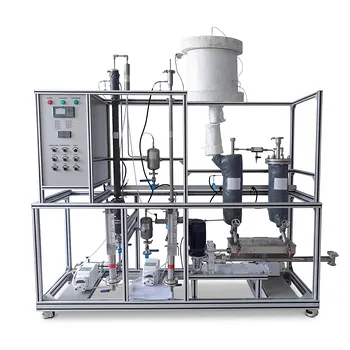
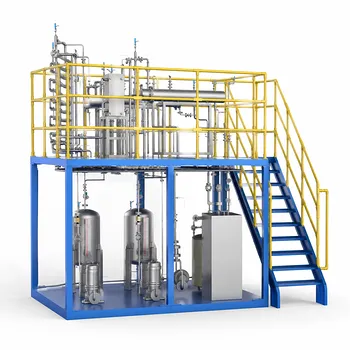
Ethane’s stubborn molecular stability forces pilot-plant operators to push temperatures higher and hold the gas in the reactor longer than they would with naphtha. In a steam-cracking pilot plant, ethane—a simple, hydrogen-rich molecule—demands outlet temperatures at the upper end of the 1050–1200 K window and residence times that often approach 0.4 seconds. Naphtha, a complex blend of hydrocarbons, reacts more readily, so it can be cracked at comparable or slightly milder thermal conditions but must be swept through the reactor faster to avoid runaway coking and product degradation. These two feedstocks therefore define opposite ends of the pilot-plant operating envelope: one requires high severity sustained over time, the other requires high severity with surgical timing.
The core insight: Feedstock hydrogen content and molecular complexity are inverses of the required residence time. Ethane, with a high H/C ratio, needs prolonged exposure at peak temperature to crack; naphtha, with a lower H/C ratio and reactive components, must be cracked rapidly with shorter residence times and higher steam dilution to preserve olefin yields and keep reactor walls clean.
Why Feedstock Stability Demands Different Thermal Histories
The first job of a pilot-plant temperature profile is to overcome the feedstock’s thermal stability. This directly determines where you set your inlet and outlet targets.
Ethane’s High Activation Energy Barrier
Ethane’s C–C bond is strong, and its symmetrical structure offers no weak points for radical attack. To achieve conversion levels of 65–70%, the gas must be heated to an outlet temperature typically between 1100 K and 1200 K. In university and research pilot units, the inlet zone is often held at 800–900 K for preheat, while the radiant section ramps aggressively to the peak temperature. This wide temperature span is necessary because ethane cracks through a clean, high-energy radical chain that demands high heat input per kilogram of feed.
The reward is selectivity: ethene yields can exceed 70 wt% (up to 84% under optimized conditions), making ethane an ideal model compound for studying radical kinetics. Because the reaction pathway is so simple, product slates are dominated by ethylene with small amounts of methane and hydrogen, and very little propylene.
Naphtha’s Readily Thermolyzed Components
Naphtha contains normal paraffins, iso-paraffins, naphthenes, and aromatics—each with a different cracking onset temperature. The mixture effectively lowers the average activation energy needed to initiate cracking. This means naphtha can be cracked at outlet temperatures similar to ethane (e.g., 1050–1150 K) but with a sharper thermal gradient: the inlet can sit at the low end (800–900 K), and the coil must deliver heat rapidly because the liquid film in the tube is quickly consumed by vaporization and reaction.
Naphtha’s reactivity is a double-edged sword. While it reduces the absolute temperature push required for conversion, it also generates a broad product distribution—methane, ethylene, propylene, butadiene, and aromatic-rich pyrolysis gasoline. The pilot plant operator must therefore balance temperature with residence time to avoid over-cracking the valuable propylene and butadiene into less valuable methane and coke.
Residence Time: The Kinetic Balancing Act
Pilot-plant residence times are not set arbitrarily; they are dialed in to manage the competition between primary cracking and secondary, yield-killing reactions.
How Feedstock Type Determines the Time Window
In modern cracking, target residence times fall in the 0.16–0.4 second range—short enough to suppress secondary reactions yet long enough to convert the feed. The specific value pivots on the feedstock:
- Ethane leans toward the longer end (0.3–0.4 s). Its slow kinetics mean that high conversion requires the gas to dwell near peak temperature for a measurable fraction of a second.
- Naphtha gravitates to the shorter end (0.2–0.3 s). Because naphtha cracks faster and its olefin products are themselves reactive, any extra time at high temperature will see propylene and butadiene recombine or degrade. Shorter residence times preserve these valuable co-products and lower the methane make.
Tube Geometry as a Residence-Time Lever
Pilot plants mimic industrial coils with micro-tubular reactors and precise flow control. Residence time is directly manipulated by changing the hydrocarbon flow rate (and steam rate) at a given tube length and diameter. By swapping tube configurations—e.g., moving from a single straight tube to a serpentine path with internal mixing—students and researchers can observe how reducing residence time at constant outlet temperature increases the ethylene-to-methane ratio, a classic kinetic demonstration.
When ethane is used, a longer tubular path with moderate flow gives the gas the necessary time. With naphtha, the same unit might switch to a shorter, smaller-diameter tube and increase the total flow to slash residence time while still achieving high heat transfer.
The Critical Role of Steam Dilution
Steam is not an inert bystander; its ratio to hydrocarbon directly affects the effective residence time, the partial pressure of reactants, and the health of the reactor.
Steam-to-Oil Ratio as a Coking Insurance Policy
Ethane’s low coking tendency allows a minimal steam dilution ratio (0.25–0.40 kg steam/kg ethane). This keeps the hydrocarbon partial pressure high, which favors ethylene yield, and adds little volume to the gas stream, so the residence time is dominated by the hydrocarbon flow.
Naphtha’s higher coking tendency requires an elevated steam ratio—typically 0.5–0.6 kg/kg for light naphtha, rising toward 0.7 kg/kg for heavier cuts. This extra steam performs three functions in the pilot plant: it reduces the hydrocarbon partial pressure (shifting equilibrium toward olefins), it supplies a gaseous velocity that shortens the residence time slightly, and it gasifies coke precursors before they can deposit on the tube wall.
Without this protective steam blanket, naphtha cracking would quickly coat the micro-reactor with carbon, lowering heat transfer, raising tube metal temperatures, and eventually giving irreproducible kinetic data.
How Steam Reshapes the Temperature Profile
Higher steam flows act as a heat sink through the radiant coil. When you switch from ethane to naphtha and increase the steam ratio, you often need to raise the external furnace setpoint slightly to maintain the same process gas outlet temperature. This coupling between dilution and apparent heat demand is a practical lesson that pilot-plant operators learn quickly: you cannot adjust steam and residence time in isolation from the temperature profile.
Understanding the Trade-offs
Every feedstock choice in a pilot plant is a compromise between simplicity and realism, between yield and operability.
Purity of Kinetics vs. Industrial Realism
Ethane delivers a pristine cracking signature. The product slate is almost entirely ethylene, so any deviation traces clearly to temperature or residence time. This makes ethane ideal for teaching the fundamentals of free-radical kinetics. The trade-off is that it tells you nothing about handling complex liquid feeds or the separation headaches that dominate real-world ethylene plants.
Naphtha provides a miniature industrial plant in a bench-scale unit, complete with tar, coke, and a multi-component product that demands online gas chromatography. The educational value is high, but the kinetic data are messy—conversions must be defined over a lump of boiling-point cuts, and repeatability demands rigorous decoking protocols.
Severity vs. Co-Product Value
Pushing severity (higher temperature, longer time) on ethane boosts ethylene until methane runaway erodes the gain. On naphtha, high severity destroys propylene and butadiene, increasing the methane yield and accelerating coke laydown. The pilot-plant operator must consciously choose whether to maximize a single olefin (run ethane at high severity) or to simulate a full-range product distribution (run naphtha at moderate severity with short residence time).
Reactor Health and Maintenance
Coke deposition is the silent variable. Even at the pilot scale, frequent decoking cycles are mandatory for naphtha operations, while ethane campaigns can run for much longer between cleanings. This impacts experiment scheduling and equipment longevity. If your research goal requires hundreds of steady-state points, ethane’s cleanliness is a practical advantage.
Making the Right Choice for Your Pilot-Plant Objectives
Your feedstock selection should flow directly from the scientific or educational purpose of your campaign. Use the following heuristics as a starting point:
- If your primary focus is teaching pure radical kinetics or maximizing ethylene in a single-product study: Choose ethane. Set the outlet temperature at 1150–1200 K, a residence time of 0.3–0.4 s, and a steam ratio of 0.30–0.35 kg/kg. The clean product stream will let students visualize conversion versus temperature profiles with minimal interference.
- If your primary focus is replicating an industrial naphtha cracker and analyzing co-product yields (propylene, butadiene, BTX): Run naphtha at a moderate outlet temperature of 1080–1120 K, a short residence time of 0.2–0.25 s, and a steam ratio of 0.55–0.60 kg/kg. Equip the pilot plant with an online GC and a liquid quench system to capture the full product spectrum.
- If your primary focus is demonstrating feedstock flexibility and the impact of coking on heat transfer: Design a rapid-switch feed system with separate preheaters for gaseous and liquid feeds. Run first ethane, then naphtha, keeping all other variables constant, and measure the resulting shift in tube skin temperature and product distribution to illustrate the role of hydrogen content.
Every knob you turn—temperature, residence time, steam—interacts with the feedstock’s molecular personality. By understanding ethane’s thermal stubbornness and naphtha’s eagerness to crack, you transform a simple pilot-plant run into a controlled exploration of chemical engineering’s first principles.
Summary Table:
| Parameter | Ethane Cracking | Naphtha Cracking |
|---|---|---|
| Outlet Temperature | 1100–1200 K | 1050–1150 K |
| Residence Time | 0.3–0.4 seconds | 0.2–0.3 seconds |
| Steam Dilution Ratio | 0.25–0.40 kg/kg | 0.50–0.70 kg/kg |
| Primary Product Slate | High-yield Ethylene (up to 84%) | Mixed Olefins (Ethylene, Propylene, Butadiene) |
| Coking Tendency | Low (longer continuous runs) | High (frequent decoking required) |
Upgrade Your Chemical Engineering Labs and Research Centers with LABPARK
To successfully teach or research complex radical kinetics like steam cracking, you need highly precise, adaptable equipment. LABPARK provides state-of-the-art Educational and Vocational Unit Operations Pilot Plants in chemical engineering, bioprocess & biotech, and environmental & water treatment for universities, research institutes, and enterprises.
Our custom-built pilot units offer precise temperature control, adjustable residence times, and advanced flow monitoring, enabling students and researchers to safely study real-world industrial processes.
Ready to elevate your engineering department's capabilities? Contact LABPARK today to discuss your project requirements!
Related Products
- Methane Cracking Educational Unit Operations Pilot Plant
- Multi-Reactor Educational Pilot Plant for Reaction Engineering Unit Operations
- Three-Tube Heat Transfer Educational Pilot Plant for Unit Operations Training
- Dual Mode Heat Transfer Pilot Plant for Unit Operations Training
- Multi-Functional Drying Educational Unit Operations Pilot Plant
People Also Ask
- How do ethane vs naphtha cracking influence teaching pilot plant analytical configurations? Key Design Guide
- How can flow-NMR be integrated with pilot plant reactors to monitor kinetics? A Complete Guide
- How do cracking temperature and residence time affect olefin yield? Pilot Plant Guide
- How are utility consumption rates integrated into chemical pilot plant economic evaluations?
- How should OSBL investments be estimated? Key Steps to Avoid Budget Overruns in Pilot Plant Projects