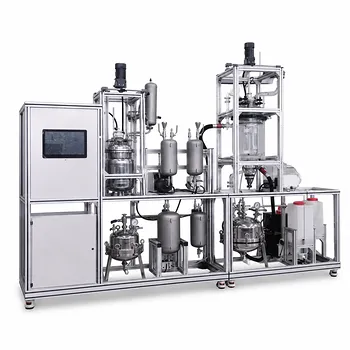
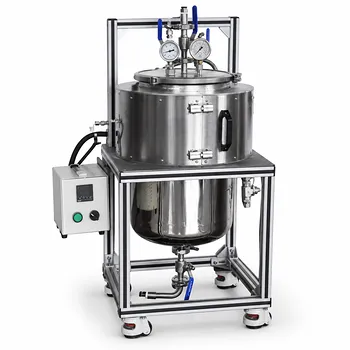
Excess properties are not an academic abstraction; they are the key that unlocks a pilot plant’s full instructional power. In training on distillation and liquid‑liquid extraction unit operations, excess properties—the measured deviation of a liquid solution from ideal thermodynamic behavior—enable learners to anticipate non‑ideal phenomena like azeotrope formation and solubility limits. By translating these deviations into activity coefficients, students and operators learn to adjust feed tray locations, reflux ratios, and solvent flow rates in real time, transforming abstract theory into actionable process control.
Ignoring excess properties widens the gap between textbook ideals and real pilot‑plant behavior. Embedding excess property analysis in training turns every pilot run into a diagnostic exercise, equipping students with the informed intuition needed to handle the non‑ideal mixtures they will face in industry.
The Bridge Between Textbook Theory and the Real Pilot Plant
Why Ideal Solutions Are Not Enough
Undergraduate texts often present separations using Raoult’s law and straight equilibrium lines. In actual pilot plants, however, liquid mixtures nearly always display positive or negative deviations from ideality.
These deviations—quantified as excess Gibbs energy, excess enthalpy, or excess volume—directly determine how components partition between phases. Without excess properties, the predictions from ideal models fail, leaving trainees unable to explain or correct poor separation performance.
Excess Properties as the Foundation of Activity Coefficients
The activity coefficient γ captures, in one number, how far a component strays from ideal behavior. It is calculated directly from the excess molar Gibbs energy of the solution.
When students measure or simulate γ values via thermodynamic frameworks (such as NRTL), they build a cause‑and‑effect link between molecular‑scale non‑ideality and large‑scale column dynamics. This conceptual bridge is the teaching core that turns pilot plant hours into deep learning.
Distillation: From Azeotropes to Tray Efficiency
Predicting Azeotrope Formation
An azeotrope—where vapor and liquid compositions become identical—is a direct consequence of non‑ideal liquid‑phase interactions. By analyzing the excess Gibbs energy, trainees can forecast whether a given mixture will form a maximum‑ or minimum‑boiling azeotrope.
In a pilot distillation column, this awareness lets them identify why purity plateaus despite increasing reflux, avoiding hours of futile operation. It also highlights when alternative separation strategies, such as pressure‑swing distillation, are necessary.
Adjusting Operating Parameters with Confidence
Non‑ideality also distorts the relative volatility, the key driver of separation efficiency. When activity coefficients deviate strongly from unity, the optimal feed tray location and required reflux ratio shift markedly from ideal‑case estimates.
During hands‑on training, students use γ calculations to reposition the feed and tune the reflux ratio. This direct feedback—thermodynamics dictating a physical knob turn—teaches far more than any simulation alone could.
Liquid‑Liquid Extraction: Solubility, Stages, and Solvent Selectivity
From Isoactivity to Practical Extraction
In extraction, a solute distributes between two immiscible phases so that its activity is equal in both. The equilibrium relation therefore depends on the ratio of activity coefficients in the two solvents.
By measuring or modelling excess properties, students calculate partition coefficients and predict how much solvent is needed to meet a purity target. This turns a trial‑and‑error pilot run into a rational design exercise.
Solvent Selection and Stage Requirements
When excess properties reveal strong positive deviations (large activity coefficients in the feed phase), a solvent with a much lower activity coefficient for the solute can extract it with far fewer theoretical stages.
In pilot plant experiments, learners test different solvents and quantify the impact of γ on mass transfer rates and stage efficiency. They also observe that ignoring non‑ideality leads to undersized columns, emulsion formation, or phase entrainment—all valuable failure‑mode lessons.
Deepening Hands‑On Skills Through Thermodynamic Calculation
Moving from Observation to Diagnosis
Standard pilot plant curricula often stop at collecting temperature and flow data. By adding an excess‑property layer, training moves up the cognitive scale from “what happened” to “why it happened.”
For instance, a gradually rising pressure drop in an extraction column might initially be blamed on mechanical fouling, but when students model the excess Gibbs energy of the mixture, they may uncover a shift in interfacial tension due to composition‑dependent activity coefficients—a thermodynamic root cause.
Integrating Models Like NRTL into Real‑Time Operation
Today’s pilot control systems can display live γ estimates from simple data reconciliation. When a trainee sees that a key component’s activity coefficient is drifting away from its design value, they learn to treat thermodynamics as a diagnostic tool, not just a chapter in a textbook.
This practice builds the reflex to check activity coefficients before mechanically adjusting setpoints, a habit that saves time and solvent in industrial operations.
Common Pitfalls When Excess Properties Are Overlooked
The “Ideal” Blind Spot
Pilot plant instructors sometimes omit excess properties to avoid complexity. This creates a hidden curriculum where students assume all mixtures behave nearly ideally.
The result is a training cohort unprepared for the azeotropes, low‑selectivity regions, and emulsion problems that dominate real‑world separations. Their first industrial encounters then become unnecessarily expensive learning experiences.
Misjudging Column Limits and Throughput
Physical properties like density difference and viscosity are not direct excess properties, but they are influenced by liquid‑phase non‑ideality. Ignoring the underlying activity coefficients can lead to predicting a 20‑tray column as sufficient when in reality 35 trays are needed, or setting a solvent‑to‑feed ratio that drives the system into a stable emulsion.
By teaching excess properties early, educators inoculate trainees against these mistakes, connecting thermodynamic limits to the hydrodynamic reality of flooding and phase entrainment.
Over‑simplified Performance Curves
Without activity coefficients, students often rely on constant relative volatility or linear equilibrium curves. While these simplifications speed up initial calculations, they mask the composition‑dependent nature of most industrial systems.
Later, when a real column underperforms, the same students lack the conceptual tools to troubleshoot—a gap that excess‑property training fills definitively.
Shaping Effective Training Outcomes
To convert pilot plant time into lasting professional competence, integrate excess‑property thinking at the level appropriate for your participants. Start with these goal‑aligned strategies:
- If your primary focus is building fundamental thermodynamic intuition: Begin every pilot run by requiring students to calculate activity coefficients from given excess Gibbs energy data and predict whether the mixture will form an azeotrope or show high solubility. Use that prediction to preset the feed tray and solvent flow rate.
- If your primary focus is advanced troubleshooting: Create intentional “non‑ideal surprises” (e.g., a feed composition near an azeotropic point) and have learners use online γ estimates to diagnose the resulting purity plateau or emulsification, then adjust parameters in real time.
- If your primary focus is process design‑oriented training: Assign solvent‑selection projects where students compare γ‑derived partition coefficients and column sizing calculations for different candidate solvents, then verify their predictions on the pilot scale.
Weaving excess properties into every pilot plant session turns routine operation exercises into profound learning events, graduating engineers and operators who see thermodynamics not as abstract theory but as the most practical tool on the plant floor.
Summary Table:
| Separation Process | Thermodynamic Driver | Practical Pilot Plant Impact |
|---|---|---|
| Distillation | Excess Gibbs Energy & Activity Coefficients (\gamma) | Predicts azeotrope formation; guides feed tray location and reflux ratio adjustments. |
| Liquid-Liquid Extraction | Activity Coefficient Ratios in Solvents | Dictates partition coefficients, stage efficiency, solvent selectivity, and phase behavior. |
Elevate Your Chemical Engineering & Bioprocess Training with LABPARK
Bridging the gap between thermodynamic theory and real-world industrial operations requires robust, high-fidelity training systems. LABPARK provides premium Educational and Vocational Unit Operations Pilot Plants in chemical engineering, bioprocess & biotech, and environmental & water treatment designed for universities, research institutes, and enterprises.
Our pilot plants allow students and operators to master complex, non-ideal liquid behaviors (such as azeotropes and solubility limits) through hands-on experimentation.
Ready to transform your lab's training outcomes? Contact LABPARK today to discuss your pilot plant requirements!
Related Products
- Continuous Sieve-Plate Distillation Pilot Plant for Unit Operations Laboratory Education
- Green Anhydrous Ethanol Purification Extractive Distillation Unit Operations Training Pilot Plant
- Multi-Modal Distillation Unit Operations Training Pilot Plant
- Continuous Batch Extractive Distillation Educational Pilot Plant
- Dual-Mode Rectification Pilot Plant for Practical Training Unit Operations
People Also Ask
- How to select the right activity coefficient model (Wilson, NRTL, UNIQUAC) for distillation pilot plants?
- How can real-time carbon number prediction improve distillation pilot plants? Optimize control.
- Why is vacuum operation capability an essential feature for a distillation unit operations pilot plant? Unlock Efficiency
- How does catalyst water concentration affect distillation pilot plant design? Key separation train choices.
- What are the primary reflux ratio control strategies? Master Distillation Unit Operations