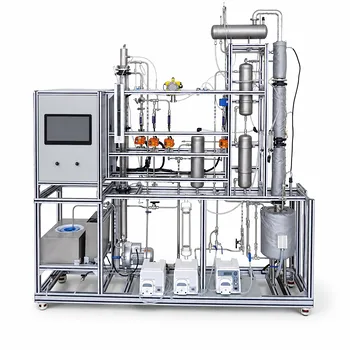
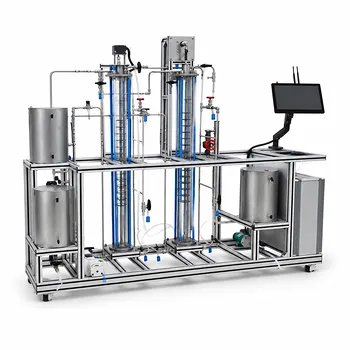
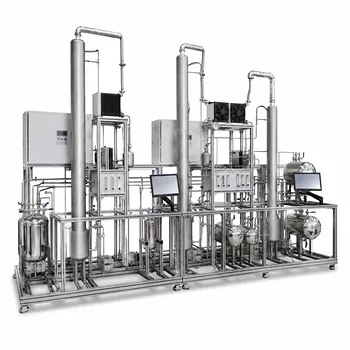
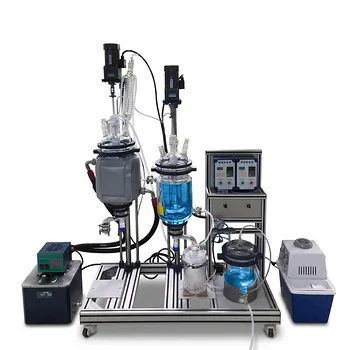
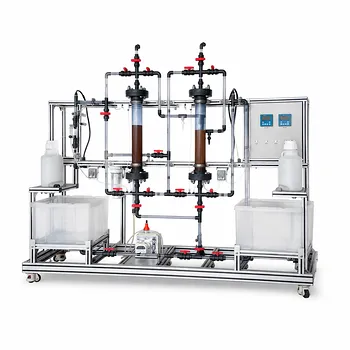
A benchtop rotary evaporator excels at concentrating a single sample, but it tells you almost nothing about how to run a chemical plant. Educational unit operations pilot plants bridge this gap by demonstrating solvent recovery as a scalable, continuous engineering challenge. Instead of simply enabling evaporation, these systems force students to quantify—and then optimize—heat transfer coefficients, mass and energy balances, vapor-liquid equilibrium, and vacuum system management under dynamic, industrial-style operating conditions.
While a rotary evaporator teaches basic concentration technique, a pilot plant transforms solvent recovery into a holistic engineering problem. Students learn to balance thermodynamics, energy consumption, and process safety—the very skills required to design and operate the distillation, evaporation, and membrane systems that handle 80% or more of the material flow in pharmaceutical and chemical manufacturing.
Moving Beyond the Rotovap: The Scale-Up in Thinking
A laboratory rotary evaporator operates as a closed, batch device that simply removes a single solvent. Its educational value stops there.
The Surface Lesson vs. The Deep Lesson
The rotary evaporator teaches flask rotation and vacuum application.
A pilot plant teaches process integration, energy economics, and continuous operation. It compels students to think about the entire solvent lifecycle, not just the moment of boiling.
From Bench Chemistry to Process Engineering
In a pilot plant, you don't just recover solvent; you must specify the heat source, design the condenser, measure the vacuum level's impact on boiling point, and calculate how much energy you're losing to cooling water.
This shifts the learning objective from "how do I dry my sample?" to "how do I design a sustainable separation train that minimizes Process Mass Intensity (PMI) and operating cost?"
Demonstrating Thin-Film Evaporation and Heat Transfer
The most direct upgrade from a rotary evaporator is the pilot-scale falling-film or rising-film evaporator. These units replicate the thin-film principle but in a continuous, instrumented environment.
Understanding the Thin-Film Advantage
A rotary evaporator spreads liquid into a thin film via centrifugal force to speed up evaporation. A falling-film evaporator does the same by gravity, flowing the solvent down a heated tube wall.
This lets students measure how film thickness, residence time, and heat transfer surface area directly influence evaporation rate—something a rotovap can only hint at.
Quantifying Heat Transfer Coefficients (U Values)
In a pilot evaporator, students collect real-time temperature and flow data to calculate the overall heat transfer coefficient (U). They see how fouling or changes in liquid viscosity degrade performance over time.
This bridges the gap between textbook correlations and the messy reality of industrial hardware.
Studying Steam Economy and Vacuum Control
A rotary evaporator's vacuum is set with a knob. A pilot plant uses a multi-stage vacuum system with condensers and traps. Students learn to balance steam economy (kg evaporated per kg of steam) by manipulating vacuum level and feed preheating, witnessing directly how a deep vacuum can sometimes increase total energy demand due to larger vapor volumes.
Exploring Distillation: Vacuum, Reflux, and Energy Optimization
Solvent recovery often involves separating mixed solvents, which a simple rotary evaporator cannot do. Pilot distillation columns fill this critical educational need.
Controlling Vapor-Liquid Equilibrium (VLE)
Pilot distillation units—often packed or tray columns—allow students to operate at atmospheric, vacuum, or pressure swing conditions. They sample liquid and vapor phases to build real VLE curves and compare them to theoretical models.
This hands-on validation is impossible with a rotovap. It teaches why an azeotropic mixture like ethanol-water cannot be fully separated by simple evaporation alone.
Learning Reflux Ratio and Column Dynamics
Students manipulate the reflux ratio—the amount of condensed vapor returned to the column—and immediately see its effect on top-product purity and energy consumption. They observe flooding when vapor velocity exceeds limits, and they learn to set operating lines that avoid this costly instability.
These lessons imprint the fundamental trade-off between separation quality and throughput far more deeply than any simulation can.
Expanding the Toolkit: Membrane Separations and Absorption
Educational pilot plants often demonstrate solvent recovery methods that have no analog in a rotary evaporator lab session, showcasing modern, energy-efficient alternatives.
Organic Solvent Recovery with Membranes
A rotary evaporator cannot separate a solvent from a heavy oil without vaporizing it. A pilot plant equipped with solvent-resistant polyimide membranes in spiral-wound modules can. Students feed a solvent-oil mixture (simulating dewaxing or edible oil processing) at 450–650 psi and watch up to 50% of the solvent permeate without a phase change.
They then calculate membrane flux and contrast the energy consumption with that of a simulated vacuum distillation, gaining direct appreciation for hybrid process design.
Gas Absorption and Stripping for Solute Recovery
When a solvent must be recovered from a gas stream—like scrubbing acetone from air—a packed column absorption unit is the tool. Using safe systems like CO₂ and water, students measure mass transfer coefficients, determine liquid-to-gas ratios, and find the column's flooding point.
This demonstrates how a solvent that is lost as vapor in a simple rotary evaporation step can be captured and recirculated in a closed industrial loop.
Integrating Unit Operations into a Complete Process
The most advanced educational demonstration connects multiple pilot-scale modules into a single, continuous solvent-recovery process.
Simulating a Real Manufacturing Sequence
A mini-plant might combine a kettle-type reboiler, a fractional distillation column, a shell-and-tube condenser, and a decanter. Students watch a crude solvent mixture enter the vaporizer, separate into top and bottom products, and get fully condensed for reuse.
They must write a complete mass and energy balance around the entire train, accounting for each heat input, loss, and stream composition. That systemic view is the exact opposite of the single-flask mindset of a rotary evaporator.
Instrumentation, Control, and Safety
A rotovap has a power switch and a vacuum release. A pilot plant has flow meters, temperature and pressure sensors, gas detectors, and automated emergency shutdowns. Students learn to interpret process trends, recognize unsafe deviations, and tune control loops—skills directly transferable to chemical plant operations.
Trade-offs and Challenges of Pilot-Scale Education
These powerful educational demonstrations come with legitimate trade-offs that must be acknowledged.
Complexity Overhead vs. Fundamental Understanding
Operating a pilot distillation column demands that a student master startup procedures, sensor calibration, and safety protocols before they can even begin a simple separation. In some cases, the procedural burden can temporarily obscure the underlying thermodynamic principle unless instructors carefully scaffold the exercise.
Cost and Throughput Limitations
Pilot plants are expensive to build, maintain, and clean. Unlike a rotary evaporator that processes one sample in minutes, a pilot column may require hours to reach steady state. This limits the number of variables a class can explore in a single lab session, forcing careful prioritization of learning objectives.
Risk of Treating the Plant as a "Black Box"
If not properly guided, students can become passive button-pushers. They might record data without truly connecting it to the heat- and mass-transfer fundamentals that a rotary evaporator, in its simplicity, forces them to think about (however superficially). Effective teaching demands that pilot-plant data be linked back to the same first-principles calculations done on the bench.
How to Choose the Right Pilot Plant for Your Educational Goal
The selection hinges entirely on which engineering dimension you want to move the student beyond the rotary evaporator’s bubble.
- If your primary focus is teaching heat transfer and continuous evaporation: A falling-film evaporator with a vacuum condenser is the most direct and intuitive step up. Students immediately grasp the thin-film concept and can start quantifying U values.
- If your primary focus is separation science and solvent recycling: Choose a packed distillation column with vacuum capability. It allows exploration of VLE, reflux ratio, and energy optimization that maps directly onto the largest industrial solvent recovery operations.
- If your primary focus is cutting-edge, non-thermal technology: Integrate a membrane solvent recovery module. It confronts students with the reality that for heat-sensitive or high-boiling mixtures, vaporization is not always the answer.
- If your primary focus is complete process thinking: Assemble a modular mini-plant that couples reaction, distillation, condensation, and absorption. This teaches students that solvent recovery in a real plant is never an isolated unit—it’s a system-wide energy and mass management problem.
By selecting the platform that matches the specific industrial challenge you want to illuminate, you transform solvent recovery from a simple lab step into a profound lesson in process design and sustainability.
Summary Table:
| Feature | Rotary Evaporator | Educational Pilot Plant |
|---|---|---|
| Process Type | Batch, single-sample concentration | Continuous, integrated separation |
| Core Learning | Simple boiling and vacuum control | Heat transfer coefficients (U), VLE, reflux ratio |
| Control & Safety | Manual control, low complexity | Industrial instrumentation, automation, and safety |
Bring Industrial-Scale Process Engineering to Your Lab with LABPARK
Bridge the gap between benchtop chemistry and industrial reality. LABPARK provides state-of-the-art Educational and Vocational Unit Operations Pilot Plants across chemical engineering, bioprocess & biotech, and environmental & water treatment.
Our systems help universities, research institutes, and enterprises deliver hands-on training in thermodynamics, mass balances, and process safety.
Contact our engineering experts today to customize a pilot plant solution for your lab.
Related Products
- Carbon Dioxide Absorption and Desorption Educational Pilot Plant for Carbon Capture Studies
- Solid Waste Pyrolysis and Refining Educational Pilot Plant for Unit Operations
- Dual-Mode Rectification Pilot Plant for Practical Training Unit Operations
- Multi-Functional Special Distillation Educational Pilot Plant
- Comprehensive Liquid-Liquid Extraction Pilot Plant for Engineering Education
People Also Ask
- How does operating pressure influence the transition between absorption and desorption in a CO2 pilot plant?
- How do temperature variations affect CO2 transport models in pilot plants? Model vs Reality
- What unit operations are critical for CCUS training pilot plants? Build hands-on engineering expertise.
- How do electrolytes affect phase equilibrium in absorption pilot plants, and how to calculate it?
- Why is critical surface tension key in column internals? Optimize gas absorption pilot plant efficiency