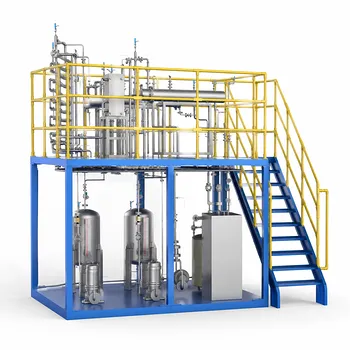
Cooling isn't just a button-press—it's a foundational infrastructure dependency. The method you choose to reject process heat fundamentally dictates your laboratory's floor plan, utility routing, and even its structural ventilation. Before you can install a distillation column or a reactor, you must first reconcile whether your heat rejection strategy will be based on a cheap-but-wasteful once-through municipal water supply, a recirculating chilled water loop, or a dry air-cooled system. This single choice cascades into requirements for floor drains, electrical switchgear capacity, ceiling height, and makeup air handling that must be locked in during site planning, not as an afterthought.
Core Takeaway: Cooling utility planning isn't just about hitting a target temperature—it's the primary driver of a lab's architectural layout and operational budget. The critical path isn't choosing the pilot plant; it's choosing the heat-rejection philosophy that your physical space and local climate can support. Once you know if you're tying into an unlimited city water main or deploying a standalone air cooler, the spatial footprint and utility backbone of the entire laboratory project are immediately defined.
The Three Cooling Philosophies That Reshape Your Lab
Your choice of cooling system is an irreversible architectural decision. Each option creates a distinct set of spatial, civil, and electrical demands.
Once-Through Municipal Water: Simplicity with Hidden Costs
This is the "garden hose" approach—simple to connect but logistically complex to sustain. You route city water through your condenser and then straight to a drain.
This method requires continuous, high-volume access to a potable or non-fouling water line and, critically, an industrial-capacity drain close to the skid. You cannot rely on a small sink drain. The site plan must guarantee that the drain line's diameter and slope can handle the maximum gallons per minute (gpm) specified by the unit, preventing a catastrophic lab flood during a full reflux condition. While cheap to install, the long-term operational cost of wasting water makes this the most expensive option over time.
Closed-Loop Chillers: Precision and Sustainability
When you can't waste water or need sub-ambient temperature control, a dedicated chiller is the solution. This trades plumbing complexity for electrical demand.
Installing a chiller means allocating a dedicated, ventilated floor space for the unit itself—often a refrigerator-sized machine that rejects its own heat into the room. Your site planning must therefore account for the chiller's heat exhaust, meaning the lab's HVAC system needs a significant bump in tonnage to prevent the room from turning into a sauna. The primary infrastructure check shifts from a water drain to a high-amperage electrical disconnect, matching the chiller's high inrush current draw.
Air-Cooled Exchangers: The Infrastructure-Free Option
An air-cooled heat exchanger eliminates the water equation entirely by using ambient air blown over a finned tube bundle. This is often the only viable path for arid regions or labs without adequate drainage.
However, "no water" means "massive airflow." These units require placement in a location with unobstructed air ingress and egress, often requiring high ceilings or external ducting. A finfan cooler consumes substantial electrical power for its large-diameter, high-tip-speed fans and generates significant noise. Site planning must account for this acoustic load, ensuring the unit doesn't violate laboratory safety noise limits, and must verify that the local high summer ambient temperature can still satisfy the pinch-point cooling demand.
Matching Cooling Capacity to Your Specific Unit Operation
Different pilot plant categories have wildly different thirst levels for heat rejection. This must be mapped to your utility header capacity during the design basis phase.
Distillation and Extraction: The Thirsty Processes
These units feature a condenser at the top of a column, and they are your biggest cooling water consumers. During a total reflux startup, the condenser must knock down 100% of the vapor load. Your site utility assessment must verify that the cooling water supply pressure at the point-of-use is sufficient to overcome the static head of the column—this often means ensuring a minimum of 2–3 bar (30–45 psi) at the skid edge.
Exothermic Reactors: Cooling as a Safety System
For a continuously stirred tank reactor (CSTR), cooling is not just for productivity; it's a process safety safeguard against a thermal runaway. Here, the cooling utility transitions from a production support to a safety-critical system. The site infrastructure must guarantee an uninterrupted power supply for the coolant circulation pump and may require a backup nitrogen or water quench line. The drainage plan must handle a potential rapid dump of hot reaction fluids into the sewer in an emergency, often requiring a blowdown tank.
The Utility Gap: When "Standard" Capacity Isn't Enough
Do not assume your building's standard utility headers are sufficient. A pilot-scale hydrotreater or reformer has an electrical appetite dwarfing that of a simple liquid-liquid extraction column. While the extraction unit needs a modest water flow for cooling, a hydrocracking demonstrator might require a 30 kW electrical furnace. This gap means site planning must include a specific load balance calculation to avoid tripping the main lab circuit breaker the moment a heater and an air-cooler compressor start simultaneously.
Understanding the Hidden Trade-offs and Pitfalls
Site integration failures rarely come from the major equipment; they stem from ignoring secondary effects like humidity and water chemistry.
The Condensation Conundrum in High-Humidity Labs
A critical nuance from site planning is the interaction between cold surfaces and ambient moisture. In a high-humidity lab, keeping a cooling water line at 10°C will cause sweating on uninsulated pipes and heat exchanger heads. This drips onto electronics or creates slip hazards. Your installation plan must therefore budget for closed-cell elastomeric foam insulation and, potentially, an air-conditioned enclosure for the cold parts of the process if you choose a wet-cooling method.
The Drainage Bottleneck
Plumbing is the silent project killer. Once-through systems demand that you know your backpressure. If the condenser outlet relies on gravity flow, the drain run must be constantly sloped. The installation layout must place the pilot plant upstream of the sanitary stack, not in a distant corner of the room. If that's not possible, you've just signed up for a pumped condensate return system, adding cost and complexity.
Unpacking the Cooling Tower Range
Even if you use a chiller, the concept of the cooling range (the ΔT between supply and return water) governs your design. A typical design basis of 5.5°C (10°F) range is standard. Widening this range to, say, 11°C (20°F) allows you to pump less water (saving pump energy and pipe sizing), but it demands a larger, more expensive heat exchange surface on your chiller's evaporator. For cramped labs, the capital cost vs. energy cost trade-off must be decided before the concrete is poured.
Thinking Beyond Just "Getting it Cold"
A well-planned pilot plant uses cooling not just as a utility, but as a research variable for teaching energy integration.
Strategic Pinch Analysis for Your Campus Utilities
The rules of process integration apply to your lab interface, not just the process. You must never use a premium utility like a glycol chiller (-10°C) to cool a stream that could be cooled by building water (20°C). This is called a utility pinch violation. During site planning, map your campus utility tiers (e.g., chilled water return, tower water, potable water). Match the highest-temperature coolant (coldest process pinch) to the cheapest water source to avoid wasting expensive refrigeration energy, a calculation that pays for itself if you can pre-heat boiler feed water with a hot return stream.
A Scalable Teaching Opportunity
For an educational lab, the utility infrastructure isn't just support—it's a curriculum tool. By installing a dedicated flow meter and RTD pair on the cooling water supply and return, the pilot plant becomes a live process economics lab. Students physically measure the kilowatt-hours of heat rejected, translating the flow rate into scaled-up variable costs. This contextualizes that utilities represent roughly 10% of variable production costs in many chemical technologies, bridging the gap from a textbook number to a tangible measurement.
Making the Right Choice for Your Installation Goal
Your cooling configuration must be dictated by the physical constraints of your site and the long-term vision for your laboratory, not just the immediate project budget.
- If your primary focus is minimizing upfront capital for a single, short-term experiment: A once-through water setup is viable, but you must first verify that your drain can handle the flow rate at a zero backpressure to avoid flooding.
- If your primary focus is building a flexible, long-term research platform: Invest in a closed-loop chiller system. This decouples you from municipal water temperature swings, eliminates water cost, and allows precise exotherm control, but requires dedicated floor space and upgraded electrical capacity.
- If your primary focus is installing in a water-scarce or high-humidity environment: An air-cooled solution isn't optional—it's the only path. Accept the higher noise profile and ensure your ceiling height can support the massive volumetric airflow required to match the thermal duty.
By treating cooling utilities as the primary spatial and engineering constraint early in the design phase, you transform a potential operational bottleneck into a reliable foundation for scalable chemical process research.
Summary Table:
| Cooling Method | Key Infrastructure Needs | Main Advantages | Key Drawbacks |
|---|---|---|---|
| Once-Through Water | High-volume water line, large-diameter sloped drain | Low initial capital cost | High water waste, high operating cost |
| Closed-Loop Chiller | Dedicated floor space, HVAC capacity, high-amp power | Precision temp control, water conservation | High electricity use, rejects heat to room |
| Air-Cooled Exchanger | High ceiling/ducting, ventilation, noise control | No water needed, low maintenance | High noise, dependent on ambient air temp |
Optimize Your Lab Layout with LABPARK
Planning the utility infrastructure for your next pilot plant can be complex. LABPARK provides premium Educational and Vocational Unit Operations Pilot Plants in chemical engineering, bioprocess & biotech, and environmental & water treatment for universities, research institutes, and enterprises.
Avoid costly installation mistakes and ensure your cooling, drainage, and power requirements are perfectly matched to your facility's layout and research goals. Contact our engineering experts today to discuss your site planning and equipment needs!
Related Products
- Carbon Dioxide Hydrogen Methanol Synthesis Educational Unit Operations Pilot Plant
- Multi Pump Fluid Transport Process Piping Unit Operations Training Pilot Plant
- Natural Product Extraction Unit Operations Training Pilot Plant
- Multi-Modal Distillation Unit Operations Training Pilot Plant
- Multi-Reactor Educational Pilot Plant for Reaction Engineering Unit Operations
People Also Ask
- How do temp & pressure affect methanol synthesis pilot plants? Optimize equilibrium and catalyst performance.
- Why is a purge system necessary when operating a gas recirculation loop in a methanol synthesis pilot plant? (Guide)
- Why do modern methanol pilot plants operate at lower pressures? Catalyst & Feed Requirements Explained
- What are the operational requirements for catalyst activation? Safe Methanol Pilot Plant Operation
- Why is the chemical plant startup schedule crucial? De-risk scale-up with pilot plants.