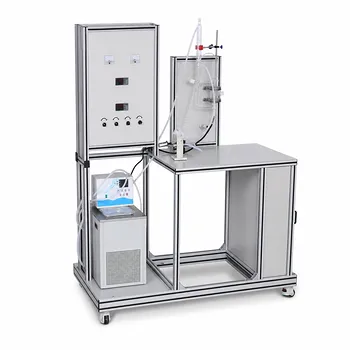
Compression staging and refrigerant choice are two of the strongest drivers of low-temperature refrigeration efficiency and cost. At temperatures such as -50°C, a single compressor may face a large pressure ratio, increasing shaft power, discharge temperature, and maintenance risk. Multi-stage or cascade compression can reduce these penalties, while the refrigerant determines whether the cycle can achieve the required evaporation and condensation temperatures at practical pressures.
The most efficient design balances compression work, heat-rejection capability, refrigerant properties, heat-exchanger area, capital cost, and safety. Staging reduces the burden on each compressor, while refrigerant selection determines whether the cycle is thermodynamically feasible in the first place.
Why Low-Temperature Operation Is Expensive
The Pressure Ratio Drives Compressor Work
A low-temperature evaporator operates at low suction pressure. If the system must reject heat to ambient air or cooling water, the compressor must raise the refrigerant pressure substantially before condensation can occur.
As the pressure ratio increases, compressor shaft power and discharge temperature generally rise. The exact penalty depends on compressor efficiency, refrigerant properties, operating pressures, and the degree of superheating and subcooling.
Temperature Lift Determines Utility Cost
The compressor is not simply moving refrigerant; it is moving heat from a cold process to a warmer environment. The larger the temperature lift between evaporation and condensation, the more electrical work is required for each unit of cooling.
This relationship is reflected in the coefficient of performance, or COP:
[ \mathrm{COP}=\frac{\text{Refrigeration capacity}}{\text{Compressor shaft power}} ]
A higher COP means that the unit delivers more cooling for the same electrical input.
Discharge Temperature Limits Reliability
High compression ratios can produce excessive discharge temperatures. This can degrade lubricant, damage valves, reduce compressor life, and create operating problems even when the calculated refrigeration capacity appears adequate.
For this reason, low-temperature systems must be assessed for both energy efficiency and mechanical operating limits.
How Compression Staging Changes Efficiency
Single-Stage Compression Has a Practical Limit
Single-stage systems are attractive because they have fewer compressors, controls, heat exchangers, and maintenance points. However, using one compressor across a large pressure ratio can result in high power consumption and unacceptable discharge temperatures.
A pressure ratio above approximately 3 to 4 is often a warning that staging should be evaluated, but it is not a universal design cutoff. The appropriate limit depends on compressor type, refrigerant, efficiency, manufacturer constraints, and the required temperature lift.
Multi-Stage Compression Divides the Pressure Rise
In a two-stage system, the total pressure increase is divided between a low-stage and a high-stage compressor. This reduces the pressure ratio handled by each compressor and can lower the total compression work.
The intermediate pressure is normally selected to balance the work of the two stages. Intercooling between stages removes some heat from the compressed vapor, reducing the volume and temperature entering the next compressor.
Intercooling Improves Both Power and Reliability
Intercooling can reduce the total shaft power required compared with an equivalent single-stage arrangement. It also lowers discharge temperatures and improves the operating environment for compressor components and lubricants.
The improvement is greatest when the system has a substantial temperature lift. At modest pressure ratios, the added equipment may provide too little energy benefit to justify its cost.
Cascade Systems Handle Very Large Temperature Lifts
A cascade system uses separate refrigeration circuits operating at different temperature levels. The low-temperature circuit removes heat from the process and rejects it to an intermediate heat exchanger, while the high-temperature circuit removes that heat and rejects it to cooling water or ambient air.
This arrangement is useful when the low-temperature refrigerant cannot condense at the available heat-rejection temperature. It also prevents one compressor from handling the entire pressure ratio.
How Refrigerant Choice Affects Feasibility and Cost
The Critical Temperature Sets a Condensation Constraint
A refrigerant must be capable of condensing at the system's heat-rejection temperature. Ethane, for example, has a critical temperature of approximately 32°C, so it cannot be condensed at 45°C in a conventional subcritical cycle.
Using ethane in that situation requires a different heat-rejection arrangement, such as a cascade system or another process that keeps the ethane circuit below its critical temperature.
Vapor Pressure Determines Equipment Requirements
The refrigerant's vapor-pressure curve establishes the suction and discharge pressures at the selected temperatures. Very low operating pressures can allow air and moisture to enter through small leaks, while excessively high pressures increase vessel, piping, and compressor requirements.
A practical refrigerant usually operates at pressures compatible with the available equipment and preferably above atmospheric pressure on the low side. This reduces the risk of inward leakage, although it does not remove the need for leak detection and containment.
Latent Heat Influences Refrigerant Circulation
A refrigerant with a high latent heat of vaporization can provide a given refrigeration duty with a lower mass flow rate. Lower flow may reduce compressor displacement, piping size, and pressure-drop losses.
Latent heat is only one selection criterion, however. The complete evaluation must also consider vapor density, compressor efficiency, pressure levels, heat-transfer behavior, chemical stability, environmental impact, toxicity, and flammability.
Propane and Ammonia Offer Practical Industrial Options
Propane can provide useful pressure levels and temperature performance for many industrial chilling and refrigeration applications. Ammonia also has strong thermodynamic performance and is widely used in industrial systems, particularly where trained personnel and appropriate safety systems are available.
Neither refrigerant is automatically the best choice. Propane's flammability and ammonia's toxicity require suitable plant layout, detection, ventilation, operating procedures, and emergency response provisions.
Designing the Heat-Rejection Side
Condensing Pressure Affects Compressor Power
A higher condensing pressure increases the compressor pressure ratio and typically raises power consumption. Operating at a pressure high enough to condense with standard cooling water may be operationally convenient, but it can increase electrical cost.
For example, a refrigerant such as propylene may be operated at a pressure that permits condensation using available cooling water. That choice must be compared with the power savings from operating at a lower condensing pressure and the capital cost of a larger or colder heat-rejection system.
Smaller Temperature Approaches Reduce Temperature Lift
A smaller temperature approach in the evaporator or condenser can allow the refrigerant to evaporate at a warmer temperature or condense at a cooler temperature. Both changes can reduce compressor work and improve COP.
The trade-off is heat-exchanger area. Reducing an approach from 10°C to 5°C generally requires more surface area, so the design must compare ongoing power savings against increased capital cost.
Heat-Exchanger Area Is an Economic Variable
Refrigeration efficiency cannot be optimized by compressor selection alone. A larger heat exchanger may reduce operating pressure lift, but it increases equipment cost, footprint, refrigerant inventory, and potentially cleaning requirements.
The economically correct design minimizes total lifecycle cost rather than maximizing COP in isolation.
Understanding the Trade-Offs
Staging Reduces Energy Use but Adds Equipment
Multi-stage and cascade systems can reduce power consumption and improve temperature control. They also require additional compressors, heat exchangers, controls, piping, instrumentation, and maintenance procedures.
The decision should include capital cost, expected operating hours, electricity price, maintenance capability, plant availability requirements, and the consequences of a failure in either circuit.
Higher Pressure Can Simplify Heat Rejection
A higher condensing pressure may allow the use of ordinary cooling water rather than a colder or more complex heat sink. That can simplify the utility system and reduce heat-exchanger size.
The disadvantage is increased compressor duty. A design that is simpler on the heat-rejection side may therefore be more expensive to operate.
Cascade Systems Can Increase Control Complexity
Cascade arrangements improve thermodynamic feasibility at very low temperatures, but the intermediate heat exchanger becomes a critical interface between the two cycles. Poor control of the intermediate temperature can reduce COP or overload one of the compressors.
The system also requires coordinated startup, shutdown, pressure control, and fault handling across both refrigerant loops.
COP Alone Does Not Determine the Best Design
A high COP is valuable, but it does not capture every cost. Refrigerant charge, safety systems, compressor purchase price, heat-exchanger area, maintenance, environmental compliance, and downtime can materially change the preferred design.
Theoretical cycle performance should therefore be checked against actual compressor maps, pressure-enthalpy analysis, heat-exchanger constraints, and site utility conditions. A real cycle may achieve substantially less than ideal performance; the supplementary reference's approximate 60% relationship to Carnot COP is a useful illustration, but it should not be treated as a universal design constant.
Refrigerant Selection Must Include Safety and Compliance
A refrigerant must have a boiling point below the target cooling temperature and a freezing point below the minimum operating temperature. It must also be compatible with the compressor lubricant, seals, construction materials, controls, and applicable regulations.
Thermodynamic performance is necessary but insufficient. A refrigerant that delivers excellent COP may still be unsuitable if its flammability, toxicity, environmental impact, or supply requirements exceed the site's capabilities.
How to Apply This to Your Project
Begin with the required evaporating temperature, heat-rejection temperature, refrigeration capacity, available cooling utilities, and allowable operating pressures.
- If your primary focus is minimum electrical cost: Evaluate multi-stage or cascade compression, intercooling, warmer evaporation, cooler condensation, and smaller heat-exchanger approaches using lifecycle cost rather than compressor power alone.
- If your primary focus is low capital cost: Consider a simpler single-stage arrangement only after verifying compressor pressure-ratio, discharge-temperature, and manufacturer operating limits.
- If your primary focus is very low process temperature: Use a cascade or staged configuration when the selected low-temperature refrigerant cannot condense against the available heat sink.
- If your primary focus is compact equipment: Compare refrigerants with favorable vapor density and latent heat while checking pressure-drop, compressor displacement, and heat-transfer requirements.
- If your primary focus is plant safety and reliability: Select a refrigerant and system architecture that match the site's detection, ventilation, containment, maintenance, and emergency-response capabilities.
- If your primary focus is total lifecycle cost: Optimize compressor power, heat-exchanger area, refrigerant charge, maintenance, utility availability, and downtime as one integrated system.
The right refrigeration design is the one that delivers the required low temperature with acceptable power, equipment complexity, safety risk, and lifecycle cost.
Summary Table:
| Design factor | Efficiency and cost impact | Key considerations |
|---|---|---|
| Compression staging | Reduces pressure ratio, shaft power, and discharge temperature | Evaluate compressor limits, intercooling, controls, and maintenance |
| Cascade refrigeration | Enables very low temperatures when one refrigerant cannot condense against the available heat sink | Adds compressors, an intermediate heat exchanger, and control complexity |
| Refrigerant choice | Determines operating pressures, feasible temperatures, circulation rate, and COP | Check critical temperature, vapor density, latent heat, lubricant compatibility, and supply |
| Condensing pressure | Higher pressure simplifies heat rejection but increases compressor power | Compare cooling-water conditions, heat-sink temperature, and energy cost |
| Heat-exchanger approach | Smaller temperature approaches can improve COP | Balance power savings against heat-exchanger area and capital cost |
| Safety and compliance | Influences plant design, operating procedures, and lifecycle cost | Assess flammability, toxicity, environmental impact, leak detection, and ventilation |
| Lifecycle economics | Identifies the best overall design rather than the highest COP alone | Include electricity, capital, maintenance, refrigerant charge, utilities, and downtime |
Need to select or optimize a low-temperature refrigeration pilot plant? Contact LABPARK to discuss your required evaporating temperature, refrigeration capacity, heat-rejection utilities, safety conditions, and operating priorities. LABPARK provides Educational and Vocational Unit Operations Pilot Plants for chemical engineering, bioprocess and biotech, and environmental and water treatment applications. Our solutions help universities, research institutes, and enterprises evaluate compression staging, cascade systems, refrigerant performance, heat-exchanger requirements, controls, and lifecycle cost in a practical training and research environment. Work with LABPARK to build a reliable pilot platform that supports hands-on education, process development, equipment comparison, and better-informed scale-up decisions.
Related Products
- Educational Compression Refrigeration Performance Determination Unit Operations Pilot Plant
- Carbon Dioxide PVT Curve Determination Educational Unit Operations Pilot Plant
- Multi-Functional Drying Educational Unit Operations Pilot Plant
- Throttling Effect Determination Educational Unit Operations Pilot Plant
- Hot Filtration Educational Unit Operations Pilot Plant Laboratory System
People Also Ask
- In chemical engineering unit operations training plants, how does partial conversion with recycle improve selectivity?
- How should operators and lab engineers resolve material-balance problems? Apply degree-of-freedom analysis
- What process factors must be evaluated when replacing vapor-compression refrigeration? A pilot-plant checklist
- Why Switch Unit Operations Flow Configurations? Impact on Experimental Measurements
- Why is distinguishing between elastic and plastic deformation critical? Prevent tablet capping.