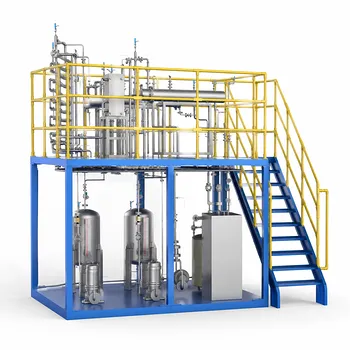
Patents are visions; simulations are hypotheses. Neither a patent diagram nor a computational fluid dynamics model can fully account for the messy, chaotic reality of a physical chemical process. Chemical engineering unit operations pilot plants serve as the indispensable arbiter of truth, enabling students and researchers to perform physical experiments that validate theoretical designs against real-world physics. This direct, tactile engagement uncovers the practical bottlenecks, energy losses, and safety constraints that idealized digital models and legal disclosures simply cannot predict.
Before a student can innovate, they must learn to navigate the gap between a perfect theory and an imperfect reality. Unit operations pilot plants transform abstract computer models and idealized patent data into tangible, empirical knowledge. They are the essential proving ground where invisible assumptions become visible failures, forcing a reconciliation between what should happen and what actually does.
The Nature of the Gap: Why Patents and Simulations Fall Short
Pure rational design, relying solely on literature and software, often creates a deceptive sense of security. The primary limitation of these tools is their inherent sterility—they describe a world that is chemically pure, perfectly mixed, and thermally ideal.
The Idealized World of Patent Literature
A patent is a legal document, not an engineering manual. It aims to protect intellectual property, often by describing the best possible outcome under tightly controlled, laboratory-scale conditions.
Real-world impurities and mixing dynamics are typically absent from these disclosures. A patent might claim a 95% yield and perfect selectivity, but it rarely defines the shear rate needed to achieve that in a 10,000-liter reactor. Pilot plants expose the gap between this idealized end-point and the physical path required to reach it.
The Unvalidated Assumptions of Computer Models
Process simulation software solves complex material and energy balances, but every model is a simplification. All simulations are built on assumptions of homogeneity, ideal heat transfer coefficients, and steady-state conditions that are rarely true.
These models are cost-effective for screening, but they require empirical validation. When a student runs a distillation column in a pilot plant, they immediately see the discrepancy between the simulation’s perfect equilibrium stages and the actual flooding point caused by real fluid dynamics and fouling.
The Pilot Plant as a Laboratory for Reality
A unit operations pilot plant is not just large glassware; it is a miniaturized factory floor. It allows researchers to safely introduce process upsets and validate multivariate models, turning theoretical chemical engineering into an experimental science.
Validating the Blueprint: From PFD to Physical Flow
The primary reference confirms that pilot plants allow users to verify actual Process Flow Diagrams (PFDs) . This means a student can trace a line on a 2D drawing and then physically open a valve to see if the material flows as predicted.
This physical run also validates the core logic of a plant: the material and energy balances. A simulation might miss a significant heat loss through a metal pipe or a pressure drop across a filter cake, but a pilot plant’s sensors will capture these deviations, forcing a refinement of the mathematical model.
Generating the Data that Builds a Business Case
Beyond science, every process must be commercially viable. Patents ignore economics, and simulations can only estimate them based on hypothetical inputs.
Pilot plants generate realistic operational data on energy consumption, solvent recovery losses, and waste generation. This allows researchers to conduct accurate economic and technical feasibility studies, transforming a laboratory curiosity into a process investors can trust.
Identifying and Solving the Hard Problems of Scale
The core of process development is not just making a product, but doing so repeatably at volume. Pilot plants equip researchers to tackle two specific, high-level challenges that virtual tools cannot solve alone.
Hunting the Bottleneck: Cycle Time and Scheduling
A batch process on paper is just a list of steps. In reality, it is a choreography of equipment occupancy. By physically running consecutive batches, researchers can track the idle time of units like reactors, Nutsche filters, and dryers.
This hands-on work identifies the scheduling bottleneck—the piece of equipment with the least idle time that limits the entire plant’s cycle time. This insight allows a student to physically demonstrate how adding an auxiliary unit, like an extra receiving vessel, can immediately shift the bottleneck and boost overall productivity.
Decoding the "Process Signature" for Consistent Quality
Successful scale-up is not about replicating a single recipe point; it is about replicating a process history. In a pilot plant, students move beyond comparing endpoint quality on a simple univariate chart.
They learn to map product quality in a multivariate space by tracking the "process signature"—the specific trajectory of temperature, pressure, and mass over time. By using sensors and latent variable methods, they can determine exactly how operating conditions must change across scales to achieve a consistent final product, a skill pure patent analysis cannot teach.
Understanding the Trade-offs
While pilot plants are the ultimate source of truth, it would be intellectually dishonest to present them as a perfect, risk-free solution. A reliance on physical experimentation without theoretical guidance is just as dangerous as trusting a simulation blindly.
- Capital and Time Cost: Building and running a pilot plant is an order of magnitude more expensive and slower than running a simulation. Investigative trials always require a strong theoretical hypothesis to justify the resource expense.
- Not All Physics Are Linear: The "scale-down" model itself has limitations. A 10-liter vessel has a much larger surface area-to-volume ratio than its 10,000-liter counterpart, leading to imbalanced heat transfer that can mislead a researcher if not critically analyzed.
- The Risk of Over-Engineering: It is easy to solve a localized problem in a visible pilot plant with expensive instrumentation that would be economically impossible to replicate at a commercial scale, creating a successful pilot that is a commercial dead-end.
Making the Right Choice for Your Research Process
Your path to a validated process depends entirely on your stage of development and the depth of risk you are willing to absorb. The pilot plant is a tool best deployed when your theoretical groundwork is solid but carries known unknowns.
- If your primary focus is early-stage screening: Do not jump to the pilot plant. Exhaust the capabilities of patent landscaping and computational process modeling to reject dead-end pathways cheaply before committing to a physical build.
- If your primary focus is validating a kinetic model: Use the pilot plant strategically. Focus on gathering high-fidelity empirical data on heat transfer coefficients and reaction kinetics that directly challenge your simulation’s assumptions.
- If your primary focus is de-risking a scale-up for investors: The pilot plant is non-negotiable. Running a full, multi-batch campaign to generate real economic data and uncover hidden failure modes provides the objective proof that no simulation or patent can ever offer.
The ultimate chemical engineering process is not born in a library or a data center; it is forged at the intersection of theory and the tangible, physical truths that only a pilot plant can reveal.
Summary Table:
| Tool / Method | Core Limitations | Key Value in Process Development |
|---|---|---|
| Patent Data | Idealized conditions, omits real-world impurities & mixing dynamics | Provides conceptual baselines and IP protection guidelines. |
| Computer Simulations | Relies on assumptions of perfect mixing and ideal heat transfer | Cost-effective for early screening and theoretical modeling. |
| Unit Operations Pilot Plants | Requires higher capital investment and operational time | Validates actual PFDs, tracks cycle bottlenecks, and generates real economic data. |
Bridge the Gap Between Theory and Reality with LABPARK
Transitioning from computer models to physical processes requires reliable, real-world testing. LABPARK provides high-quality Educational and Vocational Unit Operations Pilot Plants across chemical engineering, bioprocess & biotech, and environmental & water treatment sectors.
Tailored for universities, research institutes, and enterprises, our pilot plants empower your students and researchers to validate simulations, analyze process signatures, and safely master scale-up challenges.
Ready to elevate your engineering lab's capabilities? Contact LABPARK today to discuss your custom project requirements!
Related Products
- Carbon Dioxide Hydrogen Methanol Synthesis Educational Unit Operations Pilot Plant
- Multi Pump Fluid Transport Process Piping Unit Operations Training Pilot Plant
- Natural Product Extraction Unit Operations Training Pilot Plant
- Multi-Modal Distillation Unit Operations Training Pilot Plant
- Multi-Reactor Educational Pilot Plant for Reaction Engineering Unit Operations
People Also Ask
- How do temp & pressure affect methanol synthesis pilot plants? Optimize equilibrium and catalyst performance.
- Why is a purge system necessary when operating a gas recirculation loop in a methanol synthesis pilot plant? (Guide)
- Why do modern methanol pilot plants operate at lower pressures? Catalyst & Feed Requirements Explained
- What are the operational requirements for catalyst activation? Safe Methanol Pilot Plant Operation
- Why is the chemical plant startup schedule crucial? De-risk scale-up with pilot plants.