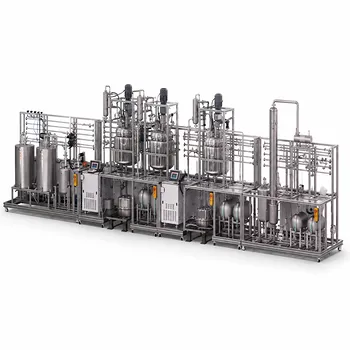
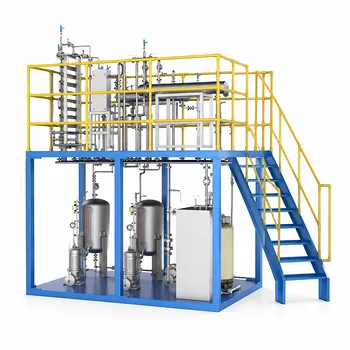
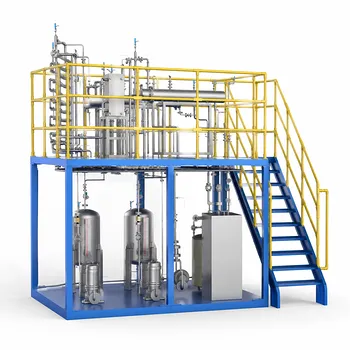
Dimensionless numbers are not just textbook abstractions—they are the invariant compass that guides every successful process scale-up. Unit operations pilot plants help students move beyond memorization by equipping them with real-time sensor data to calculate Reynolds, Nusselt, and Power numbers at different scales. This hands-on experience reveals that scaling up a chemical process is not about preserving geometry but about preserving the ratios that govern momentum, heat, and mass transfer.
By running the same unit operation at bench and pilot scales and adjusting flow rates, temperatures, and agitation, students discover that a constant Reynolds number preserves flow regime, a constant Nusselt number preserves heat transfer similarity, and a constant Power number preserves mixing intensity. The pilot plant transforms dimensionless numbers from passive variables into active design levers.
The Fundamental Role of Dimensionless Numbers in Scale-Up
A student’s first instinct is often to linearly enlarge equipment. The pilot plant shows why that intuition fails.
Why Simple Geometric Scaling Fails
Heat transfer area scales with the square of a vessel’s diameter, while volume doubles with the cube. Simply making a reactor larger changes the surface-area-to-volume ratio, distorting heat removal and mixing time. Pilot plants force this realization in real time.
The Invariance Principle: Re, Nu, and Np as Process Anchors
The Reynolds number (Re) characterizes the relative importance of inertial to viscous forces. Maintaining Re constant across scales preserves the flow regime (laminar or turbulent). The Nusselt number (Nu) describes the ratio of convective to conductive heat transfer. Keeping Nu constant ensures that temperature profiles inside the reactor remain similar. The Power number (Np) relates agitation power to impeller speed and fluid density. Constant Np retains equivalent mixing intensity and shear rates. In the pilot plant, students see these three numbers as a minimal set of invariants for a reproducible process.
How Pilot Plant Instrumentation Makes Theory Tangible
Classroom problems provide ready-made numbers. In a pilot plant, students must extract them from raw instrument readings—and that changes everything.
From Sensors to Ratios: Calculating Re, Nu, and Np in Real Time
A pilot reactor is outfitted with magnetic flow meters, thermocouples, pressure transmitters, and torque meters. Students measure flow velocity, pipe diameter, and fluid viscosity to compute Re = ρ·v·D/µ mid-experiment. They log heating jacket temperatures and process fluid temperatures to derive the heat transfer coefficient and subsequently the Nu. They record impeller speed and shaft power to calculate Np = P/(ρ·N³·D⁵). The instrument data turns abstract formulas into decisions: “To match the lab’s Re, I must increase the flow rate by 30% at this larger diameter.”
Comparing Scales: The Missing Link in Benchtop Education
Benchtop glassware is often too small to exhibit significant temperature gradients or residence time distribution effects. A pilot plant exaggerates these transport limitations, making the failure of linear scaling visible. Students run deliberate experiments at mismatched Re or Nu and witness channeling, hot spots, or poor mass transfer—outcomes that are invisible in a 100 mL flask. The pilot unit validates the theory by showing what happens when invariance is violated.
Beyond Calculation: Insight into Hidden Scale-Up Pitfalls
Mastering dimensionless numbers is necessary but not sufficient. The pilot plant reveals the deeper story.
Unmasking Heat and Mass Transfer Limitations
Even when Re and Nu are matched, a larger vessel can have non-ideal mixing and dead zones that dimensionless single-point numbers cannot fully capture. Pilot operations demonstrate why residence time distribution (RTD) must supplement these groups, connecting tank geometry to conversion and yield.
How Continuous Operation Reveals Degradation and Impurities
Lab-scale proof-of-concept often uses pure feeds and short runs. A pilot plant runs continuously with recycle loops. Students observe that catalyst coking or by-product accumulation can shift kinetics over days—challenges that no static dimensionless group alone can predict. This teaches that preserving dimensionless transport similarity must be paired with monitoring the evolving process signature in a multivariate space.
Validating Multivariate Models and Process Signatures
Industrial scale-up now relies on predictive models. In the pilot plant, students deliberately introduce process upsets—changing feed concentration while holding Re constant—to test multivariate models against empirical data. This shows that dimensionless numbers serve as anchor points within a larger set of design constraints, not as a single solution.
Understanding the Trade-offs
A purely dimensionless-number approach has limits that students must appreciate.
- Necessary but not sufficient: Matching Re, Nu, and Np does not automatically replicate local shear rates, micro-mixing, or reaction homogeneity if the impeller type or baffle configuration changes.
- Instrument and scale gaps: Pilot plant sensors introduce noise and lag. Calculated dimensionless numbers carry real uncertainty, a lesson in error propagation that textbooks skip.
- Economic reality: The famous cost-scaling exponent (≈0.6) governs capital expenditure but has no direct dimensionless analogue. Students learn that thermodynamic similarity and economic scalability are different conversations.
- Kinetic complexity: For highly exothermic or multiphase reactions, maintaining Re and Nu may be less critical than controlling heat removal per unit volume (Watts/kg) —a metric that emerges from but is not captured by dimensionless groups alone.
Making the Right Choice for Your Learning Goal
How you leverage a pilot plant for understanding scale-up depends on your primary objective.
- If your primary focus is mastering fluid dynamics scale-up: Run experiments at the bench and pilot scales where you deliberately hold Re constant and observe the preservation of flow patterns and pressure drop.
- If your primary focus is understanding heat transfer limited reactions: Keep Nu constant while varying vessel size, and map how product quality changes when this invariance is deliberately broken.
- If your primary focus is evaluating process economics: Use the pilot plant data to build mass and energy balances, then apply the 0.6 power-law scaling rule to estimate the capital investment for a commercial unit—linking physical similarity to cost.
- If your primary focus is detecting hidden scale-up failures: Operate the pilot plant in closed-loop recycle mode over extended periods, tracking how catalyst deactivation or impurity buildup can overpower even a perfectly scaled dimensionless framework.
In the end, the unit operations pilot plant does not teach that dimensionless numbers are the only answer—it teaches that they are the most reliable starting point in a complex, multi-dimensional design conversation.
Summary Table:
| Dimensionless Number | Key Components | Physical Meaning | Scale-Up Relevance |
|---|---|---|---|
| Reynolds (Re) | Density, velocity, diameter, viscosity | Inertial vs. viscous forces | Preserves flow regime |
| Nusselt (Nu) | Heat transfer coeff, diameter, conductivity | Convective vs. conductive heat transfer | Preserves heat transfer similarity |
| Power (Np) | Power, density, speed, impeller diameter | Agitation power vs. inertial force | Preserves mixing intensity and shear |
Bring Theory to Life with LABPARK Pilot Plants
Bridge the gap between textbook equations and real-world scale-up challenges. LABPARK provides state-of-the-art Educational and Vocational Unit Operations Pilot Plants in chemical engineering, bioprocess & biotech, and environmental & water treatment.
Designed specifically for universities, research institutes, and enterprises, our pilot plants empower students and researchers to collect real-time data, analyze process similarity, and master hands-on engineering principles.
Ready to elevate your engineering curriculum or research capabilities? Contact LABPARK today to find the ideal pilot plant solution for your facility!
Related Products
- Carbon Dioxide Hydrogen Methanol Synthesis Educational Unit Operations Pilot Plant
- Multi Pump Fluid Transport Process Piping Unit Operations Training Pilot Plant
- Natural Product Extraction Unit Operations Training Pilot Plant
- Multi-Modal Distillation Unit Operations Training Pilot Plant
- Multi-Reactor Educational Pilot Plant for Reaction Engineering Unit Operations
People Also Ask
- How do temp & pressure affect methanol synthesis pilot plants? Optimize equilibrium and catalyst performance.
- Why is a purge system necessary when operating a gas recirculation loop in a methanol synthesis pilot plant? (Guide)
- Why do modern methanol pilot plants operate at lower pressures? Catalyst & Feed Requirements Explained
- What are the operational requirements for catalyst activation? Safe Methanol Pilot Plant Operation
- Why is the chemical plant startup schedule crucial? De-risk scale-up with pilot plants.