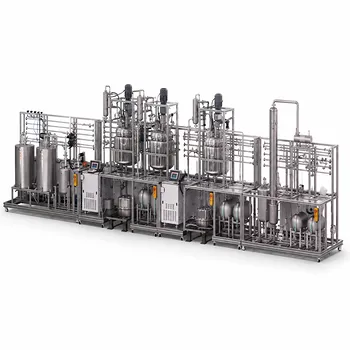
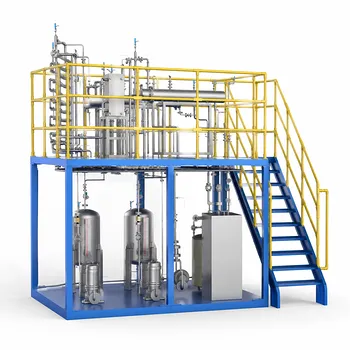
Precision is not a luxury but a prerequisite. Chemical engineering unit operations pilot plants—whether batch reactors, continuous stirred‑tank reactors (CSTRs), or plug‑flow reactors—enable the systematic study of reaction kinetics by creating a controlled environment where variables like temperature, concentration, and residence time can be independently manipulated. Through integrated dosing pumps, heat exchangers, and precise sensors, operators alter these inputs and directly measure the resulting reaction rate, defined as the change in concentration over time (v = Δc/Δt). This empirical approach allows the calculation of reaction orders, rate constants, and activation energies, directly bridging molecular collision theory with industrial reactor design.
Pilot plants are not simply scaled‑up versions of lab glassware; they are the critical experimental bridge that decouples intrinsic chemical kinetics from physical reactor dynamics. By providing the infrastructure to safely apply the Arrhenius equation and integral/differential analysis methods, they transform theoretical knowledge into actionable, scalable engineering data.
Isolating What Matters: How Pilot Plants Control Critical Variables
The primary way a pilot plant facilitates kinetic studies is by turning the reactor into a finely tuned instrument. Instead of wrestling with uncontrolled fluctuations, you can dial in the exact conditions that reveal a reaction’s true behavior.
The Power of Precision Temperature Control
Temperature is the single most influential factor in reaction rate. A pilot plant’s jacketed vessel, recirculating bath, and internal coils maintain isothermal conditions within tight tolerances—often ±0.1°C. This stability is essential because small temperature drifts cause exponential changes in the rate constant, especially for high‑activation‑energy reactions. With steady‑state control, you can confidently collect data at multiple set points to later calculate activation energy (Eₐ) via the Arrhenius equation.
Manipulating Concentration and Flow with Confidence
Pilot‑scale dosing pumps and calibrated feed tanks allow you to vary reactant concentrations systematically—either by changing the initial charge in a batch reactor or by adjusting the inlet molar flow rates in a CSTR/PFR. You can also run transient experiments, like step‑changes in feed composition, and immediately observe the resulting rate response. This direct, reproducible manipulation eliminates the guesswork that plagues qualitative lab‑scale studies.
Residence Time: The Overlooked Lever in Continuous Systems
In continuous reactors, the space time (τ = V/ν₀) dictates how long species react. By simply changing the feed pump speed, you alter the extent of conversion at a fixed temperature and feed composition. Monitoring the outlet concentration at different residence times produces a kinetic profile that directly reflects the reaction’s concentration dependence, enabling you to determine the reaction order without ever stopping the process.
Turning Raw Data into Kinetic Models
Once operating conditions are locked in, the pilot plant becomes a data‑generation engine. The real insight comes from how you transform that raw concentration‑time data into a mathematical law.
From Concentration Profiles to Rate Constants
Using the plant’s sampling ports or online analytical sensors (e.g., spectrophotometers, conductivity probes), you can track concentration versus time with high frequency. Applying the differential method, you estimate the instantaneous rate (dCₐ/dt) at multiple concentrations and fit a rate law of the form r = k Cₐⁿ. Alternatively, the integral method tests whether a zero‑, first‑, or second‑order integrated equation yields a straight line when plotted against time. The slope of that best‑fit line gives the rate constant (k) for that temperature.
The Arrhenius Equation in Action
Repeating the experiment at several controlled temperatures turns raw rate data into a mechanistic fingerprint. Plotting ln(k) against 1/T yields a straight line with a slope equal to ‑Eₐ/R. The pilot plant’s isothermal stability makes this plot reliable. Without such control, the propagation of error would easily mask the subtle activation energy differences that distinguish catalytic pathways or identify mass‑transfer limitations.
Deciding Between Integral and Differential Methods
The choice of analysis method depends on the reactor type and data density. A well‑instrumented batch reactor naturally lends itself to the integral approach by continuously monitoring a single charge. A PFR with multiple sample points along its length offers spatial concentration slices ideal for differential analysis. The pilot plant’s flexible configuration lets you pick the method that minimizes numerical noise for your specific chemistry.
Why Scale Matters: Beyond the Beaker
Beaker‑scale glassware is excellent for proof‑of‑concept. The pilot plant solves the problems that appear when you try to move from a drop to a drum.
Decoupling Kinetics from Reactor Design
In a tiny flask, it is nearly impossible to separate the intrinsic chemical speed from the mixing speed of a magnetic stir bar. Pilot‑scale reactors operate with well‑characterized residence time distributions and controlled hydrodynamics. You can deliberately run a reaction in both a batch and a plug‑flow reactor with identical thermal and concentration histories. If the rate constants match, you have successfully decoupled the true kinetics from the physical equipment—a critical step for reliable scale‑up.
Validating Scale‑Up Assumptions
A kinetic model fitted only on milligram‑scale data often fails to predict heat‑transfer effects, wall catalysis, or micro‑mixing limitations that dominate at the ton scale. Running the reaction in a pilot plant exposes these hidden variables. For instance, if the observed rate in a pilot CSTR deviates from the intrinsic model at higher concentrations, you have discovered a mixing‑sensitive regime that a small‑scale experiment would never reveal.
Handling Exothermic Reactions Safely
Exothermic reactions pose a thermal runaway risk that cannot be studied safely in an open beaker. Pilot plants are built with pressure‑rated vessels, rupture discs, and emergency quenching systems. Under controlled conditions, you can deliberately push a reaction to its thermal stability limit and collect real‑time temperature and pressure data. This empirical data is essential for fitting runaway kinetics and designing industrial pressure‑relief systems—a task that must never be left to extrapolation alone.
Understanding the Trade‑offs
Pilot‑scale kinetic studies are powerful, but they are not a silver bullet. A clear‑eyed view of their limitations keeps your project on track.
The Cost and Complexity of Scale
Pilot plants require capital, floor space, utilities, and trained operators. The time to clean, set up, and reach steady state can stretch a simple kinetics job from a few hours to a full week. If your only goal is to screen dozens of catalyst formulations, a high‑throughput micro‑reactor is often far more efficient than a full pilot unit.
Transport Limitations Can Distort Kinetics
Even at pilot scale, heat and mass transfer are never perfectly instantaneous. In highly viscous fluids or for ultrafast reactions, the measured rate may reflect diffusion into the catalyst pore rather than the true surface reaction. A rigorous pilot study must include experiments that vary stirring speed or particle size to confirm the absence of these transport artifacts; otherwise, what you call a rate constant is actually a mass‑transfer coefficient.
Not All Phenomena Scale Gracefully
Certain effects—like surface‑to‑volume ratios, static electric charge accumulation, or nucleation kinetics—can behave differently at the 20‑liter scale than in a 20‑cubic‑meter vessel. The pilot plant bridges most of the gap, but it does not eliminate it. Final design always requires an intelligent safety factor and often a confirmation campaign in a demonstration plant.
Making the Right Choice for Your Kinetic Study
Your experimental goal should dictate how you use the pilot plant. The following decision guide will help you match the tool to the task.
- If your primary focus is teaching fundamental kinetics: Use an isothermal batch reactor with sampling at fixed intervals. Apply the integral method with simple first‑ and second‑order plots to give students a direct, visual link between a linear graph and the reaction order.
- If your primary focus is industrial scale‑up and reactor design: Run identical chemistry in both a lab‑scale batch reactor and a pilot CSTR or PFR. Validate that the extracted rate constants match across scales; if they don’t, investigate mixing and heat‑transfer discrepancies before proceeding to full design.
- If your primary focus is catalyst screening or mechanism elucidation: Use the pilot plant’s precision pumps and temperature control to operate at low conversion (differential reactor mode). This approach directly yields the initial rate as a function of inlet concentration, without the confounding influence of product inhibition.
- If your primary focus is safety and thermal runaway analysis: Conduct a series of calorimetric‑grade batch experiments in the pilot reactor, deliberately operating near the heat‑removal limit. Use the resulting temperature‑time profiles to fit the full kinetic and heat‑balance model that will justify your relief system sizing.
A pilot plant transforms kinetics from an abstract mathematical exercise into a tangible, data‑driven engineering practice—provided you use its controls deliberately and interpret the results with an informed, critical eye.
Summary Table:
| Controlled Factor | Pilot Plant Mechanism | Kinetic & Scale-Up Benefit |
|---|---|---|
| Temperature | Jacketed vessels & internal coils (±0.1°C) | Reliable Arrhenius plots & activation energy ($E_a$) calculations |
| Concentration & Flow | Precision dosing pumps & calibrated feed tanks | Direct determination of reaction order and reaction rates |
| Residence Time | Adjustable feed pump speeds in CSTR/PFR | Accurate profiles of concentration dependence in continuous flow |
| Mixing & Safety | Characterized hydrodynamics & emergency quenching | Decouples chemical kinetics from physical transport limitations safely |
Accelerate Your Research and Scale-Up with LABPARK
Are you looking to bridge the gap between laboratory chemistry and industrial-scale production? LABPARK provides advanced Educational and Vocational Unit Operations Pilot Plants in chemical engineering, bioprocess & biotech, and environmental & water treatment. Designed specifically for universities, research institutes, and enterprises, our systems offer the precise control and safety instrumentation needed to study reaction kinetics accurately.
Ready to elevate your research or training capabilities? Contact us today to discuss your pilot plant requirements!
Related Products
- Carbon Dioxide Hydrogen Methanol Synthesis Educational Unit Operations Pilot Plant
- Multi Pump Fluid Transport Process Piping Unit Operations Training Pilot Plant
- Natural Product Extraction Unit Operations Training Pilot Plant
- Multi-Modal Distillation Unit Operations Training Pilot Plant
- Multi-Reactor Educational Pilot Plant for Reaction Engineering Unit Operations
People Also Ask
- How do temp & pressure affect methanol synthesis pilot plants? Optimize equilibrium and catalyst performance.
- Why is a purge system necessary when operating a gas recirculation loop in a methanol synthesis pilot plant? (Guide)
- Why do modern methanol pilot plants operate at lower pressures? Catalyst & Feed Requirements Explained
- What are the operational requirements for catalyst activation? Safe Methanol Pilot Plant Operation
- Why is the chemical plant startup schedule crucial? De-risk scale-up with pilot plants.