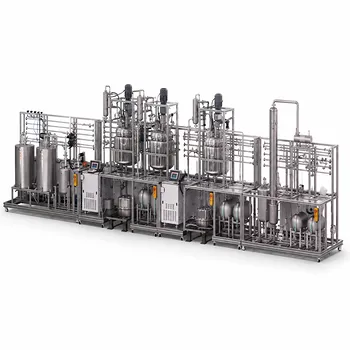
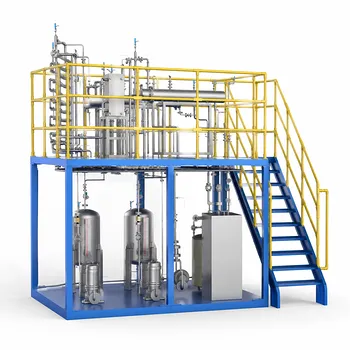
Pilot plants are the physical bridge where textbook calculations meet real-world complexity. They are instrumented, scaled-down versions of industrial processes that let you move beyond solving material and energy balances on paper. By collecting actual flow rates, temperatures, pressures, and compositions, you can compare your theoretical predictions against measured data—and in the process, uncover the mass and heat losses, side reactions, and sensor inaccuracies that no textbook problem ever gives you. This hands-on verification transforms abstract conservation laws into a practical diagnostic toolkit for optimizing and designing real chemical processes.
The real learning happens in the gap. Pilot plants expose the discrepancies between ideal balances and physical behavior, forcing students to identify and account for fugitive losses, environmental heat transfer, and non-ideal reaction stoichiometry. Mastery comes not from getting the balance to close perfectly, but from understanding why it didn’t—and using that insight to improve the process.
The Learning Gap Between Theory and Practice
Why Paper Balances Fall Short
In academic exercises, mass and energy balances are often solved with perfect assumptions: complete reactions, adiabatic boundaries, zero fugitive emissions. Real industrial systems never behave this cleanly.
A unit operations pilot plant forces you to confront the imperfections. The moment you open a sample valve, a tiny mass loss occurs. The insulation on a pipe is never 100% efficient. These realities are absent from a textbook, but they dominate plant efficiency and safety.
What a Pilot Plant Actually Gives You
A pilot plant is a modular, physical model of key industrial unit operations—reactors, distillation columns, heat exchangers, dryers, or extraction units—integrated with industrial-grade sensors. You can manipulate temperature, pressure, flow rates, and space velocity and observe how a change in the reaction phase cascades through downstream separation and final product purity.
Because the system is real, the data is real. You measure mass flow rates, stream compositions, inlet/outlet temperatures, and energy input/output. This isn’t a simulation; it’s a physical process governed by the same thermodynamics and transport phenomena as a full-scale plant.
Verifying Material Balances on a Pilot Plant
The Steady-State Foundation
For a continuous pilot plant operating at steady state, the accumulation term is zero. The material balance collapses to the simple principle: Input Material = Output Material. This is the first verification students perform.
The process is systematic, mirroring professional engineering practice:
- Write down the stoichiometry of all reactions.
- Draw a process flow diagram mapping every stream.
- Choose a calculation basis (e.g., mass per hour).
- Perform component or elemental balances (carbon, hydrogen, etc.).
When applied to real-time sensor data, this calculation immediately validates—or challenges—the integrity of your measurements and the process itself.
Exposing Mass Losses You Never Calculated
Here is where the deep learning begins. Your measured output rarely matches your calculated theoretical output exactly. The pilot plant reveals why.
You’ll identify mass loss from venting, sampling, column bottoms residue, or unexpected side reactions. In an ethylbenzene dehydrogenation pilot setup, for example, students measure actual flow rates and compositions from reactor feed, reactor discharge, condenser output, and oil-water separator phases. The main reaction produces styrene and hydrogen, but side reactions generate benzene, toluene, and light gases. Without accounting for these side products, your material balance will never close. The pilot plant forces you to track these minor components and refine your stoichiometric model, directly teaching how real selectivity and conversion are calculated.
The same principle applies in a drying pilot plant. By measuring inlet/outlet air temperatures, relative humidity, and feed flow rates, you can apply the moisture evaporation rate equation ( W = G(X_1 - X_2) ) and calculate the dry air consumption. The material balance tells you exactly how much water has been removed—and whether any solid losses occurred.
Verifying Heat Balances Under Real Conditions
Applying the Energy Accumulation Equation
Pilot plants equipped with reactors, heat exchangers, and temperature/flow sensors let you measure the enthalpy of every inlet and outlet stream. Using the energy balance equation Energy accumulated = Energy in - Energy out, you can directly calculate whether the process is endothermic or exothermic and quantify the heat that must be supplied or removed.
If the accumulation term is negative, the process absorbs energy—you’ll see the need for external heating in real-time. This turns thermodynamic formulas from abstract into a direct observation: you adjust a heater setting and watch the effect propagate through the system.
Quantifying the Invisible: Environmental Heat Loss
The most humbling lesson comes from heat loss. Your perfectly adiabatic theoretical calculation predicts one temperature profile, but the pilot plant shows another. Pipes radiate heat. Insulation has a finite resistance. Ambient air cools the column walls.
By performing a full heat balance—accounting for heat consumed by preheaters and dryers, and the enthalpy of streams—students can compare theoretical energy requirements with actual utility consumption. In a drying unit, for instance, you compute the theoretical heat needed and then measure the electrical or steam energy actually consumed. The difference is your environmental loss. This is not a failure; it’s the practical foundation for energy optimization, equipment sizing, and insulation design.
Understanding the Trade-offs and Limits of Pilot Plants
Not Every Process Requires a Pilot Plant
A pilot plant is a significant investment. According to chemical engineering rules of thumb, some systems scale predictably from bench data. Single-phase fluid flow and standard distillation usually do not require pilot testing unless complications like foaming or two-phase flow dynamics are present. However, reactors, extraction units, and solids handling systems almost always need pilot-scale verification because their behavior changes dramatically with size. Recognizing when a pilot plant is not needed is as important as using one correctly.
The Data Accuracy Dilemma
Pilot plant sensors drift, need calibration, and have measurement uncertainties. The act of verifying a material balance often reveals sensor inaccuracies—and then becomes a tool to correct them. You learn to cross-check mass flow readings against volumetric readings and independent concentration analyses. This hands-on experience teaches critical data validation, a skill that prevents catastrophic misjudgments in full-scale operations.
Time and Resource Constraints
Real pilot plant runs consume raw materials, energy, and supervision time. You can’t run infinite experiments. This teaches experimental design discipline: you must plan your tests to extract maximum information with minimal runs, a direct parallel to how industry approaches plant trials.
How to Maximize Your Learning from Pilot Plant Operations
To turn pilot plant time into genuine engineering capability, align your approach with your core objective.
- If your primary focus is fundamental understanding: Forget software for a moment. Manually construct the process flow diagram, write every balance by hand, and reconcile discrepancies. The struggle to close a balance manually builds intuition that no simulator can replicate.
- If your primary focus is process design and scale-up: Use pilot plant data not as an end, but as validation input for simulation models. Calibrate your unit operation models against the pilot data, then use the calibrated model for confident scale-up predictions.
- If your primary focus is troubleshooting or optimization: Deliberately push the process off its sweet spot—change feed composition, raise throughput, reduce heating—and observe how the balances respond. The pilot plant’s real-time feedback loop trains you to diagnose root causes quickly.
Pilot plants don’t just verify equations; they mold the judgment of an engineer who has seen theory collide with reality and knows, from experience, how to make that collision productive.
Summary Table:
| Verification Parameter | Theoretical Assumption | Real-World Reality (Pilot Plant) | Engineering Learning & Skill |
|---|---|---|---|
| Material Balance | Perfect input = output; 100% selectivity. | Mass losses from sampling, venting, and side reactions. | Account for minor components, calculate conversion, and refine stoichiometric models. |
| Heat Balance | Zero thermal loss; fully adiabatic systems. | Heat loss via pipe radiation, convective cooling, and insulation. | Quantify environmental heat losses, calculate actual utility needs, and size insulation. |
| Data Integrity | Sensors always display accurate, raw values. | Sensor drift, calibration errors, and measurement uncertainty. | Validate data through cross-checks (e.g., flow vs. volumetric readings). |
Bridge the Gap Between Chemical Engineering Theory and Practice with LABPARK
Equip your students, researchers, and engineers with the physical tools needed to master industrial thermodynamics and process design.
LABPARK provides premium Educational and Vocational Unit Operations Pilot Plants in chemical engineering, bioprocess & biotech, and environmental & water treatment. Tailored for universities, research institutes, and enterprises, our modular plants feature industrial-grade instrumentation to help users:
- Gain hands-on experience in verifying material and heat balances.
- Analyze real-world system losses, sensor drift, and process optimizations.
- Scale up chemical processes confidently with reliable pilot-scale data.
Ready to upgrade your lab's capabilities? Contact LABPARK today to explore our customizable pilot plant solutions!
Related Products
- Carbon Dioxide Hydrogen Methanol Synthesis Educational Unit Operations Pilot Plant
- Multi Pump Fluid Transport Process Piping Unit Operations Training Pilot Plant
- Natural Product Extraction Unit Operations Training Pilot Plant
- Multi-Modal Distillation Unit Operations Training Pilot Plant
- Multi-Reactor Educational Pilot Plant for Reaction Engineering Unit Operations
People Also Ask
- How do temp & pressure affect methanol synthesis pilot plants? Optimize equilibrium and catalyst performance.
- Why is a purge system necessary when operating a gas recirculation loop in a methanol synthesis pilot plant? (Guide)
- Why do modern methanol pilot plants operate at lower pressures? Catalyst & Feed Requirements Explained
- What are the operational requirements for catalyst activation? Safe Methanol Pilot Plant Operation
- Why is the chemical plant startup schedule crucial? De-risk scale-up with pilot plants.