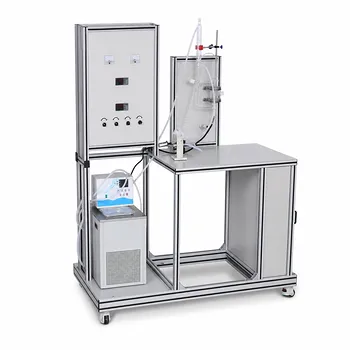
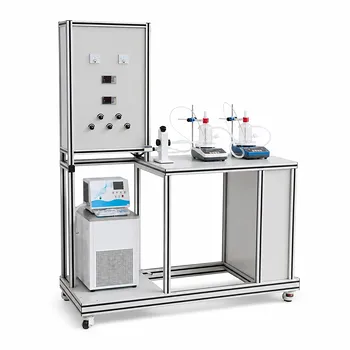
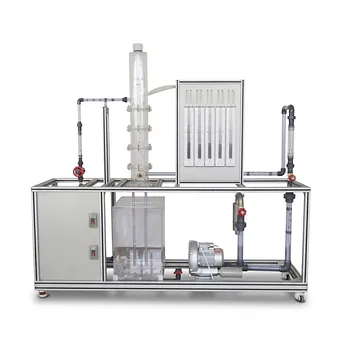
Vapor-liquid equilibrium predictions in teaching pilot plants for multicomponent hydrocarbon systems hinge on a single, elegant thermodynamic model. Chemical engineering unit operations pilot plants apply the Peng-Robinson (PR) equation of state because its simple two-constant cubic form enables students and researchers to perform vapor-liquid equilibrium (VLE) calculations analytically—without the iterative procedures required by more complex equations. By solving the PR equation for each component in a mixture, the pilot plant’s simulation software directly predicts equilibrium phase compositions, phase envelopes, and critical points with high accuracy, particularly in the challenging upper retrograde region of sour gas mixtures.
The PR equation's simplicity, combined with its superior accuracy near the critical region and for retrograde dew points, makes it the default choice for connecting theoretical VLE models to physical pilot plant data in multicomponent hydrocarbon systems. Its analytical solvability bridges textbook thermodynamics and real-time experimental observation.
Why the PR Equation is the Backbone of Pilot Plant VLE Studies
The Simplicity of a Two-Constant Cubic Equation
Unlike multiconstant equations of state that require heavy numerical iteration, the PR equation’s cubic form can be solved directly for vapor and liquid phase properties. This analytical approach is critical in a teaching environment, where students must instantly compare predicted K-values against the physical separation occurring in a running distillation or gas absorption column.
By reducing computational load, the PR equation allows pilot plant control systems to calculate real-time phase densities and component fugacities using standard mixing rules. This near-instant feedback loop reinforces thermodynamic concepts as students adjust process conditions.
Unmatched Performance for Retrograde Condensation
The primary reference highlights the PR equation’s key advantage: it provides significantly improved upper dew point predictions for sour gas mixtures in the retrograde region. In pilot plants handling natural gas or condensates, this translates to accurate identification of the pressure and temperature at which liquid first forms—critical for preventing unexpected two-phase flow in transfer lines.
Supplementary research confirms that PR predicts liquid volume percentages in the retrograde region with high fidelity, while the SRK equation overestimates liquid molal volumes. This precision is a direct learning objective, enabling students to observe retrograde behavior in a sight glass and validate it against their model.
Predicting Critical Points and Phase Envelopes
The PR equation calculates critical temperatures and pressures for mixtures with 3 to 12 components (paraffins, N2, CO2, H2S) with average errors of only ~1.31% in temperature and 2.33% in pressure. When students map a full phase envelope in a pilot plant reactor, the PR-based software generates a theoretical curve that aligns closely with experimental phase boundaries.
This accuracy is essential for safe process design: an offset in the predicted critical locus could lead to operating a separator in the two-phase region unintentionally. The PR model’s reliable critical-point prediction therefore doubles as a safety teaching tool.
How Pilot Plants Validate and Calibrate the PR Model
Generating Physical Data to Refine EOS Parameters
While the PR equation works well with standard pure-component parameters, real hydrocarbon feeds often contain ill-defined heavy fractions (C10+). Pilot plants allow researchers to measure actual phase compositions and densities, which are then used to fine-tune the equation’s binary interaction parameters or pseudo-component properties.
This calibration closes the gap between generic model predictions and the true behavior of a specific crude or condensate.
Handling Water and Polar Compounds with Interaction Parameters
The PR equation can be extended to three-phase vapor-liquid-liquid (VLL) equilibria, common when water is present in hydrocarbon streams. However, achieving accurate water dew point predictions requires a fitted binary interaction parameter for water-hydrocarbon pairs, derived from pilot plant data.
Students operating a steam distillation unit, for example, learn to adjust these parameters until the model matches the measured water content in the vapor phase, thereby preventing hydrate formation or corrosion.
Understanding the Trade-offs
Challenges Near the Critical Region and With Heavy Ends
Despite its advantages, the PR equation is not infallible. Its accuracy diminishes very close to the critical point of mixtures containing highly asymmetric components, and it struggles with heavy hydrocarbon fractions without tailored pseudo-component parameters.
In such cases, pilot plant data often reveal systematic deviations that must be corrected by incorporating more advanced characterization methods or alternative EOS models.
The Need for Pilot Plant Data to Complement Theory
All equations of state, including PR, can fail when complex polar interactions or solid phases appear. This limitation reinforces the indispensable role of the physical pilot plant.
The unit operations platform provides the empirical truth that no software can wholly replace, and the PR equation serves as a first-order interpretive lens rather than a perfect prediction tool.
Comparison With the SRK Model
The SRK equation, another two-constant cubic EOS, overestimates liquid molal volumes and shows a higher positive bias in vapor pressure predictions. The PR equation’s lower critical compressibility factor (0.307 vs. 0.333) yields 2 to 4 times better liquid density predictions.
For pilot plant column sizing and pressure drop calculations, this difference is not academic—it directly impacts the accuracy of hydraulic scaling.
Making the Right Choice for Your Goal
In a teaching pilot plant context, the decision of which model to prioritize depends on the educational and operational objectives:
- If your primary focus is rapid, analytical VLE calculations that can be directly compared with real-time pilot plant data: Rely on the PR equation’s closed-form solvability to give students immediate feedback on K-values and phase splits.
- If your pilot plant handles sour gas or condensates where retrograde condensation is a key phenomenon: The PR equation’s superior upper dew point prediction is non-negotiable—use it as the default and validate with physical sight-glass observations.
- If your system includes water or requires three-phase L1L2G modeling: Implement the PR EOS with carefully fitted water-hydrocarbon binary interaction parameters, refined using pilot plant composition measurements.
- If you are focusing on column hydraulics and density-driven pressure drops: Choose the PR equation over SRK to benefit from its 2–4× improvement in liquid density prediction, ensuring your pilot plant scale-up calculations are physically consistent.
Ultimately, the Peng-Robinson equation is not just a computational shortcut—it’s the critical bridge between thermodynamic theory and the tangible world of a running unit operations pilot plant, empowering students to see equations come alive in real phase separations.
Summary Table:
| Feature | Peng-Robinson (PR) Advantage | Educational & Practical Value |
|---|---|---|
| Solvability | Analytical cubic form (no heavy iteration) | Fast real-time student VLE feedback |
| Retrograde Region | Accurate upper dew point prediction | Safe, visible two-phase flow boundary mapping |
| Accuracy | Low error (~1.3% Temp, ~2.3% Press) | Reliable critical point & phase envelope modeling |
| Liquid Density | 2-4x better prediction accuracy than SRK | Precise column sizing and hydraulics calculations |
Bring Thermodynamic Theory to Life in Your Lab
LABPARK delivers advanced Educational and Vocational Unit Operations Pilot Plants in chemical engineering, bioprocess & biotech, and environmental & water treatment. Tailored for universities, research institutes, and enterprises, our systems provide the precise physical data needed to validate complex models like the Peng-Robinson equation in real time.
Ready to upgrade your teaching or research capabilities? Contact LABPARK today to explore our custom pilot plant solutions!
Related Products
- Binary System Vapor Liquid Equilibrium Data Determination Educational Unit Operations Pilot Plant
- Ternary Liquid-Liquid Equilibrium Educational Pilot Plant
- Comprehensive Liquid-Liquid Extraction Pilot Plant for Engineering Education
- Liquid-Liquid Mass Transfer Coefficient Determination Educational Pilot Plant
- Multi-Functional Special Distillation Educational Pilot Plant
People Also Ask
- How can pilot plants assist in validating VLE models? Bridge theory and physical reality.
- Why Collect Isothermal vs. Isobaric VLE Data? Key Pilot Unit Advantages
- How Do Equations of State Predict VLE in Pilot Plants? Optimize Your Separation Design
- How do intermolecular forces and molecular kinetic energy govern gas liquefaction and vaporization? Explore VLE pilot plants
- For VLE Experiments: Fugacity vs. Activity Coefficient Method Selection Criteria