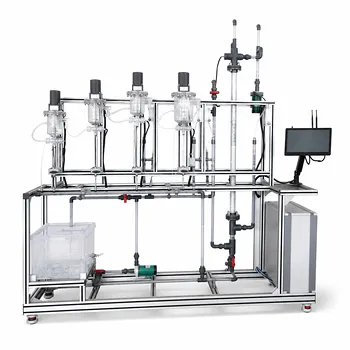
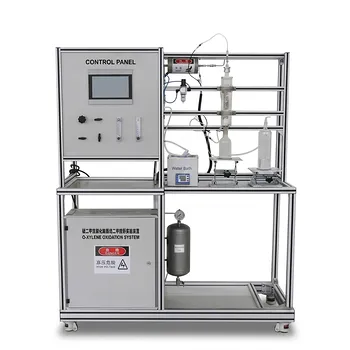
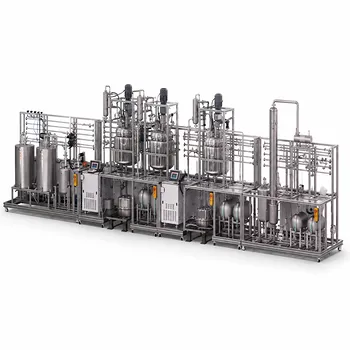
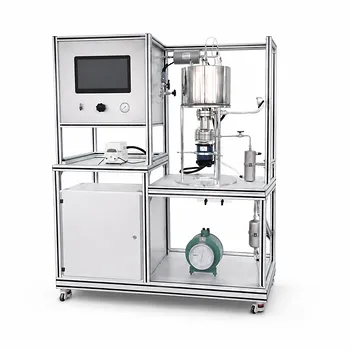
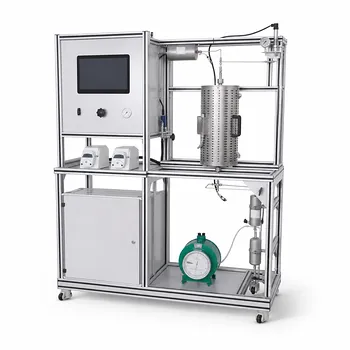
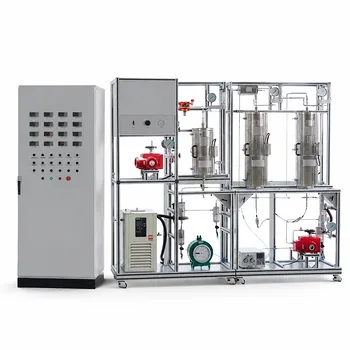
Precision in miniature. Chemical engineering reactor pilot plants replicate the extreme temperature control and composition analysis of high-temperature refining processes by integrating PID-controlled electric heating or induction furnaces with online analytical instruments like gas chromatographs and conductivity sensors. These systems are coupled to digital data acquisition platforms, enabling real-time monitoring and feedback that replace historical manual sampling and laboratory analysis.
Pilot plants are not merely scaled-down reactors—they are highly instrumented simulators. To mirror the thermal precision of an electric-furnace refining process, they use advanced heating systems and multi-point sensors governed by precise control algorithms. Simultaneously, they embed online analyzers and software loops that dynamically adjust feed rates to hold target purity and composition, transforming the plant into a living kinetic and thermodynamic experiment.
The Heart of Simulation: Temperature Control
PID Controllers and Electric/Induction Heating
The thermal core of a pilot plant is a closed-loop PID (Proportional-Integral-Derivative) controller paired with electric resistance heaters or induction furnaces.
These controllers continuously compare the measured temperature against a setpoint and modulate power output to eliminate error.
Electric heating elements provide rapid, clean heat, while induction furnaces deliver non-contact, highly localized heating ideal for melting and refining simulants.
Fighting the Enemy: The Surface-Area-to-Volume Trap
A small-scale reactor inherently has a much higher surface-area-to-volume ratio than a commercial furnace.
This makes it susceptible to significant heat loss, which could skew scale-up data.
Pilot plants compensate with high-quality insulation, multiple independent heating zones, and extensive temperature monitoring to replicate the quasi-adiabatic or controlled temperature profiles of full-scale operations.
Multi-Zone Sensing and Cooling Jackets
Beyond a single thermocouple, modern pilot units deploy multi-point temperature sensors to map axial and radial profiles in real-time.
This reveals hot spots that can degrade catalyst or trigger unexpected side reactions.
Integrated cooling jackets using thermal oil or pressurized water allow researchers to study heat transfer efficiency and safely manage exothermic excursions, exactly as they would in a production plant.
Real-Time Composition Analysis: The Digital Lab
From Grab Sample to Continuous Insight
Industrial high-temperature refining once relied on manual sampling and off-line analysis—a lag that made tight composition control nearly impossible.
Pilot plants bypass this delay with online analytical instruments such as gas chromatographs, pH sensors, and conductivity meters plumbed directly into the process stream.
These devices deliver composition data in seconds, not hours, enabling true real-time control.
The Data Acquisition and Feedback Loop
Streaming sensor data feeds into a digital data acquisition system that logs every parameter and calculates derived metrics like conversion and yield.
This information is then used by supervisory control algorithms to automatically adjust reagent feed rates, coolant flow, or power input.
For example, if gas chromatography shows a drop in product purity, the system can increase the refining time or temperature in a closed feedback loop, simulating the layered control strategies of a commercial furnace.
Why Precision is Non-Negotiable: The Deep-Science Foundation
Kinetics and the Exponential Lever of Temperature
According to the Arrhenius equation, the reaction rate constant ( k ) increases exponentially with temperature—a shift of just a few degrees can dramatically alter conversion.
In pilot plants, tight PID control allows a student or researcher to measure activation energies and verify kinetic models without the noise of thermal drift.
This is the same principle that ensures a commercial electric furnace doesn’t trap occluded gases due to a fleeting temperature dip.
Equilibrium Shifts and Thermodynamic Validation
For reactions like nitrogen dioxide dissociation or ammonia synthesis, the equilibrium constant ( K ) is hypersensitive to temperature (e.g., leaping from 0.36 at 373 K to 3.2 at 423 K).
A pilot plant that holds a setpoint within ±0.5 °C enables the accurate mapping of ( \ln K ) versus ( 1/T ) to calculate standard Gibbs free energy changes and validate thermodynamic models—essential for scaling up equilibrium-limited processes.
Selectivity and Optimal Temperature Profiles
When parallel reactions compete, selectivity is governed by the difference in activation energies.
If the desired pathway has a higher activation energy, a higher temperature boosts yield—but only if it can be precisely controlled to avoid over-cooking.
Pilot plants with programmable temperature ramps let researchers maximize target product yield by executing a bespoke thermal profile, validating the same Arrhenius-based selectivity equations used in industry.
Safety, Hot Spots, and Catalyst Health
Uncontrolled hot spots can trigger thermal runaway or sinter catalysts.
Multi-point temperature sensors in a pilot unit map the moving hot spot as catalyst activity declines, mimicking the life cycle of an industrial bed.
This allows operators to practice compensating strategies—adjusting inlet temperature or coolant flow—and learn the warning signs long before stepping onto a commercial plant floor.
Understanding the Trade-offs
While pilot plants offer extraordinary control, they come with inherent limitations.
- Heat loss compensation can mask scale-up issues. The aggressive insulation and extra heating zones required to counter the high surface-area-to-volume ratio may hide a reaction’s true propensity to generate or lose heat at scale. A reactor that appears thermally stable in the pilot plant can face runaway conditions when insulation is less dominant in a large vessel.
- Online analyzers add complexity and drift. Gas chromatographs need regular calibration and carrier gas supply; pH probes foul at high temperatures. The data is only as good as the maintenance schedule, and a sensor failure can derail an entire experimental campaign.
- Cost and infrastructure. Multi-zone PID systems with high-end mass flow controllers and spectrometers are capital-intensive, limiting their availability to well-funded research labs. The skill floor for operating and troubleshooting them is also high.
- Not all physical phenomena scale linearly. Mixing patterns, radiation heat transfer, and electrode positioning in electric-furnace refining can be challenging to mimic in a small pilot unit, meaning composition control at pilot scale may not perfectly capture the industrial reality.
Making the Right Choice for Your Pilot Plant Goals
Your experimental objectives dictate how you configure temperature and composition control systems.
- If your primary focus is kinetic research and activation energy measurement: Prioritize a reactor with a low-thermal-inertia heating source (like an oil-jacketed vessel or small induction coil) and a high-precision PID controller with data logging. Calibratable online sensors (pH, FTIR) are more critical than exhaustive multi-zone mapping.
- If your primary focus is scale-up and commercial feasibility: Invest in a multi-zone pilot plant with realistic insulation, redundant temperature sensors, and a cooling jacket system that can replicate your target plant’s heat removal rate. Neglecting the surface-area-to-volume heat loss effect here can lead to dangerous overestimations of thermal stability.
- If your primary focus is catalyst aging and safety studies: Use a fixed-bed reactor with axially distributed thermocouples to track hot spot migration. Combine this with an online gas chromatograph to correlate temperature profile movement with declining selectivity, directly mimicking industrial catalyst life cycles.
- If your primary focus is equilibrium and thermodynamic validation: A gold-standard PID temperature control (±0.1 °C) with gentle, uniform heating (to prevent gradients) and a reliable composition analyzer (e.g., gas chromatograph or mass spectrometer) is non-negotiable. You need absolute confidence in your constant-temperature assumption to derive valid ΔG° values.
A well-designed pilot plant does not just replicate a high-temperature refinery—it makes the invisible dynamics of kinetics, equilibrium, and heat transfer visible and controllable. By carefully matching your instrumentation to your actual research goal, you convert a mere simulation into a true engine for chemical understanding.
Summary Table:
| Simulation Challenge | Pilot Plant Technology | Key Purpose & Benefit |
|---|---|---|
| Temperature Precision | PID Controllers & Induction/Electric Heaters | Rapid, closed-loop error correction and localized heating |
| Heat Loss (Scale-up Trap) | Multi-zone heating & high-quality insulation | Counters high surface-area-to-volume ratio to mimic large-scale profiles |
| Thermal Profiles & Safety | Multi-point sensors & cooling jackets | Maps axial/radial profiles, manages hot spots, and prevents runaways |
| Composition Analysis | Online GCs, pH, and conductivity sensors | Replaces slow manual sampling with real-time feedback loops |
Scale Up Your Research with Precision
To translate complex kinetics and thermodynamics into viable industrial processes, you need pilot systems that deliver absolute control.
LABPARK provides state-of-the-art Educational and Vocational Unit Operations Pilot Plants in chemical engineering, bioprocess & biotech, and environmental & water treatment. Designed specifically for universities, research institutes, and enterprises, our pilot plants feature industry-grade PID temperature control, advanced multi-zone monitoring, and integrated online analytical systems to ensure your scale-up data is flawless.
Take the guesswork out of reactor design—contact our technical specialists today to find the perfect pilot plant configuration for your laboratory.
Related Products
- Fixed Bed Gas Solid Catalytic Reaction Educational Pilot Plant
- Multi-Reactor Educational Pilot Plant for Reaction Engineering Unit Operations
- Residence Time Distribution and Reactor Flow Characteristics Determination Educational Pilot Plant
- Fixed-Bed Chemical Reaction and Gas Dust Tar Removal Unit Operations Pilot Plant
- Tubular Reactor Flow Characteristics Determination Educational Unit Operations Pilot Plant
People Also Ask
- How do reactor pilot plants safely study gas-solid reactions? Master kinetics with thermal & flow control.
- How does the Mears criterion evaluate transport resistance? Key Guide to Intrinsic Kinetics
- Why is a multibed configuration necessary for exothermic reactions? Optimize your pilot plant trajectory.
- Fluidized vs. Fixed Bed Reactors: Comparing Heat & Complexity in Pilot Plants
- How is the friction factor determined for fixed-bed pilot plants? Select the best pressure drop correlation.