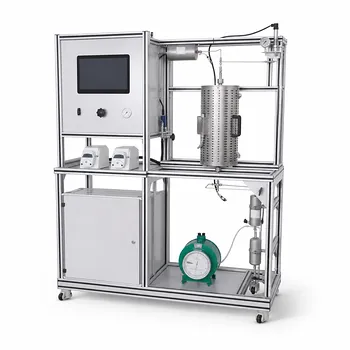
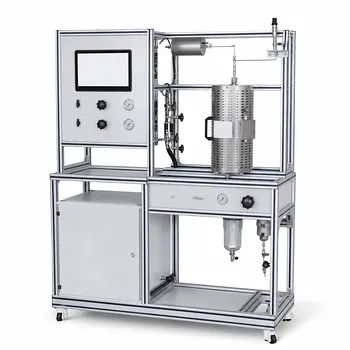
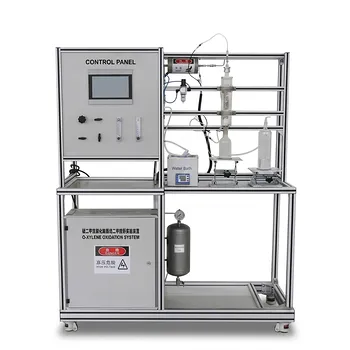
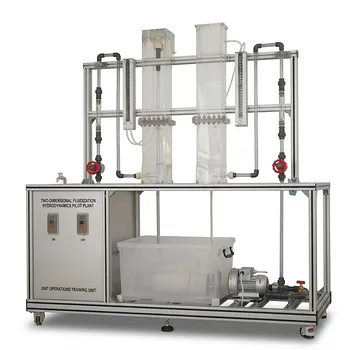
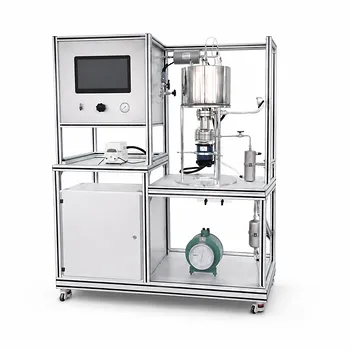
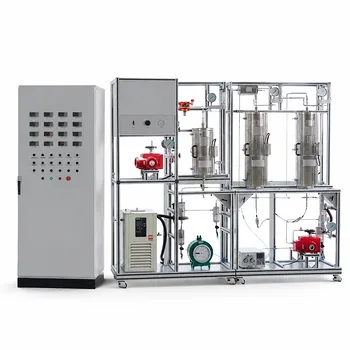
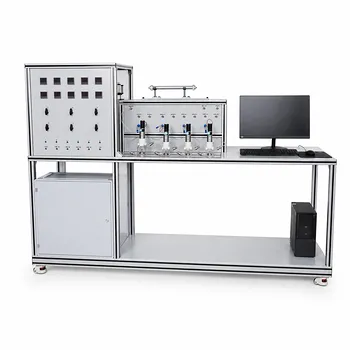
For every student or researcher working with heterogeneous catalysis, the difference between a successful experiment and a dangerous thermal runaway often comes down to a single choice: fixed bed or fluidized bed.
Reactor pilot plants are the only safe, controlled environment where these two configurations can be directly compared for the same catalytic reaction. They allow you to measure real-time temperature profiles, quantify heat transfer rates, and observe catalyst behavior under thermal stress—transforming abstract textbook concepts into tangible, empirical knowledge.
Pilot plants reveal the critical thermal trade-off: fluidized beds deliver near-perfect temperature uniformity and inherently safer operation for exothermic reactions, while fixed beds are simpler but require careful engineering to prevent localized hot spots that can trigger runaway. By operating both side-by-side in a pilot facility, students and researchers directly experience how heat management dictates reactor safety and catalyst lifetime.
Understanding the Two Thermal Realities
The Fixed Bed Dilemma – Hot Spots and Runaway Risk
In a fixed bed reactor, catalyst particles remain stationary while reactants flow through the bed. For exothermic reactions, the limited radial heat transfer and poor mixing create axial and radial temperature gradients.
Heat accumulates at specific points, forming localized hot spots that can initiate thermal runaway if not controlled. This is especially dangerous in reactions like ethylene oxychlorination, where a runaway can destroy catalyst and compromise safety.
The Fluidized Bed Solution – Isothermal Safety Through Mixing
A fluidized bed suspends catalyst particles in an upward gas flow, creating intense solid-fluid mixing. The constant particle motion equalizes temperature across the entire bed almost instantly.
This eliminates hot spots and produces highly uniform bed temperatures, even for strongly exothermic processes like benzene or acrylonitrile synthesis. From a safety standpoint, the reactor behaves as if it were isothermal, drastically reducing runaway risk.
The Pilot Plant as a Comparative Laboratory
Measuring Temperature Profiles in Real Time
Multipurpose pilot plants are equipped with thermocouples placed at multiple axial and radial positions. By running the same heterogeneous reaction in both reactor types, researchers directly map how a fixed bed develops sharp temperature peaks while the fluidized bed profile remains flat.
Students can watch these real-time data streams and see how exothermicity translates into a thermal gradient—an insight no lecture slide can replicate.
Quantifying Heat Transfer Coefficients
Pilot-scale experiments let you calculate heat transfer coefficients directly. Fluidized bed systems routinely achieve values around 200 W/(m²·°C), often an order of magnitude higher than a comparable fixed bed.
When you measure the cooling duty required to maintain a set temperature, you see firsthand why multi-tubular fixed bed reactors need a heat exchange area up to ten times larger to handle the same duty. This direct comparison cements the engineering rationale behind reactor selection.
Visualization of Fluidization and Attrition
Pilot plants with transparent sections or digital imaging allow observation of fluidization dynamics. Students see how finely powdered catalyst (typically under 300 μm) becomes fluid-like and how gas-solid separation devices like cyclones are needed to recover fines.
They also witness the mechanical stress firsthand: catalyst particles collide, wear down, and generate dust. This teaches the fundamental trade-off between thermal uniformity and catalyst mechanical durability.
Safety Insights: Preventing Runaway and Protecting Catalysts
Hot Spot Ignition Risks in Fixed Beds
During a pilot plant exercise, a deliberate reduction in coolant flow to a fixed bed reactor will show a rapid temperature spike at the hot spot. This mimics what can happen in industry when cooling fails.
The lesson is visceral: once a hot spot forms, it can accelerate the reaction rate locally, creating a positive feedback loop toward thermal runaway. Pilot plants demonstrate why multi-stage adiabatic beds or continuous heat exchange are mandatory for highly exothermic chemistry.
Thermal Uniformity and Catalyst Life in Fluidized Beds
In the fluidized bed pilot, the same exothermic run shows no such spike. The heat is instantly dispersed, protecting the catalyst from sintering and byproduct formation.
However, the pilot also reveals the safety limitation: if the gas distributor fails or the particle size distribution is wrong, fluidization can collapse, leading to a sudden loss of mixing and potential hot spot formation. This teaches holistic process safety management.
Understanding the Trade-offs
No single reactor type is universally better. Pilot plants exist to expose these trade-offs objectively.
- Operational complexity: A fixed bed pilot reactor is plug-and-play for a lab—simple to load, run, and model. A fluidized bed requires careful particle size control, stable gas flow, cyclone maintenance, and pressure drop monitoring. The learning curve is steeper, but the thermal control reward is enormous.
- Catalyst wear and recovery: Fluidized beds continuously erode catalyst, demanding high-strength particles and downstream separation equipment. Fixed beds suffer virtually no abrasion, but replacing catalyst is labor-intensive. Pilot runs that measure attrition rates and catalyst fines carryover demonstrate this operational cost directly.
- Scale-up realism: Fixed bed hydrodynamics scale predictably from a 13 mm pilot tube to a 3–9 m industrial bed in a single step. Fluidized bed scale-up is notoriously non-linear; pilot studies often need to increase size by only one or two orders of magnitude per stage. Having both units available lets students confront why fluidization is so difficult to scale.
Making the Right Choice for Your Goal
Your pilot plant’s configuration should align with what you need to learn or prove. Use these decision criteria:
- If your primary focus is teaching thermal safety and runaway prevention: Choose a pilot setup that allows side-by-side comparison of a fixed bed and a fluidized bed. Let students trigger hot spots in the fixed bed under controlled conditions and observe the fluidized bed’s isothermal stability. This leaves the strongest safety imprint.
- If your primary focus is catalyst durability and attrition studies: A fluidized bed pilot plant is essential. You can quantify particle breakage, test alternative catalyst formulations, and optimize cyclone performance, all while maintaining excellent temperature control that keeps the experiment consistent.
- If your primary focus is performing kinetic studies with minimal complexity: Start with a fixed bed pilot reactor operating in plug-flow mode. The simple hydrodynamics make data interpretation straightforward, and you can later move to a fluidized bed only after understanding the intrinsic kinetics.
- If your primary focus is scalable process development for highly exothermic reactions: A fluidized bed pilot plant provides the heat transfer data and temperature uniformity you need. Just budget for multi-step scale-up, as direct jump from pilot to plant is rarely feasible.
The true power of a pilot plant is not just answering “which reactor is better,” but giving you the physical intuition to predict thermal behavior, manage catalyst life, and design inherently safer processes—skills that define a seasoned chemical engineer.
Summary Table:
| Feature | Fixed Bed Reactor | Fluidized Bed Reactor |
|---|---|---|
| Temperature Profile | Axial & radial gradients (hot spots) | Isothermal (highly uniform) |
| Thermal Runaway Risk | High; requires precise cooling control | Low; excellent heat dissipation |
| Heat Transfer Coefficient | Low; requires larger heat exchange area | High; routinely reaches ~200 W/(m²·°C) |
| Catalyst Wear & Attrition | Minimal particle damage or attrition | High; requires cyclone separation |
| Scale-up Predictability | High; predictable linear scale-up | Low; highly non-linear scale-up |
Bring Industrial Realism to Your Chemical Engineering Lab
Equip your students and researchers with the tools to master process dynamics, thermal safety, and reactor scale-up. LABPARK provides state-of-the-art Educational and Vocational Unit Operations Pilot Plants in chemical engineering, bioprocess & biotech, and environmental & water treatment. Specifically designed for universities, research institutes, and enterprises, our systems deliver safe, hands-on learning environments that bridge theory and practice.
Ready to upgrade your lab facilities? Contact us today to explore our pilot plant solutions!
Related Products
- Fixed Bed Gas Solid Catalytic Reaction Educational Pilot Plant
- Multi Functional Catalytic Reaction and Reactor Evaluation Educational Unit Operations Pilot Plant
- Fluidized Bed Gas Solid Catalytic Reaction Educational Pilot Plant
- Ethylbenzene Dehydrogenation Educational Unit Operations Pilot Plant
- Multi-Reactor Educational Pilot Plant for Reaction Engineering Unit Operations
People Also Ask
- How to determine catalyst pore radius & porosity? Optimize your chemical engineering pilot plant.
- How does identifying the rate-limiting step optimize reaction conditions? Pilot Plant Guide
- How do reactor pilot plants safely study gas-solid reactions? Master kinetics with thermal & flow control.
- How does the Mears criterion evaluate transport resistance? Key Guide to Intrinsic Kinetics
- Fluidized vs. Fixed Bed Reactors: Comparing Heat & Complexity in Pilot Plants