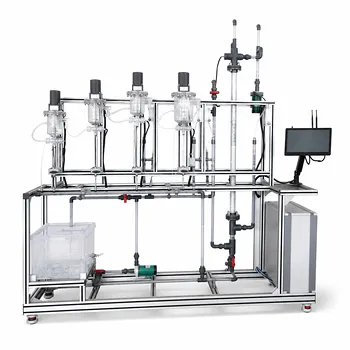
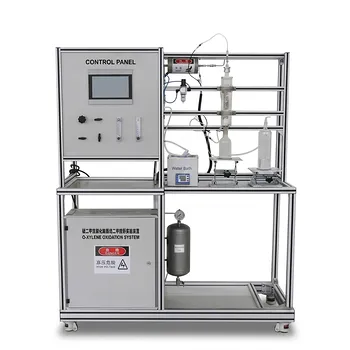
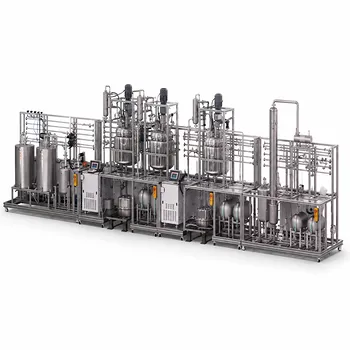
The missing link between a laboratory exotherm and a safe industrial plant is a number—the heat transfer coefficient. Chemical engineering reactor pilot plants determine the reaction heat and heat transfer coefficients by operating as precision calorimeters. Using a jacketed vessel with continuous jacket and reactor temperature monitoring, plus a built-in calibration heater, they experimentally measure the overall heat transfer coefficient (U) and available area (A). Once the UA is known, the pilot plant can directly calculate the instantaneous heat release rate of a reaction, integrate it to find the total reaction enthalpy, and provide the data needed to size industrial cooling systems.
The deep challenge of scaling up an exothermic process is that heat generation grows with volume, but heat removal capacity grows with surface area. A pilot plant bridges this gap by transforming temperature measurements into the essential thermal parameters—UA and ΔH—that let engineers quantify heat removal limits, prevent thermal accumulation, and design safe, productive full-scale reactors.
The Unforgiving Thermodynamics of Scale-up
Exothermic reactions behave like a wildfire trapped in a shrinking cage as volume increases. At small laboratory scale, a flask’s high surface-area-to-volume ratio dissipates heat easily. Industrial reactors, however, often have ratios that are 3–4 times lower, making passive cooling far less effective.
Why Surface Area Is a Hard Limit on Safety
Heat flow through a reactor wall is proportional to the heat transfer area, but total heat generated is proportional to the batch volume. As the reactor grows linearly, the heat transfer area scales with $L^2$, while the heat load scales with $L^3$. This fundamental mismatch means that a reaction that appears thermally benign in a beaker can spiral into a thermal runaway in a production vessel.
The Risk of Hidden Heat Accumulation
If heat removal cannot keep pace with heat generation, the reaction temperature rises unchecked. This temperature rise accelerates the reaction rate, which in turn generates even more heat—a vicious cycle. Pilot plants allow engineers to quantify the precise capacity of a given jacket configuration, so the cooling system can be designed to break this cycle before it starts.
How a Pilot Plant Turns Temperature Data into Thermal Insight
The principle is heat-flow calorimetry, and the instrument is the jacketed pilot reactor itself. By treating the reactor as a calorimeter, the plant measures the thermal signature of a process directly, without relying solely on theoretical calculations.
The Principle of Heat-Flow Calorimetry
Heat-flux measurement starts with monitoring the temperature difference between the reactor contents ($T_R$) and the jacket fluid ($T_J$). This gradient drives heat transfer. A simple energy balance equates the heat flow through the jacket to the reaction’s heat generation minus any accumulation, making it possible to track real-time thermal power.
The Role of the Calibration Heater
An integrated calibration heater is the key to turning a temperature difference into a true heat transfer coefficient. By supplying a known, precisely measured electric power (Q) to the reactor contents and measuring the resulting steady-state temperature difference, the system calculates the product U·A. Since the heat transfer area A is known from the vessel’s geometry, the overall heat transfer coefficient U is directly obtained. This calibration can be performed before, after, or even during experiments using solvent trials or mock batches.
From UA to Reaction Enthalpy
Once U·A is known, the pilot plant converts every temperature measurement into a heat flow value. During an actual reaction, the system continuously multiplies U·A by the measured ΔT to produce an instantaneous heat release rate. Integrating this profile over the entire reaction time yields the total enthalpy change (ΔH). This practical measurement bridges the gap between textbook Hess’s Law calculations and the real-world release of energy at an intermediate scale.
Data That De-Risks Industrial Scale-up
Pilot-plant-derived UA and ΔH do more than satisfy a lab report; they are the bedrock of a safe reactor design. They let engineers calculate the maximum allowable temperature excursion, size relief systems, and design cooling jackets or internal heat transfer tubes with confidence.
Evaluating Heat Removal Limits
With a measured UA, you can predict exactly how much heat a full-scale jacket can remove at a given cooling fluid temperature and flow rate. This removes guesswork. The pilot plant data reveals whether the proposed cooling scheme can keep the reaction within safe operating limits even if the rate doubles due to catalyst aging or a control failure.
Preventing Hazardous Thermal Accumulation
Thermal accumulation happens when the reaction generates heat faster than the jacket can remove it, even under maximum cooling. By matching the measured heat generation rate to the cooling capacity calculated from UA, a pilot plant study clearly flags the conditions—temperature, concentration, catalyst loading—where accumulation begins. You can then define safe operating windows and automated shutdown triggers before moving to production.
Validating Kinetic Models at a Meaningful Scale
The UA value allows researchers to decouple true reaction kinetics from heat transfer artifacts. When scaling up, apparent reaction rates can be distorted by temperature gradients. With accurate heat transfer coefficients, the reaction’s intrinsic rate constants and activation energies can be extracted from pilot data. These validated models then predict full-scale behavior, including selectivity and byproduct formation, in flow-through units like fixed-bed or fluidized-bed reactors.
Understanding the Trade-offs and Limitations
A pilot plant is an excellent thermal mimic, but it is not a perfect one. Recognizing the gaps ensures that data is applied with the right safety margins and engineering judgment.
Mixing and Flow Patterns Are Not Identical
Heat transfer coefficients depend on fluid velocity and turbulence near the jacket wall. A pilot-scale agitator can be tuned to match the tip speed or power-per-volume of the full-scale design, but exact geometric similarity is rarely perfect. This means the measured UA may need to be correlated with dimensionless numbers (Nusselt, Reynolds) for precise scale-up, rather than being used as a fixed constant.
Fouling and Surface Condition Evolve
Plant vessels typically experience fouling or corrosion that lowers U over time. A clean pilot reactor may give a “best-case” coefficient. To be conservative, scale-up should incorporate a fouling factor based on experience or parallel material compatibility tests, or the pilot plant itself can be operated for extended runs to track degradation.
Extrapolation Beyond the Data Range
Pilot plants typically operate at 10–20% of the industrial capacity, so some extrapolation is inevitable. The measured UA at the pilot’s surface-area-to-volume ratio must be translated to the larger vessel’s geometry and jacket design. This is where the separate determination of U and A becomes powerful—U often remains scale-independent for similar hydrodynamics, while A is a design variable.
Making the Right Choice for Your Scale-up Study
Your pilot plant strategy should match your primary objective. Focus on the measurements that directly serve your safety and design needs.
- If your primary focus is preventing thermal runaways: Prioritize measuring UA under worst-case conditions—maximum reaction temperature, lowest expected jacket flow rate, and highest viscosity. Use that data to define the lowest safe cooling capacity and set hard limits.
- If your primary focus is generating accurate kinetic models: Use the pilot plant as a calorimeter to measure heat flow and separate thermal effects from the concentration-time profiles. Validate the model by predicting the reaction’s temperature rise under several different operating conditions.
- If your primary focus is designing the industrial cooling system: Extract the overall heat transfer coefficient U from pilot data, then multiply by the full-scale area A and apply a conservative fouling factor. Confirm that the commercial jacket size can handle the peak heat release rate measured in the pilot plant.
By treating a pilot reactor as a living calorimeter, you replace dangerous assumptions with measured truths, directly linking the laboratory recipe to a safe, scalable, and profitable process.
Summary Table:
| Parameter / Concept | How Measured / Calculated | Importance in Scale-up |
|---|---|---|
| Overall Heat Transfer Coefficient (U) | Measured via calibration heater and steady-state $\Delta$T | Determines heat removal capacity of full-scale jacket |
| Reaction Enthalpy ($\Delta$H) | Integration of heat flow ($U \times A \times \Delta$T) over time | Quantifies total heat load to size industrial cooling |
| Surface-to-Volume Ratio ($A/V$) | Calculated from vessel geometry ($L^2$ vs $L^3$) | Identifies cooling limits as reactor scale increases |
Are you scaling up exothermic processes or training the next generation of chemical engineers? LABPARK provides state-of-the-art Educational and Vocational Unit Operations Pilot Plants in chemical engineering, bioprocess & biotech, and environmental & water treatment. Specifically designed for universities, research institutes, and enterprises, our systems deliver the precise thermodynamic data required to bridge the gap between laboratory research and safe industrial production.
Contact LABPARK today to find the ideal pilot plant solution for your institution or facility!
Related Products
- Fixed Bed Gas Solid Catalytic Reaction Educational Pilot Plant
- Multi-Reactor Educational Pilot Plant for Reaction Engineering Unit Operations
- Residence Time Distribution and Reactor Flow Characteristics Determination Educational Pilot Plant
- Fixed-Bed Chemical Reaction and Gas Dust Tar Removal Unit Operations Pilot Plant
- Tubular Reactor Flow Characteristics Determination Educational Unit Operations Pilot Plant
People Also Ask
- How do reactor pilot plants safely study gas-solid reactions? Master kinetics with thermal & flow control.
- How does the Mears criterion evaluate transport resistance? Key Guide to Intrinsic Kinetics
- Fluidized vs. Fixed Bed Reactors: Comparing Heat & Complexity in Pilot Plants
- Why is a multibed configuration necessary for exothermic reactions? Optimize your pilot plant trajectory.
- How is the friction factor determined for fixed-bed pilot plants? Select the best pressure drop correlation.