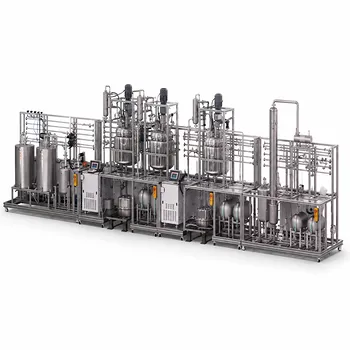
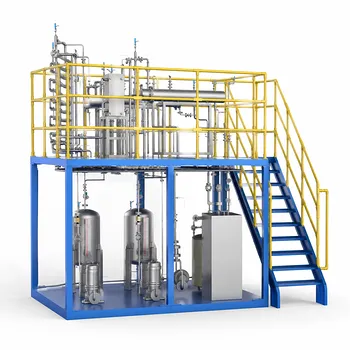
What separates a textbook-scale experiment from a scalable industrial process?
The answer lies in predictability. When planning laboratory curricula or research projects, academic and research labs use chemical engineering rules of thumb: operations like reactors, extraction units, and dryers/solids‑handling systems almost always require pilot‑plant verification because their scale‑up behavior is inherently complex. Single‑phase fluid flow and standard distillation typically do not—unless a specific complication arises, such as foaming in a distillation column or two‑phase flow dynamics. The decision is less about rigid checklists and more about evaluating how confidently you can model the governing physics at a larger scale.
The need for pilot‑plant testing is driven by the certainty (or lack thereof) in underlying transport phenomena. High‑risk, multiphase, or kinetically‑sensitive operations demand physical verification before committing to a full‑scale design or embedding them in a curriculum. Conversely, operations governed by well‑characterized, single‑phase correlations can often be validated through simulation alone—unless a known anomal
y introduces unpredictability.
The Predictability Principle: Why Some Processes Scale Easily
Single‑phase fluid flow stands on a robust foundation of empirical correlations and computational fluid dynamics.
Friction factors, pump curves, and pressure‑drop calculations for a pipe are sufficiently accurate that a pilot‑scale flow loop rarely reveals new physics.
Standard distillation benefits from decades of equilibrium‑stage modeling and reliable property data.
When the mixture exhibits ideal behavior and no unexpected phase interactions, a pilot column offers little verification beyond what a process simulator already provides.
These operations become a candidate for pilot‑plant testing only when a disrupting phenomenon enters the picture—for instance, severe foaming that invalidates tray efficiency assumptions, or a two‑phase flow regime that cannot be predicted with simple models.
Complex Transport Phenomena That Demand Pilot Verification
Certain unit operations resist purely mathematical scale‑up because their performance hinges on interactions that change non‑linearly with size. Labs and research groups treat pilot testing here not as optional, but as essential.
Reactors: When Kinetics Meet Mixing at Scale
A small glass beaker can give a perfect rate constant from an integrated rate equation—a first‑order reaction shows a tidy linear plot of $\lg(A)$ versus time, a second‑order reaction a linear $1/(B)$ plot.
But that kinetic model is only half the story. At pilot scale, mixing times, heat removal, and mass transfer between phases shift drastically, often invalidating the lab‑derived rate law for large vessels.
Pilot‑scale reactors, especially continuous stirred‑tank reactors (CSTRs) and batch units, allow researchers to introduce realistic process upsets and collect multivariate data that validate or correct their kinetic models.
They become the proving ground for scale‑up of residence time distribution, hot‑spot formation, and side‑reaction selectivity—critical unknowns that cannot be answered by simulation alone.
Extraction and Multi‑Phase Mass Transfer
Liquid‑liquid extraction units top the list of operations that “almost always” require pilot plant testing.
The mass transfer coefficient depends on interfacial area, droplet size distribution, and holdup—all of which scale in a notoriously unpredictable manner.
A pilot extraction column lets researchers verify the hydrodynamic regime (spray, pulsed, packed), confirm the effect of solvent‑to‑feed ratio at realistic throughput, and measure actual recovery rates.
These experiments provide the physical data needed to validate thermodynamic models and refine simulation predictions—particularly when novel solvent systems are involved.
Dryers and Solids Handling
Dryers and solids‑conveying systems are another category where scale‑up complexity compels pilot testing.
Particle size, moisture diffusion pathways, and agglomeration behavior are exquisitely sensitive to the size and geometry of the equipment. A benchtop tray dryer tells you nothing about the residence time distribution and channeling in a continuous fluidized‑bed dryer.
Pilot‑scale drying units therefore serve as risk‑mitigation tools, ensuring that the final product’s residual moisture, particle integrity, and flowability meet specifications before millions are spent on a full‑scale unit.
When ‘Standard’ Operations Become Exceptions
Even distillation, often cited as a predictable operation, can cross into pilot‑necessary territory under the right complications.
The primary reference flags two: foaming that destabilizes tray hydraulics and two‑phase flow that defies standard pressure‑drop correlations. In such cases, relying solely on simulation is a gamble.
Educational pilot plants with transparent columns—glass distillation or absorption towers—are invaluable here.
They allow students and researchers to visually observe hydrodynamic phenomena (flooding, weeping, packing wetting) that govern column efficiency. When the process fluid is unfamiliar, those visual observations become essential verification of column internals design, far beyond what a computational model can deliver.
A similar logic applies to any unit operation where safety is non‑negotiable. Operations at pressures of 10 or 25 bar, with corrosive media, automatically demand pilot‑scale testing on systems built with the correct metallurgy (e.g., stainless steel 304 or 316) and instrumented with pressure relief valves, burst discs, and alarms. Here the pilot plant verifies safe operating limits, not just performance.
The Decision‑Making Framework for Academic and Research Labs
To systematically determine which unit operations need pilot verification, laboratories—whether designing a teaching curriculum or a research project—apply a layered assessment that goes beyond the rules of thumb.
-
Classify by transport phenomena. Unit operations fall into momentum, heat, mass, or simultaneous heat‑and‑mass transfer. A well‑rounded teaching lab will select pilot plants across these categories to cover core curriculum requirements. In research, this classification reveals inherent complexity: simultaneous heat‑and‑mass processes (drying, crystallization) almost always need pilot data.
-
Evaluate the novelty of the system. For a well‑characterized binary distillation with standard internals, a pilot plant offers little new insight. For a novel reactive distillation with an unproven catalyst, the pilot column becomes the only way to verify before scale‑up.
-
Assess safety and material compatibility. A corrosive reagent or high‑pressure reactor pushes the decision toward pilot verification—not just for data, but to validate the integrity of the equipment under controlled conditions with proper utility support (correct voltage, cooling water flow, ventilation).
-
Align with educational or process‑chain coverage. In vocational training, labs often configure pilot plants to simulate an entire industrial sequence: raw material preparation → reaction → separation → recovery → waste treatment. The “verification” becomes proving that students can balance capacities and implement continuous control, rather than testing a single unit’s scale‑up.
-
Match utility infrastructure. A pilot plant cannot verify anything if the lab lacks the required electrical capacity, steam supply, or safe drainage. An honest infrastructure audit often rules out certain pilot operations or forces a scaled‑down, modular approach.
Understanding the Trade‑offs: Cost, Time, and Pedagogical Value
Pilot‑plant testing is never free. The upfront investment in equipment, utilities, safety systems, and lab space can be substantial.
Research groups must weigh whether the risk of not piloting—a failed scale‑up, a safety incident, or a flawed kinetic model—justifies that investment.
For educational institutions, the trade‑off is pedagogical. A pilot‑scale distillation column that could be replaced by a simulator might still be worth installing if it visually demonstrates phenomena that textbooks cannot convey. Yet every meter of lab space taken by a pilot plant is space not available for another unit. Curricular designers must therefore verify not process performance but learning outcomes: does the operation instill the principles of kinetics, transport, and control that the programme demands?
Another common pitfall is over‑piloting. A lab that builds a full‑scale replica of an industrial plant for every single unit operation may exhaust its budget without generating proportionally more insight. The art is selecting the high‑leverage points—the reactor, the crystallizer, the drying loop—where pilot testing fundamentally changes confidence in the design or the student’s understanding.
Making the Right Choice for Your Goal
Which operations you verify at pilot scale depends entirely on your primary objective. Use these goal‑focused guidelines to prioritise.
- If your primary focus is building a comprehensive teaching laboratory: Choose pilot plants that span all transport‑phenomena categories (momentum, heat, mass, simultaneous) and can be linked into a complete process chain. The verification is of curricular coverage and hands‑on skill development, not industrial scale‑up.
- If your primary focus is researching a novel reaction, solvent, or separation sequence: Pilot testing is mandatory for reactors, extraction, and dryers. For distillation or single‑phase flow, you may bypass it—unless you anticipate foaming, two‑phase flow, or atypical phase behaviour, in which case a pilot column or flow loop becomes a critical verification tool.
- If your primary focus is process safety and regulatory confidence: Any operation involving high pressure, corrosive materials, or uncharacterised kinetics demands pilot‑plant verification with correct materials of construction and engineered relief systems to validate safe operating boundaries before full‑scale implementation.
Ultimately, pilot‑plant verification is a strategic risk‑management decision. By grounding your choices in the predictability of transport phenomena, the novelty of the system, and the true goal of your laboratory, you can deploy these powerful teaching and research tools where they deliver the greatest certainty—and the deepest understanding.
Summary Table:
| Unit Operation Category | Pilot Verification Required? | Key Driving Factors / Exceptions |
|---|---|---|
| Single-Phase Fluid Flow | Rarely | Highly predictable; only needed for complex two-phase flow or atypical geometries. |
| Standard Distillation | Rarely | Well-characterized; required if foaming, two-phase flow, or unknown phase behaviors occur. |
| Chemical Reactors | Almost Always | Scale-up kinetics, mixing times, heat removal, and mass transfer are highly non-linear. |
| Extraction & Mass Transfer | Almost Always | Unpredictable droplet size distribution, interfacial area, and holdup at larger scales. |
| Dryers & Solids Handling | Almost Always | Particle size, moisture diffusion, and agglomeration are highly sensitive to equipment size. |
Empower Your Lab with LABPARK's Industry-Grade Pilot Plants
Are you looking to bridge the gap between classroom theory and industrial application? LABPARK provides premium Educational and Vocational Unit Operations Pilot Plants in chemical engineering, bioprocess & biotech, and environmental & water treatment.
Specially designed for universities, research institutes, and enterprises, our pilot plants ensure safe operation, precise control, and reliable data generation for your curricula or scale-up research.
Contact LABPARK today to discuss your laboratory infrastructure and find the ideal custom pilot solutions for your team!
Related Products
- Carbon Dioxide Hydrogen Methanol Synthesis Educational Unit Operations Pilot Plant
- Multi Pump Fluid Transport Process Piping Unit Operations Training Pilot Plant
- Natural Product Extraction Unit Operations Training Pilot Plant
- Multi-Modal Distillation Unit Operations Training Pilot Plant
- Multi-Reactor Educational Pilot Plant for Reaction Engineering Unit Operations
People Also Ask
- How do temp & pressure affect methanol synthesis pilot plants? Optimize equilibrium and catalyst performance.
- Why is a purge system necessary when operating a gas recirculation loop in a methanol synthesis pilot plant? (Guide)
- Why do modern methanol pilot plants operate at lower pressures? Catalyst & Feed Requirements Explained
- What are the operational requirements for catalyst activation? Safe Methanol Pilot Plant Operation
- Why is the chemical plant startup schedule crucial? De-risk scale-up with pilot plants.