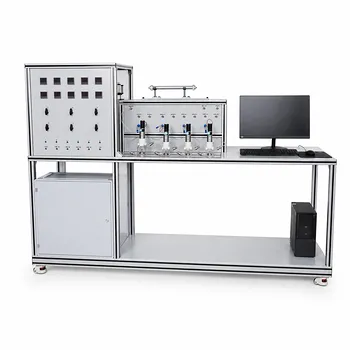
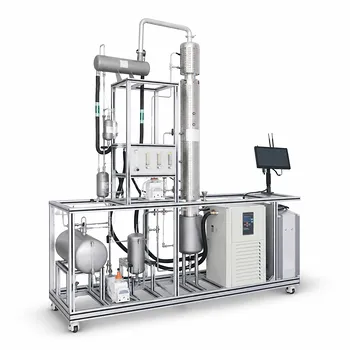
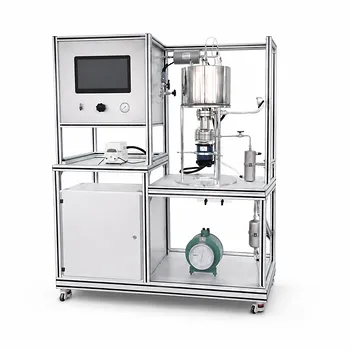
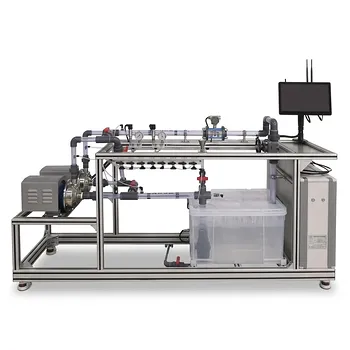
The key to transforming chemical engineering theory into practical intuition lies in the controlled chaos of a benchtop pilot plant. University educators can use these physical non-isothermal CSTRs to validate mathematical models by running steady-state and dynamic experiments, collecting real-time temperature and concentration data, and then systematically adjusting model parameters—like the overall heat transfer coefficient ($U$) and activation energy—until the simulation’s predicted curves align with the physical reactor's actual performance.
While software provides the ideal scenario, a physical pilot plant reveals the unvarnished reality of heat loss, sensor lag, and imperfect mixing. The core pedagogical value is not just getting a match, but the process of justifying the “why” behind every necessary parameter adjustment to bridge the gap between a theoretical ODE on a screen and the living, breathing process on the lab bench.
Understanding the Bridge from Theory to Reality
Educational mathematical models for non-isothermal CSTRs are built on coupled ordinary differential equations (ODEs). These equations solve for concentration and temperature by linking material balances to energy balances, requiring inputs for reaction kinetics, physical properties, and transport coefficients. But a model run in MATLAB or Python is only as good as its assumptions. Perfect mixing and instant heat transfer don't exist. The physical pilot plant forces a confrontation with these assumptions.
Confronting the Imperfections of Physical Systems
An idealized simulation assumes every fluid element instantly reaches the jacket temperature. The pilot plant tells a different story. Heat is lost to the environment, temperature sensors have a time constant, and fluid mixing has a finite rate.
By collecting physical data on reactor temperature ($T$) and coolant temperature ($T_c$) during an exothermic reaction, students see the deviation from the ideal curve.
The Iterative Parameter Tuning Cycle
The validation process is about targeted adjustment. You start with textbook kinetic parameters and heat transfer coefficients. You then run the physical reactor and overlay the experimental concentration profile and temperature curve onto your simulation. The mismatch is where learning begins. You adjust one parameter at a time—first the overall heat transfer coefficient ($U$), then perhaps the activation energy—to see if you can force the model to reflect reality. This teaches that parameters are not just numbers; they are representations of physical phenomena like fouling or imperfect flow.
Deconstructing the Validation Workflow
A single data point at steady state is not validation. True validation requires testing the model against the reactor’s response to change. The pilot plant setup allows for rigorous dynamic testing that a purely theoretical course cannot replicate.
Executing the Steady-State Multiplicity Test
Non-isothermal CSTRs can exhibit multiple steady states. The primary reference hints at this through parameter adjustment, and the supplementary references detail the van Heerden stability criterion. To validate your model, you must prove it can predict this dangerous behavior.
You experimentally manipulate the flow rate to change the Damköhler number (Da) or the coolant flow to change the heat transfer parameter. By physically measuring the reactor temperature at these new settings, you can plot the experimental heat generation and heat removal curves. If your mathematical model’s predicted stable and unstable points match the physical reactor’s ignited and extinguished states, you have validated the model's safety-critical predictive power.
Tuning the Residence Time Distribution (RTD)
Your mathematical model likely assumes an ideal mixer, meaning the outlet concentration equals the uniform tank concentration instantly. A physical CSTR betrays this assumption. Dead zones and bypassing create a non-ideal residence time distribution.
The Tracer Pulse Method
To validate the flow model within the energy balance, you must first isolate the mixing. Inject a tracer pulse into the physical reactor’s feed and measure the outlet concentration over time. Compare the resulting RTD curve to the ideal exponential decay of a perfect CSTR. The deviation is used to build a reactor network model (like a CSTR with a dead zone) that accurately reflects the physical unit. Your validated non-isothermal model must then incorporate this actual mixing physics rather than the perfect-mixing assumption.
Understanding the Trade-offs
An honest technical assessment requires acknowledging the limitations of this validation method. The benchtop pilot plant creates specific risks that a purely digital model avoids.
The Danger of Scale-Dependent Parameters
A parameter that works perfectly for a 1-liter pilot plant might catastrophically fail at industrial scale. The surface-area-to-volume ratio is enormous in a small reactor, meaning heat transfer coefficients ($U$) are trumped by environmental heat loss. A validated model on a pilot scale is a teaching moment about dimensional analysis, not a plug-and-play solution for a production reactor. Students must learn that the process of validation is the skill, not the final numerical values.
When Perfect Tuning Becomes Curve Fitting
There is a pedagogical pitfall where parameter adjustment becomes arbitrary. If a student has ten adjustable parameters, they can force a model to fit almost any dataset without learning the underlying physics. The objective is to validate using the minimum statistical deviation and the most physically justifiable parameter changes. This teaches intellectual honesty, ensuring the model predicts future dynamic behavior rather than just mimicking past data.
Making the Right Choice for Your Educational Goal
How you deploy the pilot plant for non-isothermal validation should depend entirely on the specific learning outcome you want to achieve. The sequence of the experiment dictates the lesson.
- If your primary focus is teaching model construction from first principles: Force students to derive the ODEs, guess the initial parameters, and use the physical pilot plant data to prove their simulation is unstable. The key is letting them fail with the textbook value before they physically measure the true temperature difference.
- If your primary focus is operator training and process safety: Focus on the van Heerden stability criterion experiments. Manipulate the coolant jacket flow to physically trigger ignition and extinction events, proving that the intermediate steady state is a mathematical mirage that cannot be held in a physical reactor.
- If your primary focus is system characterization for research: Use the pilot plant to generate RTD curves and heat transfer correlations that will be integrated into a larger industrial digital twin. The CSTR becomes a source of empirical closure terms for a multiphase computational fluid dynamics model.
The ultimate goal is not to confirm that the model was right all along, but to use the physical reality of the pilot plant to expose the model’s initially fragile assumptions, creating engineers who trust the data, not just the equations.
Summary Table:
| Validation Step | Experimental Method | Core Pedagogical Value |
|---|---|---|
| Parameter Tuning | Overlay simulation onto physical T & C curves; adjust $U$ and activation energy. | Understanding physical parameters vs. mathematical assumptions. |
| Stability Validation | Manipulate flow rates (Da) and coolant flow to find ignition/extinction states. | Applying the van Heerden criterion to real-world process safety. |
| Mixing Characterization | Run tracer pulse tests to measure Residence Time Distribution (RTD). | Identifying dead zones and bypassing in non-ideal reactors. |
Bring Hands-On Process Validation to Your Lab
Bridging the gap between mathematical simulations and physical chemical engineering dynamics requires reliable, high-precision training equipment. LABPARK provides state-of-the-art Educational and Vocational Unit Operations Pilot Plants in chemical engineering, bioprocess & biotech, and environmental & water treatment.
Designed specifically for universities, research institutes, and enterprises, our pilot plants empower students and researchers to master reactor dynamics, validate complex models, and gain true physical intuition.
Ready to upgrade your laboratory capabilities? Contact us today to request a quote or custom consultation!
Related Products
- Multi-Stage Stirred Tanks in Series Residence Time Distribution and Mixing Performance Determination Educational Pilot Plant
- Residence Time Distribution and Reactor Flow Characteristics Determination Educational Pilot Plant
- Gas Phase Mixing and Residence Time Distribution Determination Educational Unit Operations Pilot Plant
- Multi Functional Catalytic Reaction and Reactor Evaluation Educational Unit Operations Pilot Plant
- Multi-Reactor Educational Pilot Plant for Reaction Engineering Unit Operations
People Also Ask
- How does MRF model impeller rotation in CFD? Key Boundary Conditions Explained
- How can a CSTR pilot plant demonstrate reactor staging? Visualize volume savings.
- What parameters to monitor transitioning from Batch to CSTR? Master Pilot Plant Setup
- How does steady-state multiplicity affect the operation and safety of exothermic reactions within a CSTR pilot plant? - Guide
- Why is temperature regulation via a cooling jacket a critical feature in CSTR pilot plants used for laboratory training?