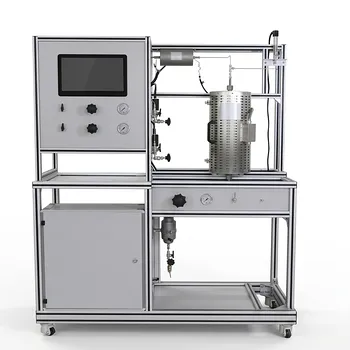
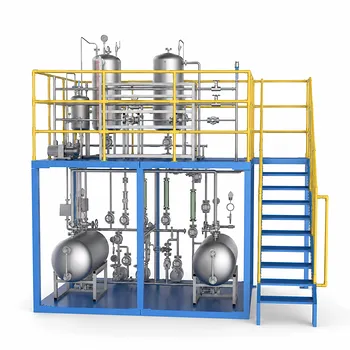
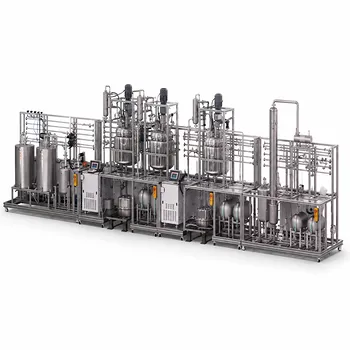
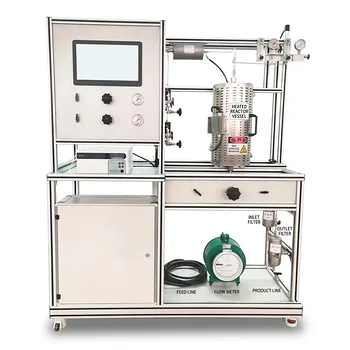
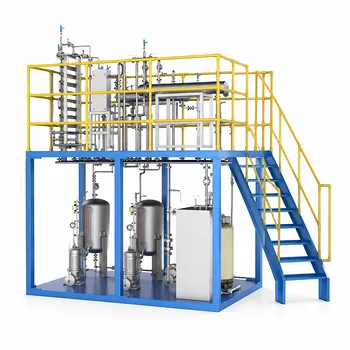
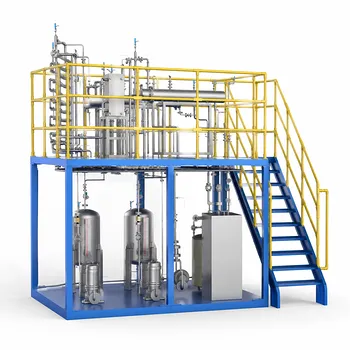
Yes, you can watch a reaction ‘decide’ to proceed.
Pilot plants transform the abstract equation ΔG = ΔH – TΔS into a tangible dial you can turn. By precisely controlling temperature and measuring heat flows in reactor systems, you directly observe the shift from non-spontaneous to spontaneous behavior, turning theory into a physical event you can validate.
The most direct demonstration of Gibbs free energy in a pilot plant is identifying the exact temperature at which a reaction becomes spontaneous. This is achieved by manipulating the system’s temperature while simultaneously monitoring the heat released or absorbed (ΔH) and interpreting how the entropic term (TΔS) tips the balance, turning ΔG from positive to negative.
Moving Beyond the Equation: The Core Experiment
The equation ΔG = ΔH – TΔS is deceptively simple. Its real power emerges when you can force a reaction to walk the line between feasibility and futility. For reactions where ΔH and ΔS have the same sign, temperature is the ultimate decision-maker. A pilot-scale reactor lets you find the precise temperature threshold where everything changes.
The Temperature Threshold: Where Theory Meets Reality
Imagine an endothermic reaction with a positive entropy change (ΔH > 0, ΔS > 0). At low temperatures, the unfavourable enthalpy term dominates, keeping ΔG positive and the reaction stalled. As you raise the reactor’s temperature, the TΔS term grows until it outweighs ΔH, and the reaction suddenly becomes spontaneous.
Pilot plants equipped with jacketed reactors, heating/cooling units, and online concentration sensors (like FTIR or gas chromatography) make this transition observable. You can program a temperature ramp and watch conversion take off at the equilibrium point where ΔG crosses zero. This is not just a calculation—it’s a live demonstration of spontaneity.
Heat Flow as a Window to ΔH
A reactor’s jacket does more than control temperature. By measuring the heating fluid’s flow rate and its inlet/outlet temperature difference, you perform a real-time energy balance. This yields the enthalpy change of the reaction (ΔH) in a tangible, measured form.
Students quickly see that ΔH isn’t a mystical number from a table. It’s the extra energy you must supply or remove to maintain isothermal conditions. The pilot plant demystifies the enthalpy term by converting it into a heat duty you can log and graph.
Decoding the Hidden Variable: Entropy Measurement via Maxwell Relations
Entropy (S) cannot be read from a simple sensor. Yet you can’t understand ΔG without it. Pilot plants, combined with Maxwell’s thermodynamic relations, allow you to compute entropy changes from ordinary pressure, volume, and temperature measurements.
From Sensor Data to Entropy Changes
Every compressor, gas expansion unit, or pressured reactor in a pilot plant is a laboratory for entropy. For example, the relation (∂S/∂P)_T = –(∂V/∂T)_P means you can calculate how entropy varies with pressure simply by measuring how the system’s volume responds to temperature changes.
In practice, a gas expansion experiment logs P, V, and T during a slow, controlled pressure release. By feeding this data into the appropriate Maxwell relation, you calculate the entropy change directly—making an abstract, non-measurable property as real as the pressure gauge on the control panel.
Why This Matters for Gibbs Free Energy
When you compute ΔS via Maxwell relations and combine it with a measured ΔH, you can calculate ΔG from live pilot-plant data without relying on standard tables. This closes the loop between fundamental theory and practical process data. Students learn that thermodynamics is a complete, self-consistent framework, not a collection of isolated formulas.
Path Dependence and the Reversible Limit: A Gas Expansion Demonstration
Gibbs free energy is intimately linked to maximum work. For a process at constant temperature and pressure, ΔG represents the maximum non-expansion work obtainable. A multi-stage gas expansion pilot plant makes this concept visceral.
Why Reversibility Matters to Gibbs Free Energy
Consider expanding a gas from high to low pressure. The initial and final states are identical whether you do it in one violent step or many tiny, near-equilibrium steps. In both cases, ΔU = 0 for an isothermal ideal gas. But the work obtained is drastically different.
A pilot plant with multiple expansion chambers shows that each additional step extracts more work from the same pressure drop. The limit of infinite steps—the reversible path—gives the maximum work. This directly parallels the meaning of ΔG: it’s the theoretical best-case workload, achieved only when a process is carried out reversibly. Students see with their instruments that real processes always fall short, which reinforces why ΔG is a benchmark, not always an actual yield.
Predicting Yields and Shifting Equilibrium in Reactors
Gibbs free energy doesn’t just predict spontaneity; it governs the equilibrium composition of a reacting mixture. Pilot-scale continuous stirred-tank reactors (CSTRs) or tubular reactors let you explore this connection experimentally.
From ΔG to Concentration: The Equilibrium Constant Connection
The relationship ΔG° = –RT ln K ties the standard Gibbs free energy change to the equilibrium constant K. If you operate a pilot plant reactor at different temperatures and let it reach steady state, you can measure outlet concentrations and calculate K experimentally.
Plotting ln K versus 1/T yields a line whose slope gives ΔH°, validating the van’t Hoff equation. By comparing the reactor’s actual conversion to the theoretical equilibrium conversion predicted by Gibbs energy minimization, you identify kinetic bottlenecks, mass transfer limitations, or heat integration flaws. The pilot plant thus becomes a tool for process diagnostics, not just academic validation.
Understanding the Trade-offs
Real pilot plants are not ideal thermodynamic textbooks. Embracing the inherent messiness is part of the learning.
Heat Losses and Non-Idealities
No reactor is perfectly adiabatic. Heat leaks to the environment, the reactor’s own heat capacity soaks up energy, and mixing may be uneven. These factors cause the measured ΔH to deviate from the “true” reaction enthalpy. However, this is not a flaw—it’s a lesson in engineering energy balances. Students must account for these losses, mirroring what they’ll face in industrial scale-up.
Experimental Time and Cost
Running a pilot plant to map a reaction’s spontaneity boundary consumes materials, utilities, and hours. In many industrial settings, computational thermodynamics (equations of state, process simulators) will screen conditions first. Pilot plants are best used sparingly, to validate key predictions or to provide the physical intuition that software cannot.
Sensor Limitations and Error Propagation
Maxwell relations demand accurate P-V-T data. A small sensor drift can produce large errors in calculated entropy changes. This teaches critical error analysis and the importance of calibration—skills equally vital in research and plant operations.
How to Apply This to Your Own Learning or Process Development
Your goal determines how you should use a pilot plant to explore Gibbs free energy.
- If your primary focus is deeply grasping the meaning of spontaneity: Design a temperature-sweep experiment in a jacketed reactor with a reaction where ΔH and ΔS share the same sign. Watch conversion surge past the equilibrium temperature, making the ΔG sign flip a tangible event.
- If your primary focus is understanding non-measurable properties: Use a gas compressor or expansion unit to log P-V-T data, then apply Maxwell relations to compute entropy changes, turning the abstract into a calculated, numeric output.
- If your primary focus is optimizing reaction yield: Operate the pilot plant at several temperatures, measure outlet concentrations, and compare actual equilibrium constants to those predicted by Gibbs energy minimization. The gaps will spotlight your reactor’s real-world inefficiencies.
- If your primary focus is teaching the concept of reversible work: Employ a multi-stage gas expansion apparatus to demonstrate that more stages deliver more work, approaching the maximum dictated by ΔG—and showing that a reversible process is an ideal, not an everyday reality.
By turning the equation into an experiment, the pilot plant transforms Gibbs free energy from a cryptic formula into a functional compass for navigating the realities of chemical processes.
Summary Table:
| Thermodynamic Concept | Pilot Plant Demonstration Method | Engineering & Practical Value |
|---|---|---|
| Spontaneity (ΔG) | Temperature-sweep in a jacketed reactor | Identifies the temperature threshold where reaction begins |
| Enthalpy (ΔH) | Reactor jacket energy balance calculation | Quantifies real-time heat duty and isothermal energy needs |
| Entropy (ΔS) | P-V-T logging in gas expansion units | Computes entropy changes using Maxwell thermodynamic relations |
| Reversible Work | Multi-stage gas expansion comparison | Demonstrates maximum thermodynamic work vs. real-world losses |
Bring Thermodynamics to Life in Your Lab
Bridging the gap between complex thermodynamic equations and physical chemical processes requires the right equipment. LABPARK provides premium Educational and Vocational Unit Operations Pilot Plants in chemical engineering, bioprocess & biotech, and environmental & water treatment.
Whether you are a university looking to enhance student comprehension of Gibbs free energy, a research institute validating thermodynamic models, or an enterprise optimizing scale-up yields, our pilot plants deliver the precise control and data logging you need.
Ready to elevate your engineering curriculum or research capabilities? Contact LABPARK today to find the perfect pilot plant solution for your facility!
Related Products
- Carbon Dioxide Hydrogen Methanol Synthesis Educational Unit Operations Pilot Plant
- Multi Pump Fluid Transport Process Piping Unit Operations Training Pilot Plant
- Natural Product Extraction Unit Operations Training Pilot Plant
- Multi-Modal Distillation Unit Operations Training Pilot Plant
- Multi-Reactor Educational Pilot Plant for Reaction Engineering Unit Operations
People Also Ask
- How do temp & pressure affect methanol synthesis pilot plants? Optimize equilibrium and catalyst performance.
- Why is a purge system necessary when operating a gas recirculation loop in a methanol synthesis pilot plant? (Guide)
- Why do modern methanol pilot plants operate at lower pressures? Catalyst & Feed Requirements Explained
- What are the operational requirements for catalyst activation? Safe Methanol Pilot Plant Operation
- Why is the chemical plant startup schedule crucial? De-risk scale-up with pilot plants.