Knowledge Chemical Engineering Education How to Apply the Kremser Method to Evaluate Column Efficiency in Pilot Plants? A Practical Guide
Author avatar

Tech Team · LABPARK

Updated 1 month ago

How to Apply the Kremser Method to Evaluate Column Efficiency in Pilot Plants? A Practical Guide


The Kremser method bridges the gap between textbook absorption theory and the reality of a pilot plant. It allows you to calculate the number of theoretical equilibrium stages ((N)) required to achieve the measured separation, using the absorption factor ((A = L/mG)) and the inlet/outlet concentration data from your column. By comparing this theoretical number to the actual number of physical trays or the equivalent packed height, you directly determine the overall column efficiency, quantifying how real-world hydrodynamics and mass transfer limitations impact performance.

The true power of the Kremser method for pilot-plant evaluation lies not in a single calculation, but in its ability to systematically turn raw concentration measurements into a precise efficiency benchmark, provided you account for the non-ideal conditions that cause absorption factors to vary along the column.

The Foundation: Applying the Kremser Equation to Pilot Plant Data

What is the Absorption Factor?

The absorption factor ((A = L/mG)) is the dimensionless ratio that governs solute removal in a counter-current column.

It compares the slope of the operating line ((L/G), the liquid-to-gas molar flow ratio) to the slope of the equilibrium line ((m)). When (A > 1), the liquid phase has a greater capacity to absorb the solute than the gas has to carry it, making high recovery possible. This single parameter is the engine of the entire analytical method.

How to Calculate Theoretical Stages from Concentration Measurements

For a dilute system with a linear equilibrium line, the Kremser equation directly links the number of theoretical stages ((N)) to the absorption factor and a recovery fraction.

By measuring the solute mole fractions in the inlet and outlet gas and liquid streams of your pilot plant, you can compute the relative absorption. Plugging this value along with the operating (L/G) and (m) into the analytical Kremser equation solves for (N)—the number of equilibrium stages a theoretical column would need to achieve the same separation.

From Theoretical Stages to Column Efficiency

The calculated (N) is a pure thermodynamic requirement, ignoring real-world fluid mechanics.

You evaluate column efficiency by comparing this theoretical need to the physical hardware. If the pilot plant is a tray column with (N_{actual}) real trays, the overall tray efficiency is simply (N / N_{actual}). For a packed column, the number of theoretical stages combined with the known packing height gives the Height Equivalent to a Theoretical Plate (HETP), a direct measure of mass-transfer effectiveness.

Overcoming Real-World Complexities in Pilot Plants

The Problem with a Single Absorption Factor

A pilot plant rarely operates under the idealized, isothermal conditions assumed in a basic Kremser calculation.

As solute transfers from the gas to the liquid, heat of absorption can be released, changing the temperature profile and thus shifting the equilibrium constant (m). Simultaneously, the total gas and liquid flow rates change slightly. Using a single absorption factor based on the column’s average or inlet conditions introduces a significant error.

Using the Geometric Mean Absorption Factor

To achieve accurate efficiency evaluation, you must account for these varying conditions.

The correct approach is to calculate the absorption factor at the dilute top ((A_t)) and the more concentrated bottom ((A_b)) of the pilot column separately. The effective absorption factor for the entire column is their geometric mean, (A_{eff} = \sqrt{A_t \times A_b}). Substituting this averaged value into the Kremser equation yields a far more reliable number of theoretical stages that faithfully represents the non-ideal separation achieved.

The Role of Counter-Current Flow

The high efficiency you are evaluating is only possible because of the column’s counter-current design.

Your pilot plant connects the gas with the lowest solute concentration to the freshest, leanest solvent. This configuration sustains a large and uniform mass transfer driving force along the entire height of the column. It is this fundamental advantage that the Kremser model mathematically exploits, and which makes the experimental determination of efficiency meaningful and repeatable.

Trade-offs and Limitations of the Kremser Approach

The Assumption of a Linear Equilibrium Line

The method’s primary limitation is its mathematical foundation.

The standard Kremser equation is analytically derived for systems where the equilibrium relationship is a straight line ((Y^* = mX + b)). If your pilot plant handles highly non-ideal, concentrated solutions with a curved equilibrium line, the method becomes increasingly inaccurate. You would then need to rely on graphical or computational stage-by-stage methods, losing the simple, parameterized elegance of the absorption factor.

Sensitivity to Operating Condition Variations

Even with the geometric mean correction, the method assumes the operating line is essentially straight.

If there are drastic temperature spikes or highly non-dilute concentration changes, the variation in (m) and flow rates may not be perfectly captured by a simple top-and-bottom average. The calculated efficiency becomes a useful approximation rather than a precise fundamental value. In such cases, you must judge whether the analytical speed of the Kremser method is worth the slight loss in rigor compared to a full numerical simulation.

Making the Right Choice for Your Pilot Plant Analysis

Your specific goal for evaluating column efficiency should guide how you apply the Kremser method.

  • If your primary focus is rapid diagnostics and teaching fundamentals: Use the standard Kremser equation with average conditions. The direct comparison between theoretical stages and physical trays provides an immediate, intuitive grasp of hydrodynamic limitations without complex corrections.
  • If your primary focus is obtaining data accurate enough for process scale-up: Measure temperatures and concentrations at both ends of the pilot column. Calculate the geometric mean absorption factor to ensure your derived theoretical stages, and thus your reported HETP or tray efficiency, are reliable enough for designing a production-scale unit.
  • If your primary focus is troubleshooting an underperforming column: Collect intermediate samples if possible. A significant deviation between the theoretical (N) calculated from the overall separation and the actual physical stages at the corrected conditions can isolate whether the problem is a thermodynamic limitation (low (A)) or a mechanical deficiency (poor contact, weeping, flooding).

By selecting the right level of correction, the Kremser method moves from a simple classroom calculation to a decisive tool for pilot plant intelligence.

Summary Table:

Application Focus Key Approach Key Outcome
Diagnostics & Teaching Standard Kremser (using average $A$) Quick overall tray efficiency / HETP
Process Scale-Up Geometric Mean ($A_{eff} = \sqrt{A_t \times A_b}$) Accurate HETP for industrial scaling
Troubleshooting Localized stage-by-stage calculations Identifies mechanical vs. thermodynamic limits

Optimize Your Unit Operations with LABPARK Pilot Plants

Are you looking to bridge the gap between absorption theory and hands-on process engineering? LABPARK designs and manufactures state-of-the-art Educational and Vocational Unit Operations Pilot Plants in chemical engineering, bioprocess & biotech, and environmental & water treatment. We help universities, research institutes, and enterprises achieve precise, repeatable mass transfer and column efficiency evaluations.

Ready to elevate your engineering lab? Contact LABPARK today to find the perfect pilot plant solution for your educational or research needs!

Related Products

People Also Ask

Related Products

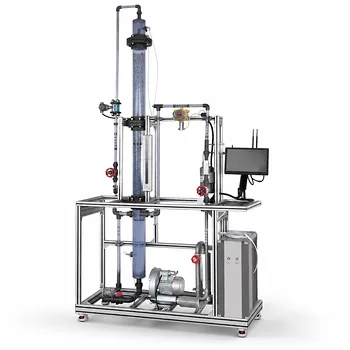
Multimodal Absorption and Desorption Pilot Plant for Unit Operations Training

Multimodal Absorption and Desorption Pilot Plant for Unit Operations Training

Multimodal absorption and desorption pilot plant for higher education labs. Bridges theory and industrial practice with transparent packed columns, three operational modes (real-material, simulated, semi-physical), and SCADA control. Students explore mass transfer, column hydraulics, and process control. Customizable.

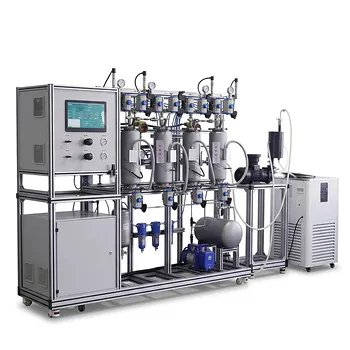
Multi-Component Gas Pressure Swing Adsorption Pilot Plant for Unit Operations Education

Multi-Component Gas Pressure Swing Adsorption Pilot Plant for Unit Operations Education

Multi-component gas pressure swing adsorption pilot plant designed for unit operations education. Features four-tower configuration, IoT touchscreen control, dual regeneration, and real-time breakthrough curve analysis for engineering training with safety interlocks and mobile frame simulates industrial PSA processes.

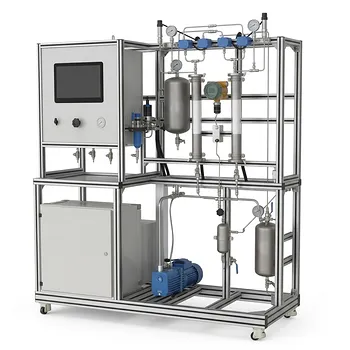
Absorption and Desorption Educational Unit Operations Pilot Plant

Absorption and Desorption Educational Unit Operations Pilot Plant

Dual packed column absorption and desorption pilot plant for chemical engineering education, offering real-time mass transfer coefficient measurement, durable mobile frame, industrial touch-screen interface, and customizable design for varied laboratory curricula, enabling hands-on study of gas absorption and stripping.

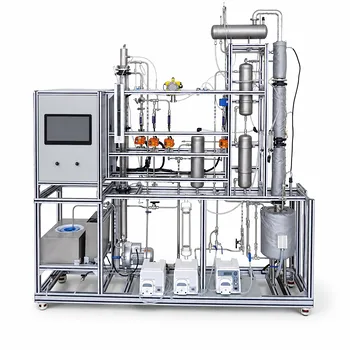
Dual-Mode Gas Absorption and Desorption Unit Operations Training Pilot Plant

Dual-Mode Gas Absorption and Desorption Unit Operations Training Pilot Plant

Industrial-scale pilot plant for gas absorption and desorption training in chemical engineering. Features dual-mode operation with real and simulated materials, transparent columns for flow visualization, and customizable design. Supports independent or combined loops for hands-on unit operations experiments.

Packed Bed Absorption Educational Unit Operations Pilot Plant

Packed Bed Absorption Educational Unit Operations Pilot Plant

Study gas-liquid absorption, pressure drop, flooding, and mass transfer coefficients with this pilot plant. Transparent packed column, industrial touchscreen, real-time sensor data, automated analysis. Investigate two-phase flow, loading points, column efficiency. Comprehensive data logging and assessment software included.

Pressure Swing Adsorption Educational Unit Operations Pilot Plant

Pressure Swing Adsorption Educational Unit Operations Pilot Plant

Integrated bench-scale pressure swing adsorption pilot plant for hands-on teaching of gas-solid separation, mass transfer, and process optimization using nitrogen-oxygen model, featuring dual-column design, industrial touchscreen control, digital assessment suite, and customizable hardware and software configurations for educational laboratories.

Carbon Dioxide Absorption and Desorption Educational Pilot Plant for Carbon Capture Studies

Carbon Dioxide Absorption and Desorption Educational Pilot Plant for Carbon Capture Studies

Explore carbon dioxide absorption and desorption with this educational pilot plant. Transparent columns visualize mass transfer; electric heating simulates industrial solvent regeneration; touchscreen interface enables data monitoring. Ideal for chemical engineering, bridging theory and practice.

Bench Scale Carbon Dioxide Capture Educational Unit Operations Pilot Plant

Bench Scale Carbon Dioxide Capture Educational Unit Operations Pilot Plant

This bench-scale educational pilot plant simulates industrial CO₂ separation using a multi-tower adsorption system for hands-on engineering training. Students achieve ≥90% CO₂ purity while studying pressure swing adsorption, desorption kinetics, and process control in gas purification experiments.

Low Concentration Carbon Dioxide Capture Pressure Swing Adsorption Educational Pilot Plant

Low Concentration Carbon Dioxide Capture Pressure Swing Adsorption Educational Pilot Plant

Low-concentration CO2 capture pilot plant using Pressure Swing Adsorption for engineering education. Students gain practical experience in breakthrough curve measurement, adsorption dynamics, and variable analysis in a hands-on lab setting. Ideal for unit operations, mass transfer, and chemical engineering labs.

Carbon Material Thermal Pretreatment Multiphase Separation Educational Pilot Plant

Carbon Material Thermal Pretreatment Multiphase Separation Educational Pilot Plant

Educational pilot plant for carbon material thermal pretreatment and multiphase separation. Features jacketed agitated reactor, separation column, and modern controls for hands-on unit operations training in heat transfer, fluid flow, and process safety with industrial-grade materials and wireless data acquisition.

Bench Scale Dual Column Gas Separation and Capture Educational Pilot Plant

Bench Scale Dual Column Gas Separation and Capture Educational Pilot Plant

This dual-column educational pilot plant provides hands-on teaching of gas adsorption, separation, and capture processes. It features stainless steel columns, regeneration up to 400°C, and a 15.6-inch touchscreen PLC for TSA and PSA studies in chemical engineering curricula, process simulation.

Multi-Reactor Educational Pilot Plant for Reaction Engineering Unit Operations

Multi-Reactor Educational Pilot Plant for Reaction Engineering Unit Operations

Integrated bench-scale educational pilot plant for chemical engineering teaching featuring fixed bed fluidized bed and stirred tank reactors with web-based digital twin controls and safety interlocks for hands-on unit operations and reaction engineering comparative studies in one compact system.

Multi Functional Membrane Crystallization Educational Unit Operations Pilot Plant

Multi Functional Membrane Crystallization Educational Unit Operations Pilot Plant

Integrated bench-scale membrane crystallization pilot plant for engineering education. Provides hands-on training in advanced separation technologies, combining membrane distillation crystallization and process intensification. Features variable scaling vessels, industrial-grade flow control, and interactive digital data acquisition. Customizable for university labs.

Multi-Functional Special Distillation Educational Pilot Plant

Multi-Functional Special Distillation Educational Pilot Plant

Versatile multi-functional special distillation pilot plant for chemical engineering education. Supports continuous, vacuum, azeotropic, reactive, extractive distillation. Transparent glass columns enable real-time visual observation of hydrodynamics and separation processes.

Multi-Functional Drying Educational Unit Operations Pilot Plant

Multi-Functional Drying Educational Unit Operations Pilot Plant

Versatile multi-functional drying educational unit operations pilot plant integrating tunnel, fluidized bed, and spray drying. Enables hands-on study of drying curves, psychrometry, and gas-solid separation for chemical engineering curriculum in higher education labs.

Multi Functional Catalytic Reaction and Reactor Evaluation Educational Unit Operations Pilot Plant

Multi Functional Catalytic Reaction and Reactor Evaluation Educational Unit Operations Pilot Plant

Bench-scale educational pilot plant for catalytic reaction and reactor evaluation, integrating fixed bed, fluidized bed, and stirred tank reactors. Students compare reactor designs, evaluate catalysts, and study reaction kinetics and hydrodynamics. Perfect for unit operations labs in chemical engineering curricula.

Continuous Batch Extractive Distillation Educational Pilot Plant

Continuous Batch Extractive Distillation Educational Pilot Plant

Versatile pilot plant for continuous, batch, and extractive distillation training. High-borosilicate glass column for visualizing hydraulics, 15.6-inch touchscreen with data logging, precise reflux ratio control 1-99, and durable corrosion-resistant frame. Ideal for chemical engineering education and process research.

Natural Product Extraction Unit Operations Training Pilot Plant

Natural Product Extraction Unit Operations Training Pilot Plant

Integrated natural product extraction pilot plant for chemical engineering training bridges theory and industrial practice with modular extraction and evaporation/concentration units, hybrid touchscreen and manual control, realistic process simulation, and self-contained softened water and vacuum utilities.

Multifunctional Membrane Separation Educational Pilot Plant with Ultrafiltration, Nanofiltration, Reverse Osmosis

Multifunctional Membrane Separation Educational Pilot Plant with Ultrafiltration, Nanofiltration, Reverse Osmosis

An integrated laboratory bench-scale membrane separation system for higher education engineering labs combining Ultrafiltration, Nanofiltration, and Reverse Osmosis processes. Features industrial PLC control with touch-screen HMI, transparent piping, and academic assessment software. Ideal for chemical and environmental engineering curricula.

Rising and Falling Film Evaporation Educational Unit Operations Pilot Plant

Rising and Falling Film Evaporation Educational Unit Operations Pilot Plant

Hands-on educational pilot plant for studying rising and falling film evaporation, flow regimes, and heat transfer. Customizable for university labs with industrial instrumentation and data acquisition. Enables comparative evaluation of evaporation modes and energy efficiency.


Leave Your Message