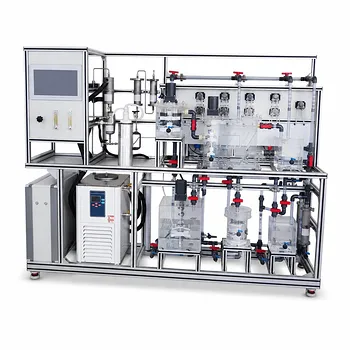
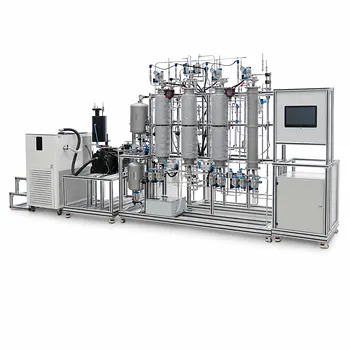
The catalytic dehydration of bioethanol to ethene can be practically demonstrated using a tubular reactor pilot plant with precise multi-zone temperature profiling and integrated online analytics. By operating across a temperature range of 420–770 K and measuring conversion, yield, and selectivity, students immediately see how reaction thermodynamics and kinetics govern the competing pathways to ethene (favored at 600–770 K) and diethyl ether (favored at 420–570 K). Adding a separation module—such as a pervaporation unit to continuously remove water—further enriches the experiment by linking reaction engineering to advanced separations and Le Chatelier-based process intensification.
A well-designed pilot-plant experiment transforms an abstract chemistry equation into a tangible engineering investigation. The core value lies in letting students manipulate temperature profiles, collect real-time selectivity data, quantify the endothermic heat load (ΔH = +45.3 kJ/mol), and integrate the reactor with a separation stage—all essential skills for modern bio-process and unit operations education.
Why This Reaction Is a Perfect Teaching Vehicle
A Classic Competition Between Kinetics and Thermodynamics
Ethanol dehydration simultaneously produces ethene and diethyl ether. The dominant product is not fixed; it is a direct consequence of the operating temperature you choose.
At 420–570 K, diethyl ether is kinetically favored, while at 600–770 K, ethene becomes the primary product. This built‑in selectivity switch lets students physically witness how a single process variable can redirect the entire outcome of a catalytic step.
The Endothermic Demand Teaches Heat Integration
Producing ethene requires a net input of 45.3 kJ per mole of ethanol converted. In a pilot plant, the heating duty becomes a measurable quantity—not just a textbook number. Students must instrument the reactor, log the energy supplied, and compare it against the expected enthalpy. This directly connects thermochemistry to unit operations and opens discussions on heat recovery and reactor design.
Configuring the Pilot Plant for a Hands-On Experiment
The Core Reactor Setup
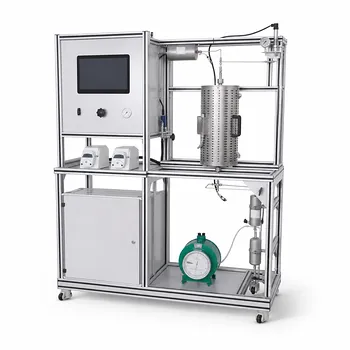
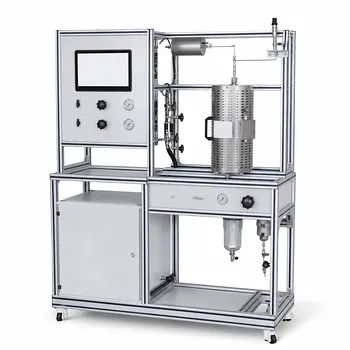
A tubular fixed‑bed reactor is the workhorse. It provides uniform flow, simple scale‑up logic, and easy integration of multiple temperature zones. The plant should include:
- A liquid ethanol feed system with a calibrated metering pump.
- An evaporator/pre‑heater to ensure the ethanol enters the catalyst bed as vapor at a precisely controlled inlet temperature.
- A multi‑zone furnace or heating jacket with independent PID controllers, allowing you to impose a defined temperature profile along the reactor length.
- Thermocouples placed at the inlet, inside the catalyst bed (multiple axial positions), and at the outlet, giving a full thermal map.
- A back‑pressure regulator to maintain the reaction pressure and an online gas chromatograph or mass spectrometer for real‑time product analysis.
Data You Collect During the Experiment
With this configuration, students can systematically measure:
- Conversion of ethanol: from the feed rate and the unreacted ethanol in the outlet.
- Selectivity to ethene vs. diethyl ether: by integrating the GC‑area percentages calibrated against standards.
- Axial temperature profile: showing the bed temperature changes due to the endothermic reaction and the furnace response.
- Endothermic heat duty: from the difference between the energy supplied by the heating system and the sensible heat carried by the product stream.
Stepwise Experimental Protocol
- Start at low temperature (≈ 450 K): Observe diethyl ether as the dominant product. Record steady‑state compositions.
- Raise the setpoint stepwise into the ethene‑favored regime (≈ 650–750 K): Watch the selectivity shift in real time. Plot selectivity vs. temperature to find the optimal window.
- Impose a temperature gradient along the reactor: For example, keep the inlet section cooler to initiate the reaction gently, then ramp up to prevent ether re‑formation downstream. Correlate the gradient pattern with overall yield.
- Perform an energy balance: Measure the electrical/heating input, calculate the latent and sensible heat flows, and isolate the reaction’s endotherm.
This progression turns a theoretical reaction network into a concrete, data‑driven investigation.
Integrating Separation to Deepen the Learning
Coupling the Reactor with Pervaporation
Water is a co‑product of ethene formation. Continuously removing water from the reactor outlet (or even from a recycle loop) shifts the equilibrium toward ethene per Le Chatelier’s principle. A pervaporation unit operations module—as used in esterification pilots—can be placed downstream.
The membrane selectively permeates water vapor, returning a water‑depleted stream to the reactor. Students then observe:
- Increased single‑pass conversion compared to the reactor without water removal.
- A measurable reduction in ether selectivity because the lowered water partial pressure can suppress side reactions, depending on the catalyst.
- The energy cost of pervaporation (vacuum, condensation), which opens a realistic trade‑off discussion: higher yield vs. additional separation duty.
Optional Feed Purification via Azeotropic Distillation
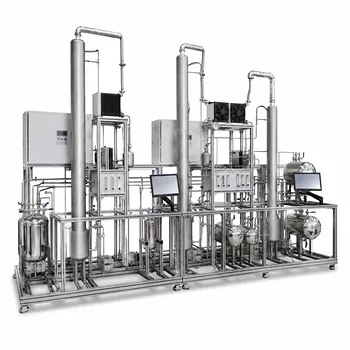
If the experiment uses raw bioethanol (hydrous ethanol), students may first need to break the ethanol–water azeotrope. A modular distillation pilot plant with decanter (using an entrainer like benzene or cyclohexane) can produce anhydrous ethanol feed. This pre‑treatment stage demonstrates:
- The limitation of simple distillation for azeotropic mixtures.
- The role of an entrainer and liquid‑liquid phase separation.
- The energy penalty of bioethanol dehydration before it even reaches the reactor.
While not mandatory for the catalytic step, this addition transforms the experiment into a full bio‑process chain, linking fermentation product workup to green‑chemistry conversion.
Understanding the Trade-offs
Temperature Window and Catalyst Deactivation
Running at high temperature (770 K) maximizes ethene selectivity but accelerates catalyst coking and sintering. A pilot plant experiment should include a catalyst stability study: measure conversion decline over time at a fixed temperature, then relate it to observed carbon deposition. This teaches the practical reality that optimal yield is always a compromise between activity and longevity.
Energy Efficiency vs. Product Value
The endothermic heat demand is substantial. Students can calculate the energy ratio (energy in product ethene divided by the total process heat). Adding pervaporation improves yield but requires extra energy for vacuum and condensation. The distillation pre‑step likewise carries a steam cost. By quantifying these inputs, students learn to perform a simplified techno‑economic assessment—an invaluable skill beyond pure chemistry.
Complexity and Student Throughput
A fully integrated reactor‑pervaporation‑distillation pilot plant is educationally rich but can overwhelm a single laboratory session. A modular approach—where different student teams run the reactor, the pervaporation unit, or the distillation columns in rotation—often works best. Clear, pre‑written standard operating procedures and data‑logging templates keep the focus on the engineering principles rather than equipment troubleshooting.
Making the Right Choice for Your Educational Goal
Different curricula emphasize different aspects of bio‑process engineering. Tailor the experiment accordingly.
- If your primary focus is reaction engineering and kinetics: Use the stand‑alone tubular reactor with multi‑zone temperature control. Let students spend their time mapping conversion and selectivity as a function of temperature and residence time.
- If your primary focus is process intensification and equilibrium‑driven separations: Couple the reactor with a pervaporation module. Emphasis shifts to how membrane‑assisted water removal increases ethene yield and how to measure/optimize the combined reactor‑separator energy consumption.
- If your primary focus is the complete bio‑process chain: Start with a hydrous bioethanol feed, incorporate azeotropic distillation for purification, then run the dehydration reactor, and finally separate the product gas stream. This sequence mirrors a realistic biorefinery, giving students exposure to distillation, reaction, and membrane operations in one integrated project.
A well‑instrumented pilot plant does more than validate textbook equations—it gives students the confidence to analyze, troubleshoot, and optimize a real chemical conversion process. The catalytic dehydration of bioethanol, with its clear temperature‑driven selectivity and its natural link to separation technologies, remains one of the most effective ways to teach modern unit operations and green chemistry side by side.
Summary Table:
| Stage / Module | Operating Conditions | Educational & Process Focus |
|---|---|---|
| Low-Temp Reaction | 420–570 K, Tubular Fixed-Bed | Diethyl ether selectivity (Kinetics study) |
| High-Temp Reaction | 600–770 K, Tubular Fixed-Bed | Ethene selectivity & Endothermic heat load (+45.3 kJ/mol) |
| Pervaporation Module | Downstream membrane separation | Continuous water removal, shifting equilibrium (Le Chatelier) |
| Azeotropic Distillation | Pre-treatment with entrainer | Breaking ethanol-water azeotrope & complete process chain analysis |
Bring Advanced Unit Operations to Your Lab with LABPARK
To successfully demonstrate complex chemical and bioprocess concepts like catalytic dehydration, you need reliable, industry-grade equipment. LABPARK provides state-of-the-art Educational and Vocational Unit Operations Pilot Plants in chemical engineering, bioprocess & biotech, and environmental & water treatment.
Designed specifically for universities, research institutes, and enterprises, our modular systems allow students and researchers to master heat integration, kinetics, and advanced separations first-hand.
Contact LABPARK today to customize the perfect pilot plant solution for your educational goals!
Related Products
- Ethylbenzene Dehydrogenation Educational Unit Operations Pilot Plant
- Green Anhydrous Ethanol Purification Extractive Distillation Unit Operations Training Pilot Plant
- Bio-fermentation Ethanol Production Practical Training Unit Operations Pilot Plant
- Crude Benzene Hydrogenation Educational Unit Operations Pilot Plant
- Carbon Dioxide Hydrogenation Methanol Synthesis Educational Unit Operations Pilot Plant
People Also Ask
- What parameters & reactor configurations are needed for ethylbenzene dehydrogenation pilot plants?
- Why is steam dilution critical in dehydrogenation? Pilot Plant Control Guide
- Isothermal vs Adiabatic Reactors: Key Differences in Ethylbenzene Dehydrogenation Pilot Plants
- How do pilot plants help students verify material balances? Bridge Theory with Real-world Data
- Why is the steam-to-feedstock ratio critical in catalytic dehydrogenation? Learn the 3 key roles of steam.