Synthetic lipid bilayers across microscopic apertures can function as controlled teaching and research modules within bioprocess pilot plants. A roughly 70 Å-thick planar bilayer reproduces key properties of a biological plasma membrane, including high electrical resistance, capacitance, and low passive permeability to charged species. By measuring ion transport before and after adding antibiotics or cation-complexing agents, users can directly demonstrate how molecular structure regulates selective permeability and mass transfer.
Synthetic bilayer apertures provide a molecular-scale model of membrane separation: they show how a membrane can strongly restrict charged solutes while permitting selected species to cross, and how chemical modifiers change that behavior. Integrated with pilot-plant measurements, the model connects molecular transport principles to practical variables such as flux, rejection, resistance, and selectivity.
What the Bilayer Demonstrates
A Biological Selective Barrier
A lipid bilayer contains a hydrophobic interior that presents a substantial barrier to ions and other charged species. Its high electrical resistance and capacitance can therefore be used as measurable indicators of membrane integrity and interfacial structure.
In a pilot-plant laboratory, the bilayer can be formed across a small aperture separating two liquid compartments. The compartments represent the feed and permeate sides of a membrane, allowing transport to be studied under controlled concentration or electrical-potential differences.
Passive Ion Transport
The system can demonstrate passive transport, in which species move down a chemical or electrochemical potential gradient without an external energy source. Under baseline conditions, charged species should exhibit strongly restricted transport across an intact bilayer.
Users can vary the ion composition, concentration gradient, and applied voltage while recording current or conductance. These measurements reveal whether transport occurs through the lipid phase, through defects, or through transient or induced pathways.
Selective Permeability Changes
Modifying agents provide a direct way to show that permeability is not a fixed property. Antibiotics or cation-complexing molecules can interact with the bilayer or with ions near the membrane, creating pathways or changing the effective transport of selected species.
The key observation is a change in electrical conductance, ion flux, or apparent permeability after the modifier is introduced. A selective response to one ion or solute illustrates the difference between general membrane leakage and chemically controlled transport.
How to Integrate the System into a Pilot Plant
Use the Bilayer as a Molecular Transport Module
The aperture cell can be installed as a small, instrumented demonstration module alongside conventional membrane equipment. It should include separate feed and permeate reservoirs, controlled mixing, sampling points, and electrical measurement capability.
The module is best used to explain the molecular origin of behaviors later observed in microfiltration, ultrafiltration, nanofiltration, reverse osmosis, or liquid-membrane operations. Its role is mechanistic rather than production-scale.
Establish a Baseline Before Modification
An effective experiment begins by characterizing the intact bilayer. Users can record electrical resistance, capacitance, baseline current, and the transport of selected neutral and charged species under a defined gradient.
This baseline establishes whether the membrane is continuous and provides a reference for evaluating the effect of each chemical or operating change. Repeating the measurement across multiple bilayers also exposes the variability associated with formation and stability.
Apply Controlled Chemical Perturbations
A modifier can be added to one side of the membrane at a known concentration while the system remains under constant temperature, mixing, and concentration-gradient conditions. The resulting change in conductance or solute transfer can then be attributed more confidently to the modifier.
Experiments should compare untreated and treated bilayers and, where possible, vary modifier concentration. This allows users to distinguish concentration-dependent permeability changes from irreversible membrane damage.
Connect Molecular Data to Process Variables
The bilayer experiment can be paired with pilot-scale measurements such as:
- Permeate flux, describing the amount of material transported per unit area and time.
- Permeability, describing transport normalized to the driving force and membrane area.
- Solute rejection, indicating the fraction retained by the membrane.
- Transmembrane pressure, which provides a pressure-based driving force in many process membranes.
- Electrical resistance and capacitance, which indicate the condition and structure of the lipid bilayer.
- Fouling and concentration polarization, which show how real feed streams alter transport performance.
This comparison helps users understand that flux is a process-level outcome, while selective permeability originates from membrane composition, structure, and interactions with the transported species.
Translating the Demonstration to Bioprocess Operations
Fractionation and Bioseparation
Conventional synthetic membranes separate components primarily through differences in size, charge, diffusivity, or solubility. A lipid bilayer adds a complementary example in which the hydrophobic barrier and molecular interactions strongly influence transport.
The combined demonstration helps explain why membrane composition and pore or pathway structure matter during fractionation, concentration, and purification of biological products.
Liquid-Membrane Operations
A lipid bilayer is particularly useful as a conceptual bridge to liquid-membrane separation, where a thin liquid film selectively transports species between two aqueous phases. Users can examine how a carrier or complexing agent changes the transfer of a target ion.
This illustrates facilitated or chemically assisted transport while preserving the distinction between passive membrane transport and active biological transport. The chemical modifier may improve transfer of a selected species, but it does not by itself constitute biological energy-driven pumping.
Comparison with Solid Synthetic Membranes
Pilot plants can compare the lipid aperture module with membranes made by phase inversion, sintering, or electrospinning. Solid synthetic membranes generally provide greater mechanical and chemical stability, while lipid bilayers provide a clearer model of molecular-level membrane interactions.
The comparison demonstrates why no single membrane is optimal for every operation. A fragile membrane may offer biologically relevant selectivity, whereas a robust polymeric or inorganic membrane may be more suitable for sustained pressure-driven processing.
Linking to Flux and Selectivity
The same pilot plant can demonstrate the practical trade-off between permeability and selectivity using a solid membrane or gas-separation module. For a binary separation, selectivity can be quantified using the separation factor:
[ \alpha = \frac{y_A/y_B}{x_A/x_B} ]
Here, (x_A) and (x_B) are the feed mole fractions, while (y_A) and (y_B) are the corresponding permeate mole fractions. A larger (\alpha) indicates stronger preferential transport of component A relative to component B.
The lipid system supplies the molecular explanation for selective transport, while the process module supplies the engineering metrics needed to evaluate separation performance.
Designing Useful Pilot-Plant Experiments
Vary One Driving Force at a Time
Users should independently vary concentration difference, electrical potential, pressure where applicable, temperature, and modifier concentration. Holding other variables constant makes the relationship between driving force and transport easier to interpret.
For lipid bilayers, electrical potential and ion concentration gradients are especially relevant. For pressure-driven process membranes, transmembrane pressure and feed flow rate are central operating variables.
Measure Both Transport and Membrane Condition
A rise in flux is not automatically an improvement. If increased transport results from membrane rupture or nonspecific leakage, selectivity has decreased even though permeability appears higher.
Electrical resistance, capacitance, solute transfer, and selectivity should therefore be recorded together. The most informative result is a controlled increase in transport for a target species while the bilayer remains intact.
Use Simple, Well-Defined Solutes First
Initial experiments should use ions or small marker solutes with known charge and size. Complex biological feeds can be introduced later to investigate fouling, adsorption, concentration polarization, and loss of membrane stability.
This progression separates fundamental transport behavior from the additional effects caused by proteins, cells, suspended solids, and multicomponent process streams.
Understanding the Trade-offs
Model Fidelity Versus Process Realism
Planar lipid bilayers closely represent important properties of biological membranes, but they do not reproduce the full complexity of a cell membrane. They may lack membrane proteins, active transport systems, cytoskeletal support, and the dynamic repair mechanisms present in living cells.
Consequently, the aperture system should be presented as a controlled mechanistic model rather than a direct substitute for a commercial bioprocess membrane.
Selectivity Versus Permeability
Increasing permeability can reduce selectivity if the change results from nonspecific defects or general membrane disruption. A useful experiment must distinguish regulated transport from loss of barrier function.
The practical objective is not the highest possible flux in isolation. It is an appropriate balance of flux, selectivity, product quality, membrane stability, and energy use.
Stability and Reproducibility
Lipid bilayers are more sensitive than many solid membranes to mechanical disturbance, solvent exposure, temperature, and chemical composition. Bilayer formation can also vary from run to run.
Pilot-plant operation should therefore include integrity checks, standardized formation procedures, replicate trials, and clear criteria for rejecting unstable membranes.
Scale-Up Limitations
A small aperture cannot directly predict the area-specific productivity, pressure tolerance, or lifetime of a large membrane module. The geometry and operating conditions are fundamentally different.
Its value in scale-up is explanatory: it helps identify how charge, hydrophobicity, carriers, or membrane defects may influence transport before those principles are tested in larger synthetic membranes.
Confusing Passive and Active Transport
A concentration or electrochemical gradient can drive passive transport, but active biological transport requires an energy source and a suitable molecular mechanism. Chemical modifiers that increase ion transfer should not be described as creating active transport unless an energy-coupled process is actually present.
Maintaining this distinction prevents an otherwise useful demonstration from producing an incorrect model of biological membrane function.
How to Apply This to Your Pilot Plant
A well-designed installation should use the bilayer aperture as a molecular-scale complement to conventional membrane separation equipment.
- If your primary focus is membrane fundamentals: Measure resistance, capacitance, and ion flux across an untreated bilayer, then introduce controlled gradients to demonstrate passive transport and barrier integrity.
- If your primary focus is selective permeability: Add antibiotics or cation-complexing agents under controlled conditions and compare species-specific conductance or permeation changes with the untreated baseline.
- If your primary focus is bioprocess scale-up: Pair the aperture experiment with microfiltration, ultrafiltration, nanofiltration, or reverse osmosis trials and relate molecular transport behavior to flux, rejection, fouling, and transmembrane pressure.
- If your primary focus is process design: Quantify separation factor, permeability, and energy requirements while examining how membrane composition and operating conditions shift the balance between flux and selectivity.
- If your primary focus is education: Progress from defined ions and stable bilayers to complex biological feeds, allowing students to distinguish intrinsic selectivity from fouling, polarization, and membrane damage.
Used in this way, synthetic lipid bilayer apertures turn selective permeability from an abstract concept into a measurable connection between molecular membrane behavior and bioprocess separation performance.
Summary Table:
| Focus | What It Demonstrates | Key Measurements |
|---|---|---|
| Bilayer integrity | Barrier function and membrane structure | Resistance, capacitance |
| Passive transport | Ion movement driven by concentration or electrical gradients | Current, conductance, ion flux |
| Chemical modification | Controlled changes in species-specific permeability | Apparent permeability, solute transfer |
| Process integration | Links molecular transport to pilot-plant performance | Flux, rejection, TMP, fouling |
| Membrane comparison | Differences between lipid and solid synthetic membranes | Selectivity, stability, energy use |
| Experimental design | Effects of one operating variable at a time | Replicate results, separation factor |
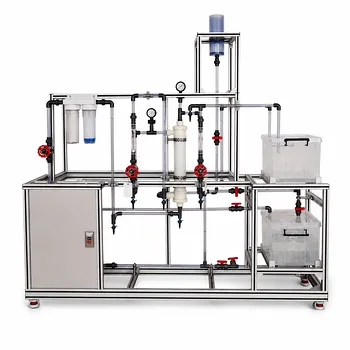
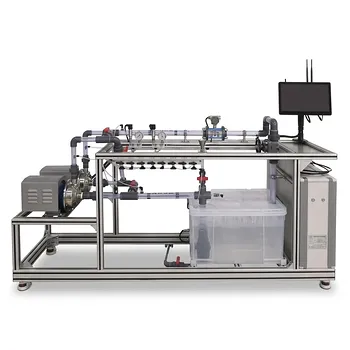
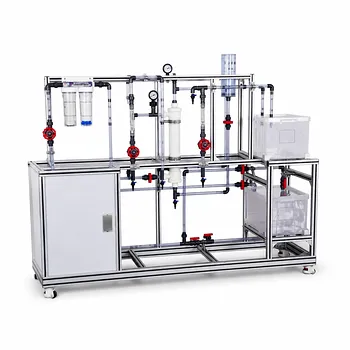
Connect molecular membrane science to practical bioprocessing with LABPARK. Our Educational and Vocational Unit Operations Pilot Plants help universities, research institutes, and enterprises demonstrate membrane separation across chemical engineering, bioprocess and biotech, and environmental and water-treatment applications. Contact us to discuss a pilot-plant configuration that supports hands-on training, controlled lipid-bilayer studies, flux and rejection analysis, fouling evaluation, and comparisons with microfiltration, ultrafiltration, nanofiltration, and reverse osmosis. LABPARK can help you turn selective-permeability concepts into measurable experiments that improve teaching, research, process development, and operator capability.
Related Products
- Multifunctional Membrane Separation Educational Pilot Plant with Ultrafiltration, Nanofiltration, Reverse Osmosis
- Multi-Functional Membrane Separation Educational Pilot Plant for Unit Operations Lab
- Constant Pressure Filtration Educational Unit Operations Pilot Plant
- Ultrafiltration Membrane Separation Educational Pilot Plant
- Photocatalytic Membrane Separation and Degradation Unit Operations Pilot Plant
People Also Ask
- How do PEI, PVDF, and PSU membranes compare in pilot plants? Find the best fit.
- Pervaporation vs. Vapor Permeation: Handling Suspended Solids in Membrane Pilot Plants
- What are the trade-offs of polymer vs inorganic membranes in teaching pilot plants? Key laboratory comparison.
- What are the key flow configuration loops in membrane pilot plants? Optimize Performance
- What are the advantages of membrane separation in pilot plants? Efficient Organic Vapor Recovery