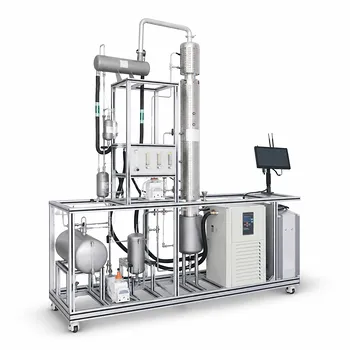
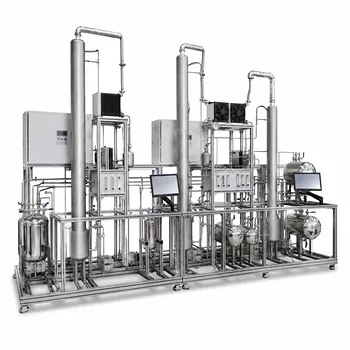
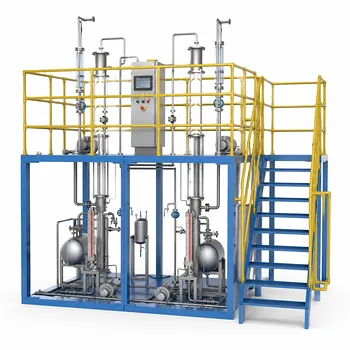
The fundamental method for students to determine phase boundaries in a hydrocarbon distillation lab is a systematic, iterative calculation. This process directly links the abstract thermodynamics of vapor-liquid equilibrium to the physical pressures and temperatures observed on the pilot plant's control panel. You start by setting your system pressure, then use a trial-and-error approach with a thermodynamic data source like a DePriester chart to find the temperature where the mixture's vapor-liquid equilibrium constants ($K_i$) mathematically satisfy the condition for either an incipient bubble or an incipient dew drop.
Bubble and dew point calculations are not just academic exercises; they are the practical foundation for setting every critical temperature in a distillation column, from the reboiler to the overhead condenser. The core challenge lies in mastering the iterative logic, understanding the difference between ideal and non-ideal mixture behavior, and then using your calculated values to validate the real-time sensor data on the pilot plant.
Applying the Iterative Method in Your Lab
The goal is to solve a single equation for each phase boundary. This is done by guessing a temperature, looking up data, checking your math, and refining your guess.
Calculating the Bubble Point ($\sum K_i x_i = 1$)
A bubble point defines the condition where a liquid mixture is at equilibrium with an infinitely small bubble of vapor. In a pilot plant, this is the temperature you would set for the feed preheater or the reboiler to just begin vaporization.
Follow these steps at a known, fixed pressure:
- Define the Liquid: You know the liquid's composition ($x_i$), as this is your starting mixture, feed, or bottom product.
- Guess a Temperature: Make an initial guess for the bubble point temperature ($T_b$).
- Find K-values: Use a DePriester nomograph, or software database, to find the equilibrium constant ($K_i$) for each component at the system pressure and your guessed temperature.
- Check the Summation: Multiply each $K_i$ by its known liquid mole fraction $x_i$, and sum the results. If $\sum K_i x_i = 1.0$, your guess is correct.
- Iterate Intelligently:
- If $\sum K_i x_i > 1.0$, your guessed temperature is too high. Lower it and return to step 3.
- If $\sum K_i x_i < 1.0$, your guessed temperature is too low. Raise it and return to step 3.
- A new temperature guess can be estimated proportionally based on how far from 1.0 the sum is.
Calculating the Dew Point ($\sum y_i / K_i = 1$)
A dew point defines the condition where a vapor mixture is at equilibrium with an infinitely small droplet of liquid. This is the target temperature for your overhead condenser to initiate condensation.
The process is the mirror image of the bubble point calculation:
- Define the Vapor: You know the vapor's composition ($y_i$), which is typically your distillate vapor leaving the top tray.
- Guess a Temperature: Make an initial guess for the dew point temperature ($T_d$).
- Find K-values: Determine the $K_i$ for each component at the system pressure and your guessed temperature.
- Check the Summation: Divide each vapor mole fraction $y_i$ by its $K_i$, and sum the results. If $\sum (y_i / K_i) = 1.0$, your guess is correct.
- Iterate:
- If $\sum (y_i / K_i) > 1.0$, your guessed temperature is too low. Raise it and return to step 3.
- If $\sum (y_i / K_i) < 1.0$, your guessed temperature is too high. Lower it and return to step 3.
Bridging the Gap from Theory to Pilot Plant Hardware
The deep need is to understand how these numbers control a physical machine. Your calculations are the setpoints.
Linking Calculations to Column Equipment
Your calculated points define the thermal boundaries of the entire separation process.
- Feed Preheater: For a saturated liquid feed, the preheater's exit temperature setpoint is exactly your calculated bubble point temperature at the feed stage pressure.
- Reboiler Duty: The bottoms product temperature should align with the bubble point of the bottom mixture. A significant deviation suggests an incorrect boil-up ratio or a pressure measurement error.
- Overhead Condenser: The condensing vapor temperature should correspond to the dew point of the top vapor stream. This temperature directly sets the column's top pressure via the Antoine equation for the distillate composition.
A Practical Validation Exercise
A powerful learning moment comes from closing the loop. After feeding a known mixture, measure the temperatures and pressures at the column's top and bottom in steady-state. Use your iterative method to verify that the measured top temperature matches the dew point of the overhead vapor sample and the measured bottom temperature matches the bubble point of the bottoms liquid sample. A near-match validates both your thermodynamic model and the plant's sensors.
Understanding the Trade-offs and Limitations
The simple iterative method hides assumptions that are often invalid. A true advisor will show you where the pitfalls lie.
The Ideal vs. Non-Ideal Mixture Problem
The DePriester chart method assumes the $K_i$ value depends only on temperature and pressure. This is an ideal system assumption.
- Ideal Systems: For mixtures of chemically similar hydrocarbons like propane and butane, this assumption holds well. The calculation is simple and fast.
- Non-Ideal Systems: For mixtures with polar molecules or significant differences in molecular size (like ethanol and water), the $K_i$ is also a function of composition. Your simple chart is now inaccurate. A nested iterative algorithm is required: an inner loop corrects for liquid-phase activity coefficients, while the outer loop adjusts the temperature, often using a Newton-Raphson method to converge on the solution efficiently.
The Consequences of Getting It Wrong
Incorrect bubble or dew point calculations manifest as operator errors in the lab.
- Reboiler Error: If your bubble point calculation is too high, you may set the reboiler temperature too hot, causing thermal degradation of sensitive components, excessive energy use, or column flooding from too much vapor.
- Condenser Error: If your dew point calculation is too low, you may not sub-cool the condenser enough. Incomplete condensation allows valuable product to escape as vapor loss and makes stable pressure control impossible.
Making the Right Choice for Your Lab Exercise
Your calculation approach should match the goals of your specific training module.
- If your primary focus is understanding basic thermodynamic principles: Master the manual, iterative trial-and-error method with a DePriester chart for an ideal hydrocarbon mixture. This builds a visceral, intuitive feel for how pressure and temperature influence phase equilibrium.
- If your primary focus is validating the pilot plant's sensor calibration: Calculate the dew and bubble points using a high-precision process simulator (like Aspen HYSYS) as your reference, then check if the plant’s physical thermocouples and pressure transducers match the theoretical values within an acceptable error margin.
- If your primary focus is learning to handle complex, non-ideal systems: Move beyond charts immediately. Implement a numerical algorithm that accounts for non-ideality using activity coefficients, and recognize that the simple bubble point pressure equation ($p_b = \sum p_i^s x_i$) is only a rough approximation for your system.
By treating these calculations as a powerful diagnostic tool for an entire operating system, you transform a tedious trial-and-error exercise into the central logic that governs all distillation unit operations.
Summary Table:
| Feature | Bubble Point Calculation | Dew Point Calculation |
|---|---|---|
| Governing Equation | $\sum K_i x_i = 1$ | $\sum (y_i / K_i) = 1$ |
| Known Composition | Liquid mole fraction ($x_i$) | Vapor mole fraction ($y_i$) |
| Iteration Rule | If sum > 1: lower temp; If sum < 1: raise temp | If sum > 1: raise temp; If sum < 1: lower temp |
| Pilot Plant Application | Reboiler & Feed Preheater temperature settings | Overhead Condenser temperature setting |
Bring Thermodynamic Theory to Life with LABPARK
Bridging the gap between complex thermodynamic calculations and real-world pilot plant operation is critical for student success. LABPARK provides premium Educational and Vocational Unit Operations Pilot Plants in chemical engineering, bioprocess & biotech, and environmental & water treatment. Designed specifically for universities, research institutes, and enterprises, our pilot plants offer students hands-on experience to validate bubble and dew point calculations with real-time sensor data.
Ready to upgrade your engineering laboratory? Contact LABPARK today to explore our custom pilot plant solutions and request a configuration guide!
Related Products
- Continuous Sieve-Plate Distillation Pilot Plant for Unit Operations Laboratory Education
- Multi-Modal Distillation Unit Operations Training Pilot Plant
- Green Anhydrous Ethanol Purification Extractive Distillation Unit Operations Training Pilot Plant
- Dual-Mode Rectification Pilot Plant for Practical Training Unit Operations
- Ethyl Acetate Synthesis Unit Operations Pilot Plant for Practical Training
People Also Ask
- How can real-time carbon number prediction improve distillation pilot plants? Optimize control.
- What are the primary reflux ratio control strategies? Master Distillation Unit Operations
- How to select the right activity coefficient model (Wilson, NRTL, UNIQUAC) for distillation pilot plants?
- How does catalyst water concentration affect distillation pilot plant design? Key separation train choices.
- Why is vacuum operation capability an essential feature for a distillation unit operations pilot plant? Unlock Efficiency