Simplifying complex hydrocarbon modeling starts with a strategic grouping. When you’re tasked with simulating a distillation or separation pilot plant for a complex hydrocarbon feed, the most practical first step is to collapse the hundreds of real compounds into a manageable set of pseudocomponents based on chemical family (paraffins, aromatics, olefins, etc.). You then determine the mixture’s critical temperature (Tc) and critical pressure (Pc) from the molar percentages of these pseudocomponents. This introduces a small, acceptable error margin and gives you a far more reliable starting point than rough estimates or black‑box approximations.
The core simplification is to replace an unmanageable list of individual species with a handful of chemically meaningful pseudocomponents. Use their molar fractions to calculate average critical properties, then couple that foundation with a fit‑for‑purpose thermodynamic model and pilot‑plant validation. The result is a workflow that is both computationally light and experimentally trustworthy.
Building the Foundation with Pseudocomponents
Turning a complex hydrocarbon mixture into a workable simulation begins with intelligent grouping. You trade a small loss of molecular detail for a radical gain in practicality.
Group by Chemical Family, Not by Boiling Point Alone
Lumping compounds solely by boiling range often hides non‑idealities. Instead, group by molecular family—paraffins with paraffins, aromatics with aromatics, olefins with olefins. This respects the structural similarities that govern phase behavior and makes the resulting pseudocomponent mixture behave more like the real fluid.
Calculate Critical Properties from Molar Averages
Once you have your pseudocomponents, assign each a representative Tc and Pc (often the true values of a dominant member or a weighted blend). Then compute the mixture’s overall Tc and Pc using the molar fractions of those pseudocomponents. This linear averaging is not rigorous thermodynamics, but for pilot‑plant modeling it yields remarkably accurate vapor‑liquid equilibrium (VLE) predictions without requiring a full compositional analysis.
The Acceptable Error Margin
No pseudocomponent method is exact. Yet for pilot‑plant distillation and separation studies—where you need to size equipment, predict temperature profiles, or select operating pressures—the introduced uncertainty is typically within the engineering tolerance. It is far better than using a single “pseudo‑oil” with guessed properties, which can destabilize simulations and hide convergence problems.
Selecting the Right Thermodynamic Framework
Grouping into pseudocomponents is only half the story. The thermodynamic model that sits on top of this simplified mixture determines whether your simulation mirrors the pilot plant.
Match the Model to the Mixture’s Chemistry
For hydrocarbon‑only mixtures with limited polarity, a straightforward cubic equation of state (like Peng‑Robinson or Soave‑Redlich‑Kwong) often suffices. These models handle the vapor phase well and can be extended to the liquid phase with a single set of consistent parameters.
The picture changes when your mixture contains polar or associating components—water, alcohols, aldehydes, or organic acids. Here, simple equations of state struggle, and you need to treat the vapor and liquid phases differently.
A Multi‑Equation Approach for Non‑Ideal Systems
For polar mixtures, pair a modified equation of state for the vapor phase (e.g., Prausnitz‑Chueh Redlich‑Kwong or a Soave‑Redlich‑Kwong variant) with an activity coefficient model for the liquid phase. The Wilson, NRTL, or UNIQUAC equations are the proven workhorses for these liquid‑phase non‑idealities.
Why this split works: The vapor phase may be non‑ideal, but its fugacity corrections are still best captured by an equation of state. The liquid phase, where strong molecular interactions dominate, is far better described by local‑composition models that can represent hydrogen bonding and size asymmetry.
Lean on UNIFAC When Data Are Scarce
When you lack experimental VLE data for your specific binary pairs, the UNIFAC group contribution method allows you to predict activity coefficients from the functional groups present in your pseudocomponents. It’s not as accurate as a fully regressed NRTL or UNIQUAC, but it is often good enough for scoping studies and early pilot‑plant design.
Bridging Theory and Reality with Pilot‑Plant Validation
Even the best pseudocomponent grouping and model choice need a reality check. The pilot plant is your definitive arbiter.
Regress Binary Parameters Against Real Data
Take VLE data (or liquid‑liquid equilibrium data for extraction units) and regress the binary interaction parameters of your chosen model across the boiling‑point temperature range at the pilot plant’s operating pressure. For NRTL, this gives you parameters that correctly capture the temperature dependence of activity coefficients and match the column’s internal profiles.
Use Pilot‑Plant Runs to Converge Models
When a simulation fails to converge near the mixture’s critical point or shows tray temperatures that drift from measurements, the pilot plant run itself becomes a diagnostic tool. Compare experimental temperature and composition profiles with the model’s predictions. Adjust the binary interaction parameters within physically plausible bounds until the two align. This iterative loop builds a verified process model you can trust.
A Special Note for Liquid‑Liquid Extraction
For LLE pilot plants, relying solely on VLE‑derived parameters or brute‑force data fitting is a common dead end. Instead, first fit binary VLE and LLE data, then optimize parameters with multicomponent LLE experimental data. This combined regression ensures the model reproduces actual distribution coefficients, making your simulation a reliable guide for extraction experiments.
Understanding the Trade‑offs and Limitations
Every simplification carries a cost. Being aware of the pitfalls keeps the workflow honest.
- Pseudocomponent Lump Errors: Grouping dissimilar molecules in the same family can blur subtle phase behavior. Aromatics with different alkylation levels may not act identically. Test your grouping logic against a small set of known pure‑component data before committing.
- Convergence in Critical Regions: Even well‑tuned models can show numerical instability near the mixture’s critical point. When this happens, slightly reduce the model’s rigor (e.g., use a simpler mixing rule) or confine the simulation range just outside the problematic region.
- Extrapolation Danger: A model regressed on a narrow temperature or pressure range may behave erratically outside that window, even if the published limits suggest otherwise. Always validate with at least one pilot‑plant point at the new condition.
- Data‑Hungry Activity Models: NRTL and UNIQUAC require binary interaction parameters for every pair. Without experimental data, you rely on UNIFAC estimates—accepting a larger margin of error. The effort to obtain even a few key binary VLE points often pays back substantially in prediction quality.
Making the Right Choice for Your Research Goal
Your specific objective determines where you draw the line between simplicity and rigor. Use these guidelines to navigate the decisions.
- If your primary focus is rapid feasibility screening: Start with pseudocomponent grouping and a simple cubic equation of state (Peng‑Robinson or SRK). Use UNIFAC for activity coefficients when polarity is moderate. This lightweight approach will quickly tell you if a separation is thermodynamically viable.
- If your primary focus is high‑fidelity modeling of polar or associating mixtures: Invest in the multi‑equation approach: a modified equation of state for the vapor phase and Wilson, NRTL, or UNIQUAC for the liquid phase. Regress binary parameters against experimental VLE data, even if you must generate a few key data points yourself.
- If your primary focus is validating a specific pilot‑plant operation: Build the model with pseudocomponents, select the model class (NRTL or UNIQUAC), and then regress parameters directly against the pilot plant’s own temperature and composition measurements. This closed‑loop method ties the model intimately to your physical hardware.
- If your primary focus is scaling up from pilot to production: Combine pseudocomponents with UNIQUAC or NRTL parameters regressed from multicomponent VLE and LLE data that span the expected operating envelope. This gives you a model robust enough to survive the transition from a laboratory column to a full‑scale unit.
A well‑chosen simplification is not a shortcut—it is a deliberate, defensible strategy that turns an overwhelming computational problem into a transparent, experimentally grounded engineering tool.
Summary Table:
| Modeling Phase | Key Strategy | Recommended Approach |
|---|---|---|
| 1. Mixture Simplification | Pseudocomponent Grouping | Group by chemical family (paraffins, aromatics, etc.) and calculate molar average Tc and Pc. |
| 2. Framework Selection | Chemistry-Matched Models | Use Cubic EOS (e.g., Peng-Robinson) for hydrocarbons; use NRTL/UNIQUAC for polar/associating mixtures. |
| 3. Model Validation | Pilot-Plant Feedback Loop | Regress binary interaction parameters against experimental temperature and composition profiles. |
Bridge the Gap Between Thermodynamic Theory and Physical Reality
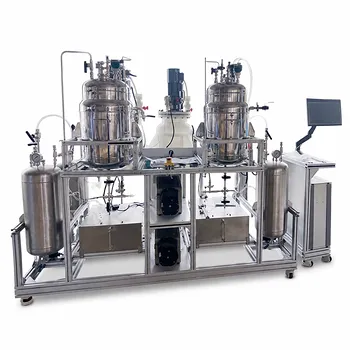
To successfully validate your thermodynamic models, you need reliable, industry-grade hardware. LABPARK provides advanced Educational and Vocational Unit Operations Pilot Plants in chemical engineering, bioprocess & biotech, and environmental & water treatment. Designed specifically for universities, research institutes, and enterprises, our pilot plants enable researchers and students to safely run real-world separation and distillation experiments.
Ready to elevate your chemical engineering laboratory? Contact LABPARK today to explore our customizable pilot plant solutions!
Related Products
- Continuous Sieve-Plate Distillation Pilot Plant for Unit Operations Laboratory Education
- Multi-Functional Special Distillation Educational Pilot Plant
- Continuous Batch Extractive Distillation Educational Pilot Plant
- Multi-Modal Distillation Unit Operations Training Pilot Plant
- Electrolyte Distillation Purification and Formulation Educational Pilot Plant
People Also Ask
- How does catalyst water concentration affect distillation pilot plant design? Key separation train choices.
- Why is vacuum operation capability an essential feature for a distillation unit operations pilot plant? Unlock Efficiency
- What are the primary reflux ratio control strategies? Master Distillation Unit Operations
- How to select the right activity coefficient model (Wilson, NRTL, UNIQUAC) for distillation pilot plants?
- How can real-time carbon number prediction improve distillation pilot plants? Optimize control.