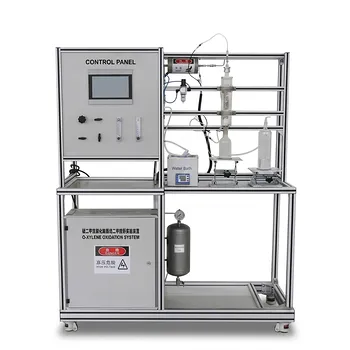
Mixing sensitivity is revealed by a simple comparative experiment in the lab.
Researchers can identify a mixing-limited reaction before scaling up by performing two side-by-side tests: one where the reagent is added slowly to a well-stirred flask, and another where it is added quickly with poor mixing. If the product purity, selectivity, or impurity profile differs significantly between the two runs, the reaction is mixing‑sensitive and will likely suffer at larger scales. Additionally, calculating the dimensionless Damköhler number (Da)—the ratio of the characteristic mixing time (e.g., blend time) to the reaction time—provides a theoretical gauge: a Da ≫ 1 signals mixing control, while Da ≪ 1 points to kinetic control.
To avoid scale-up disasters, determine whether your reaction’s speed outstrips the blending rate of your intended vessel. Two lab‑scale diagnostics—comparative addition tests and the Damköhler number—offer a rapid pre‑screening. When mixing dominates, pilot‑plant experiments with controlled agitation then confirm the limitation and guide mitigation.
Why Mixing Matters at Scale
The Hidden Trap of Lab Glassware
In a typical laboratory flask, blend times are often just 1–2 seconds.
This masks mixing limitations because the liquid homogenises almost instantly.
Scale‑up to a pilot‑plant reactor can increase blend times to 30 seconds or more.
Slow blending creates localised zones of high reagent concentration, triggering unwanted side reactions and eroding selectivity.
Understanding the Mixing‑Timescale Gap
The core concept is the Damköhler number (Da)—the ratio of the mixing timescale to the reaction timescale.
For a second‑order reaction, if the half‑life is shorter than the blend time, the reaction “sees” a poorly mixed environment and by‑products will form.
- Da = mix time / reaction time
- Da ≫ 1 : Reaction is faster than mixing → mixing‑limited.
- Da ≪ 1 : Mixing is faster than kinetics → kinetically controlled.
A rapid acid‑base neutralisation often has a Da of 100 or more—it is firmly mixing‑controlled in anything larger than a beaker.
Pre‑Scale‑Up Lab Diagnostics
Comparative Addition Tests (The “Poor Mixing” Stress Test)
The most direct test comes from the primary reference: run two experiments in the same glassware.
- Well‑mixed, slow addition: Add the reagent dropwise with strong stirring.
- Poorly mixed, fast addition: Dump the same amount of reagent quickly with minimal stirring.
If the product purity or selectivity drops noticeably in the second case, the reaction is mixing‑sensitive.
This simple side‑by‑side reveals how local concentration spikes affect the outcome.
Agitation Speed Variation Experiments
Another robust method is to repeat the reaction at two or three different stirrer speeds (e.g., 200, 600, and 1000 rpm) while taking multiple samples over time.
Keep all other variables—temperature, catalyst loading, feed rate—constant.
- If conversion or impurity levels change with rpm: The reaction is influenced by macromixing (bulk blending) or mesomixing (feed‑zone mixing).
- If there is no change: The reaction is most likely kinetically controlled, and mixing is already fast enough.
This experiment works well in standard lab reactors and provides a clear go/no‑go signal before investing in pilot‑plant time.
Damköhler Number Calculation
You don’t always need to run wet experiments to spot trouble.
Estimate the blend time in your planned vessel using empirical correlations or a decolourisation tracer test, then compare it with the reaction half‑life or characteristic reaction time.
- If the blend time is 10× longer than the reaction half‑life, treat the system as mixing‑limited.
- The Da framework helps you decide whether to slow the kinetics (lower temperature, more dilute feeds) or to improve mixing.
The Pilot Plant’s Role in Confirmation
Diagnostic Addition-Order Reversals
In a pilot‑scale unit, compare forward versus reverse addition of the same materials.
If the heat‑flow profile or product yield is significantly different, then a substantial amount of reaction is occurring during the addition itself—proof that mixing is the bottleneck.
Controlled Agitation and Heat‑Flow Tracking
Pilot plants equipped with variable‑speed agitators and precise calorimetry let you rigorously confirm lab findings.
Run replicate experiments at, say, 200 rpm and 1000 rpm while monitoring the rate of heat release.
- If the reaction rate increases with stirrer speed, the system is mixing‑controlled.
- If the rate is insensitive, the system is kinetically controlled, and you can focus on temperature and concentration optimisation.
This data is invaluable for building a reliable scale‑up model.
Bridging Lab and Production
Once mixing is identified as the limit, the pilot plant becomes a testbed for mitigation.
Strategies like fed‑batch operation with low feed concentration, reduced temperature to slow kinetics, or altered impeller geometry can be evaluated under realistic hydrodynamic conditions before committing to full‑scale equipment.
Understanding the Trade‑offs and Pitfalls
Limitations of Lab‑Scale Diagnostics
Lab glassware can still give a false sense of safety.
Even a “poorly mixed” flask may have blend times under 5 seconds, far faster than the 30‑second reality of a production vessel. A reaction with a half‑life of 10 seconds might appear kinetically controlled in the lab but become mixing‑limited at scale.
The Risk of Oversimplifying Da
A single Damköhler number assumes a perfectly mixed tank, yet real reactors have spatial distributions of mixing intensity.
A reaction may be mixing‑limited near the feed point but not elsewhere. Therefore, Da should always be paired with experimental stress tests and not used as the sole decision criterion.
When Pilot Plants Are Essential
For multiphase systems (gas–liquid, solids loading), viscous fluids, or highly exothermic reactions, lab‑scale diagnostics can be misleading.
Poor mixing may entrain gas differently, change particle suspension, or create dangerous thermal runaways. A pilot‑scale run under real process conditions remains the gold‑standard validation.
Making the Right Choice for Your Scale‑Up Goal
Your strategy depends on where you are in the development timeline and what risks you can tolerate.
- If your primary focus is rapid risk screening before any scale‑up: Run the poor‑mixing stress test alongside a normal run and calculate the Damköhler number. If Da > 10 or selectivity drops by more than 5%, treat the reaction as mixing‑limited and plan for mitigation from the start.
- If your primary focus is process optimisation in the pilot plant: Use variable agitation and addition‑order reversal experiments to pinpoint the exact mixing bottleneck. Then adjust feed strategy (slow addition, dilute feeds) or lower the temperature to give blending a head start over kinetics.
By combining simple lab diagnostics with strategic pilot‑plant experiments, you can reliably unmask mixing limitations and build a robust, scalable chemical process.
Summary Table:
| Diagnostic Method | Test Protocol | Mixing-Limited Indicator |
|---|---|---|
| Comparative Addition | Compare slow addition/high stir vs. fast addition/low stir. | Significant decrease in product purity or selectivity. |
| Agitation Speed Variation | Run reactions at varying RPMs (e.g., 200 vs. 1000 RPM). | Reaction rate or impurity profile changes with speed. |
| Damköhler Number (Da) | Calculate: Mixing timescale / Reaction timescale. | Da ≫ 1 (mixing is slower than chemical kinetics). |
| Pilot-Scale Calorimetry | Monitor heat release at different agitation speeds. | Heat-flow profile changes with stirrer speed. |
Ensure Seamless Scale-Up with LABPARK Pilot Plants
Don't let mixing limitations ruin your process scale-up. LABPARK provides state-of-the-art Educational and Vocational Unit Operations Pilot Plants in chemical engineering, bioprocess & biotech, and environmental & water treatment. Specially designed for universities, research institutes, and enterprises, our pilot plants enable precise fluid dynamics testing, reliable heat-flow tracking, and accurate process validation.
Ready to optimize your scale-up process? Contact LABPARK today to find the perfect pilot plant solution for your facility!
Related Products
- Fixed-Bed Chemical Reaction and Gas Dust Tar Removal Unit Operations Pilot Plant
- Fixed Bed Gas Solid Catalytic Reaction Educational Pilot Plant
- Multi-Reactor Educational Pilot Plant for Reaction Engineering Unit Operations
- 100L Continuous Loop Hydrogenation Educational Unit Operations Pilot Plant
- O-Xylene Oxidation to Phthalic Anhydride Educational Unit Operations Pilot Plant
People Also Ask
- When to transition from PID to adaptive control in pilot plants? Key process indicators.
- How do deviations in estimating latent heat impact pilot plant thermal systems? Avoid hardware mis-sizing.
- Why Compare Predicted and Experimental Excess Enthalpy? Key to Accurate Pilot Plant Scale-up
- How to study gasification in pilot plants? Compare exit gas composition & efficiency
- Why Use PTFE & Hastelloy in Chemical Pilot Plants? Prevent Corrosion & Ensure Safety