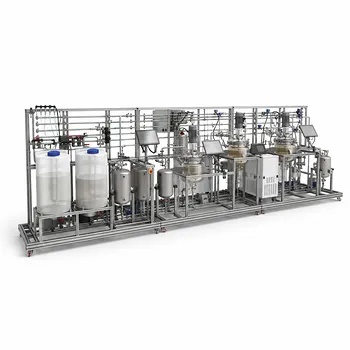
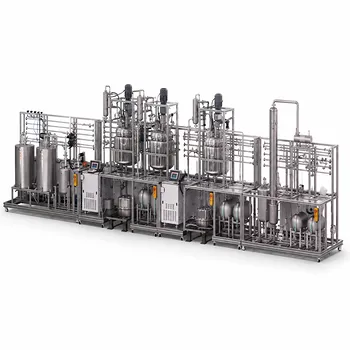
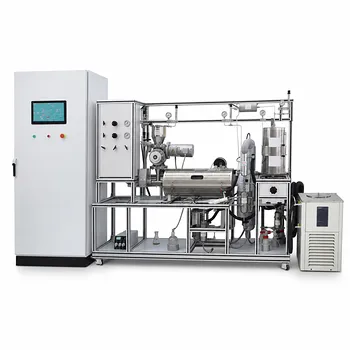
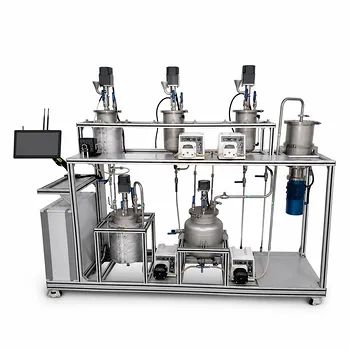
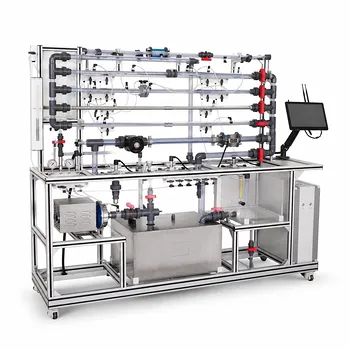
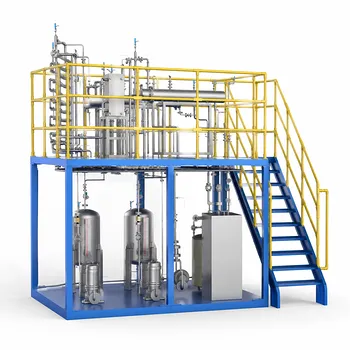
The most direct answer is that bridging this gap requires a disciplined, staged scale-up methodology that translates high-throughput screening rankings into validated process knowledge using pilot-scale unit operations. High-throughput (HT) parallel screening rapidly identifies lead candidates by testing many samples simultaneously, but the data it generates is inherently qualitative due to limited individual sample control. To bridge the gap, research laboratories must then validate only the top candidates in a pilot plant—a system that sacrifices parallelization to deliver the precise control over heat, mass transfer, and hydrodynamics needed to mimic commercial-scale conditions. This systematic progression from rough screening to high-fidelity validation is what converts promising chemistry into a viable, scalable process.
High-throughput screening tells you which catalyst to look at; pilot-plant validation tells you how it will actually perform at scale. The gap is bridged not by refining the screening itself, but by accepting its inherent data-quality limitations and integrating it into a larger workflow where realistic, continuous-flow pilot studies serve as the critical translation step.
Why the Gap Exists: The Fundamental Trade-off in Catalyst Testing
The disconnect between HT results and pilot-plant reality stems from a deliberate design difference, not a flaw. HT systems maximize throughput; pilot plants maximize data fidelity. Understanding this trade-off is the first step toward bridging the gap.
The Data Quality Parallelization Penalty
As you increase the number of parallel samples, individual control over each catalyst’s reaction environment degrades rapidly.
A primary screen testing over 250 samples cannot maintain uniform temperature, well-defined space velocity, or consistent feed-catalyst contact across all reactors. You sacrifice the ability to isolate heat and mass transfer effects.
The result is a rough relative ranking—good enough to winnow candidates, but dangerously incomplete for predicting full-scale behavior. A top-performing catalyst in a poorly mixed HT cell might fail spectacularly in a real reactor with sharp thermal gradients.
What Pilot Plants Provide That HT Arrays Cannot
A pilot plant, typically evaluating just 1 or 2 samples at a time, flips the priority: it maximizes control while sacrificing throughput.
This control is non-negotiable for scale-up. Pilot reactors provide well-defined residence time distributions, precise temperature profiles, and quantifiable mass transfer coefficients across the catalyst bed.
Only under these conditions can you measure true intrinsic kinetics, identify potential hot spots, and assess catalyst lifetime under continuous flow—the exact data engineers need to design a commercial unit. The primary reference correctly notes that pilot plants allow researchers to “validate catalyst performance under realistic, continuous flow conditions” and “evaluate heat and mass transfer limitations.”
The Bridge: A Staged Workflow from Screening to Validation
Bridging the gap is not about a single technique; it’s about a logical sequence. The most effective research groups adopt a tiered approach that progressively reduces parallelization while increasing process realism.
Stage 1: Parallel Screening as a Funnel, Not a Predictor
View your HT data as a selection tool, not a design tool. The goal is to rapidly scan a wide parameter space (catalysts, promoters, supports) and choose a handful of leads.
Accept that the quantitative data—turnover frequencies, selectivity at given conversions—carries a wide error band due to poorly defined flow. Use it to rank order, not to build a kinetic model.
The supplementary references reinforce this: as parallelization increases, “space velocity and feed-catalyst interaction become poorly defined.” That’s acceptable for a funnel; it’s disastrous for final design.
Stage 2: Lab-Scale Refinement with Controlled Bench Reactors
Before jumping to a pilot plant, selected candidates move to a lab-scale reactor array (1–8 samples). Here, you regain independent control over temperature, pressure, and Weight Hourly Space Velocity (WHSV) for each channel.
This is where you begin to decouple kinetics from transport phenomena. By varying flow rates and particle sizes, you can confirm that you are measuring true catalytic activity, not just mass transfer limitations masked by the HT rig.
This stage bridges the language between the screening team and the process engineers, producing high-accuracy performance data that feeds directly into pilot plant design.
Stage 3: Pilot-Plant Validation Under Industrial Mimicry
The final bridge is the unit operations pilot plant, which tests a single catalyst (or a single pair) in a fully instrumented, continuous-flow system that mirrors commercial reactor configurations.
Every parameter—feed purity, recycle streams, pressure drop, axial temperature profiles—can be controlled and monitored. This is the environment where you:
- Validate lifetime under realistic feed contaminants.
- Optimize process control loops (temperature ramps, flow ratios).
- Generate the high-fidelity data sets (mass & energy balances) required for a rigorous techno-economic analysis.
Understanding the Trade-offs and Pitfalls
A sincere bridging strategy must acknowledge the inherent compromises. Blurring these lines leads to costly scale-up failures.
The Danger of Over-Relying on HT Absolute Values
Treating HT selectivity or activity numbers as predictive of pilot performance is a classic trap. The uncharacterized flow patterns in a heavily parallelized array can artificially flatten temperature profiles or mask channeling. A catalyst that appears selective in an isothermal HT screening cell might produce far more byproducts in an adiabatic pilot reactor where a heat front develops. Always sanity-check HT leads against expected thermodynamic and transport constraints.
The Cost-Time Trade-off in the Workflow
Progressing from HT screening to a well-instrumented pilot plant is resource-intensive. It demands capital for reactor hardware, analytical tools, and skilled operators. However, the cost of not bridging the gap—building a commercial plant on flawed data—is exponentially higher. The staged workflow balances risk, concentrating resources on the few catalysts that have a real chance of success.
Maintaining Representative Sampling at Every Scale
A common pitfall is inadequate sampling protocols. As you scale down parallelization and scale up physical reactor size, you must ensure that product analysis downstream remains representative. Pilot plants must avoid dead volumes, condensation, or side reactions in sample lines. This rigorous sampling hygiene is exactly what the pilot-plant environment is designed to provide but which HT rigs often lack.
How to Apply This to Your Project
The right bridging strategy depends entirely on your primary goal. Use this guidance to tailor your approach.
- If your primary focus is speed of catalyst discovery: Accept the data quality trade-off and use HT screening purely to generate leads. Immediately transition the top 3–5 candidates to a lab-scale or micro-reactor for controlled kinetic measurements before any claims of scalability.
- If your primary focus is generating reliable scale-up data for a specific process: Minimize reliance on extensive parallel screening. Instead, invest in a carefully designed pilot plant study on a few pre-selected catalysts, prioritizing precise control of WHSV, temperature, and flow distribution to produce engineering-grade validation.
- If your primary focus is training researchers on industrial workflow: Use the entire staged bridge as a pedagogical tool. Have students experience the data quality degradation at high parallelization, then the insight gained at the controlled bench and pilot scale, reinforcing why unit operations pilot plants are the gold standard for process validation.
Bridging the gap is ultimately an exercise in intellectual discipline: respecting what each scale of testing can and cannot tell you, and committing to the staged sequence that turns a catalog of catalyst leads into a bankable industrial process.
Summary Table:
| Stage | Testing Scale | Primary Focus | Control Level | Output Data Type |
|---|---|---|---|---|
| 1. Parallel Screening | High-Throughput (HT) | Candidate Selection (Funnel) | Low (Poorly defined flow) | Relative rankings |
| 2. Lab-Scale Refinement | Bench Reactor Array | Decoupling Kinetics & Transport | Medium (Independent control) | High-accuracy data |
| 3. Pilot-Plant Validation | Unit Operations Pilot Plant | Industrial Process Mimicry | High (Precise heat & mass control) | Engineering-grade data |
Bridge the Gap from Lab to Scale with LABPARK
Transitioning from screening to pilot-scale validation requires reliable, high-fidelity equipment. LABPARK provides premium Educational and Vocational Unit Operations Pilot Plants across chemical engineering, bioprocess & biotech, and environmental & water treatment.
Whether you are a university, research institute, or enterprise, our pilot systems empower you to accurately evaluate heat/mass transfer, assess catalyst lifetime, and generate bankable engineering data.
Ready to elevate your research? Contact LABPARK Today to find the perfect pilot plant solution for your project.
Related Products
- Natural Product Extraction Unit Operations Training Pilot Plant
- Fixed-Bed Chemical Reaction and Gas Dust Tar Removal Unit Operations Pilot Plant
- Ethyl Acetate Synthesis Unit Operations Pilot Plant for Practical Training
- Methanol Synthesis and Catalyst Performance Evaluation Educational Unit Operations Pilot Plant
- Electrolytic Hydrogen Production Educational Unit Operations Pilot Plant
People Also Ask
- How to Demo Solubility Sensitivity in SFE Pilot Plants? Practical Thermodynamics
- How do pilot plants differentiate physical vs chemical extraction? Enhance Chemical Engineering Training
- How are HTU and NTU applied to determine extraction column height? Guide to Pilot Plant Scaling
- How can Hotelling's T² & Q statistics detect pilot plant abnormalities? Optimize Safety
- Why use split-plot designs in pilot plants instead of CRD? Optimize process parameters effectively.