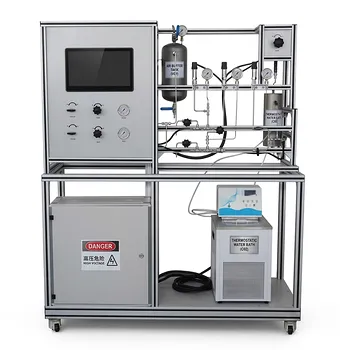
One of the most critical responsibilities for a pilot plant operator is knowing—before a single drop of reactant flows—whether a non-adiabatic tubular reactor can stay in a stable, safe operating zone. You can confidently predict a unique steady state by verifying that the reactor operates in a regime where convection utterly dominates dispersion (a high Péclet number), heat transfer to the cooling jacket is highly efficient (large dimensionless heat transfer coefficient δ), the reaction rate is slow relative to the transport rate (small Damköhler number Da), and the overall reactor length is sufficiently short. When these four qualitative pillars stand together, the coupled heat and mass balances lock into one and only one temperature-and-conversion profile, shutting the door on the dangerous multiplicity of steady states that leads to thermal runaway.
Predicting a unique stable steady state in a non-adiabatic tubular reactor is not a matter of hoping—it is a direct consequence of operating in a parameter space where transport phenomena overwhelm the reaction’s potential to bifurcate. By dialing in a high Pe, a high δ, a low Da, and a modest L, the operator imposes an ironclad stability guarantee, transforming the reactor’s complex, coupled physics into a predictable, single-solution system.
The Hidden Complexity Behind the Question
At first glance, the surface need is a checklist of parameter limits. But the deep need is to understand why those parameters work—and what terrible things happen when they don’t. A non-adiabatic tubular reactor is a system where heat and mass balances are inextricably coupled. Unlike an adiabatic case or a perfectly mixed tank, any local temperature spike instantly distorts the concentration profile, and any change in conversion feeds back into the heat generation term. When the Lewis number Le ≠ 1 or the thermal and mass Péclet numbers diverge (Pe_h ≠ Pe_m), the system of partial differential equations becomes non-self-adjoint, making a clean analytical stability proof nearly impossible without resorting to sufficiency methods like the direct Liapunov technique.
Why Multiplicity Is the Real Threat
The danger isn't just that the reactor might drift—it’s that for exactly the same flow rates, coolant settings, and feed composition, the reactor can settle into up to seven distinct steady states. Some of these states are hot and high-conversion, some are cold and low-conversion, and some are unstable nodes that can spit the system straight into a runaway. This phenomenon, called steady-state multiplicity, is the practical nightmare you’re trying to avoid.
How Bifurcations Turn Stable into Chaotic
Even if the reactor manages to find a single steady state, that state itself can become unstable through Hopf bifurcations, giving birth to self-sustained oscillations. In a pilot plant, these oscillations may first appear as a wobbly temperature trace, but they are the early warning that the system is dancing on the edge of a runaway cliff. Understanding the four stability pillars is your shield against this entire cascade of nonlinear misbehavior.
The Four Pillars of a Unique Steady State
The primary reference offers a qualitative compass based on the axial dispersion model. These four conditions are not just independent knobs; they interact, but each contributes a distinct layer of security.
A High Péclet Number (Pe) Forces Convection to Discipline the Reactor
The Péclet number is the ratio of convective transport to diffusive or dispersive transport. When Pe is high, the axial dispersion of heat and mass is suppressed. This matters because dispersion is the enemy of uniqueness—it allows upstream information to feed back and create multiple possible profiles. By running a high fluid velocity (increasing flow rate) or reducing axial mixing, you make the reactor behave more like an orderly plug-flow system with a single, deterministic outcome.
A High Heat Transfer Coefficient (δ) Starves the Potential for Hot Spots
The dimensionless parameter δ captures how effectively the cooling jacket can suck heat out of the reaction mixture. A high δ means that even if a localized exotherm tries to ignite a higher reaction rate, the extra heat is immediately removed. This thermal “stiffness” prevents the positive feedback loop that would otherwise generate an alternative high-temperature steady state. In a pilot plant, you adjust δ by increasing the coolant flow rate, lowering the coolant temperature, or improving the heat transfer surface area.
A Low Damköhler Number (Da) Keeps the Reaction’s Appetite in Check
Da compares the characteristic reaction rate to the transport rate. A small Da means the reaction is slow relative to how fast material moves through the reactor. The consequence is profound: heat generation never outruns heat removal. Even if a small temperature bump accelerates the kinetics locally, the overall residence time is too short for that bump to grow into a full-blown alternative state. Lowering Da is often as simple as increasing the feed flow rate.
A Shorter Reactor Length (L) Limits the Canvas for Instability
A long reactor gives instability more physical space to develop. Since dispersion and reaction can interact over a greater distance, multiple steady-state profiles have room to form. A shorter reactor length reduces the contact time and the axial extent over which feedback loops can organize into competing solutions. It is a brute-force but effective way to eliminate multiplicity.
How Operators Translate These Pillars into Pilot Plant Predictions
You cannot directly read Pe, δ, and Da off a standard gauge. Instead, you command their physical counterparts—flow rate, coolant circulation, and reactor geometry—and then verify the reactor’s response against the stability boundaries.
Using Flow Rate to Master Pe and Da Simultaneously
Increasing the flow rate is the single most powerful lever: it raises Pe (reducing dispersion) and lowers Da (reducing reaction-to-transport ratio). In a pilot plant, operators systematically vary the feed pump speed while monitoring the axial temperature profile. The moment the profile becomes repeatable and insensitive to small perturbations—lacking any ignition–extinction hysteresis—you have empirical evidence that Pe and Da are in the safe zone.
Tuning the Cooling System to Push δ Above the Critical Threshold
The supplementary references reveal a crucial parameter: the ratio of the heat transfer parameter to the Damköhler number, δ/Da. Thermal runaway theory shows that a critical heat of reaction parameter B_c defines a boundary. Operators must maintain (δ/Da) above the value that prevents the second and third derivatives of temperature with respect to conversion from vanishing. In practice, this means monitoring the coolant jacket’s outlet temperature and flow, and ensuring that the heat removal rate scales correctly with the reaction heat release as you adjust the feed flow.
Recognizing the Limits Imposed by Activation Energy and Reaction Order
While the four pillars are transport-focused, the chemistry cannot be ignored. A high activation energy (γ) makes the reaction exquisitely sensitive to temperature; even a well-cooled reactor can tip into multiplicity if γ is too large for the chosen δ/Da. Similarly, small reaction orders sustain high rates deep into the conversion, making it harder to quench a runaway candidate. In prediction, you must incorporate these chemical pressures by demanding even larger δ/Da margins for high-γ, low-n systems.
Accounting for the Dissimilarity of Heat and Mass Dispersion
When Pe_h ≠ Pe_m or Le ≠ 1, the stability region shrinks. Operators need to be acutely aware of the reactor’s packing, the coolant jacket design, and the flow conditions that create different effective dispersion coefficients. The practical prediction is: if you are running a catalyst bed where radial heat conduction is poor (low Pe_h) or a liquid-phase system where thermal and mass diffusivities differ drastically, you must tighten the other pillars—either raise the total flow rate further, increase δ further, or shorten the bed—to compensate for the narrowed stability window.
Understanding the Trade-offs
Pursuing absolute stability is not a cost-free exercise. A short, high-flow, heavily cooled reactor may guarantee a single steady state, but it can also crush your primary objective.
Sacrificing Conversion for Safety
A low Damköhler number means low conversion per pass. A super-high flow rate might give you a unique steady state at the cost of an unacceptably low product yield, requiring massive separation and recycle loops. Operators must balance safety margins against process viability.
The Paradox of Over-Cooling
While a high δ is stabilizing, an extremely low jacket temperature can create large radial temperature gradients even if the overall state is unique. These gradients can catalyze localized catalyst deactivation or unwanted side reactions, especially in heterogeneous systems like Fischer-Tropsch where microchannel reactors illustrate that near-isothermal operation often demands both high conductive substrates and careful geometry design—not just aggressive cooling.
The Danger of Creating a False Sense of Security
Checking the pillars at one flow rate or coolant setting does not guarantee stability across the full operating window. Bifurcation diagrams are parameter-dependent. A pilot plant campaign must explore the boundaries by deliberately inducing small perturbations (e.g., a temporary increase in feed temperature) to see if the reactor returns to its original profile or snaps to a new one. Only then can you confirm that the uniqueness you predicted is robust.
Making the Right Choice for Your Pilot Plant Goal
To apply these predictive criteria effectively, align your operating strategy with your specific objective.
- If your primary focus is maximum inherent safety during novel catalyst screening: Prioritize a short bed length, a very high heat transfer coefficient (via microchannel or structured packing if possible), and a flow rate that yields Da < 0.1 to guarantee a single, low-temperature steady state, even if it means accepting low conversion.
- If your primary focus is demonstrating scalable, economically viable conversion: Find the operational sweet spot where the critical δ/Da ratio is satisfied with a just-sufficient margin—monitor the disappearance of temperature profile hysteresis as you incrementally adjust flow—to run as close to the stability boundary as safety protocols allow.
- If your primary focus is educational mapping of bifurcation behavior: Utilize the four pillars not as absolute limits but as levers to deliberately traverse the stability frontier, systematically reducing δ or increasing Da while watching for the emergence of oscillations and multiple steady states, and always having a pre-programmed safety shutdown tied to the onset of high sensitivity.
- If your primary focus is dealing with high-activation-energy, low-reaction-order systems: Compensate by imposing a Péclet number at least 50% higher than what a simple isothermal analysis would suggest, and ensure the coolant jacket’s inlet temperature is controlled to a level that keeps the heat transfer parameter well above the critical runaway locus for the specific B and γ values of your chemistry.
Stability is not found by accident—it is designed by deliberately forcing the reactor into a transport-dominated regime where the physics simply cannot support more than one solution.
Summary Table:
| Parameter | Symbol | Role in Stability | Operational Action |
|---|---|---|---|
| Péclet Number | Pe | Suppresses axial dispersion (forces convection) | Increase feed flow rate / fluid velocity |
| Dimensionless Heat Transfer | δ | Enhances cooling (prevents hot spots) | Increase coolant flow / lower coolant temp |
| Damköhler Number | Da | Limits reaction rate relative to transport | Increase feed flow rate (lower residence time) |
| Reactor Length | L | Restricts the physical space for feedback loops | Select shorter reactor beds or microchannel designs |
Empower Your Chemical Engineering Lab with LABPARK
Mastering complex reactor dynamics and avoiding thermal runaway requires hands-on, reliable training systems. LABPARK provides premium Educational and Vocational Unit Operations Pilot Plants in:
- Chemical Engineering (including advanced tubular and batch reactors)
- Bioprocess & Biotech
- Environmental & Water Treatment
Tailored specifically for universities, research institutes, and enterprises, our systems bridge the gap between thermodynamic theory and industry-grade practice.
Ready to elevate your engineering curriculum or research capabilities? Contact us today to explore our pilot plant solutions!
Related Products
- Residence Time Distribution and Reactor Flow Characteristics Determination Educational Pilot Plant
- Educational Unit Operations Pilot Plant for Intraparticle Diffusion Effective Factor Measurement
- Tubular Reactor Flow Characteristics Determination Educational Unit Operations Pilot Plant
- O-Xylene Oxidation to Phthalic Anhydride Educational Unit Operations Pilot Plant
- Multi-Stage Stirred Tanks in Series Residence Time Distribution and Mixing Performance Determination Educational Pilot Plant
People Also Ask
- Why is temperature regulation via a cooling jacket a critical feature in CSTR pilot plants used for laboratory training?
- What parameters to monitor transitioning from Batch to CSTR? Master Pilot Plant Setup
- How does CSTR cooling jacket design influence stability? Control reactor oscillations.
- What is the significance of CSTR chaotic behavior? Master Reactor Safety
- How does steady-state multiplicity affect the operation and safety of exothermic reactions within a CSTR pilot plant? - Guide