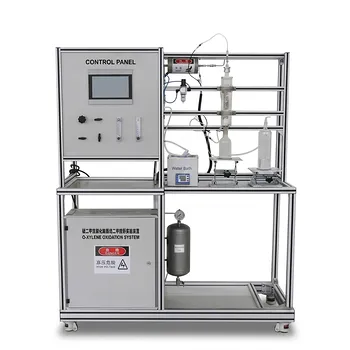
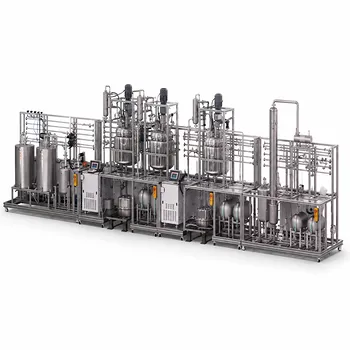
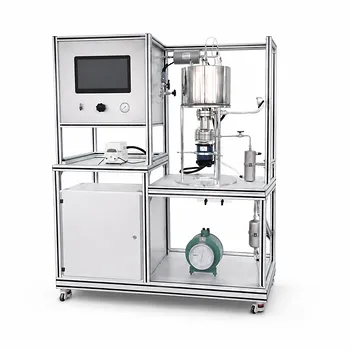
The most direct way to demonstrate mixed-integer non-linear programming (MINLP) and superstructure optimization with a reactor pilot plant is to treat the plant as a modular network of alternative pathways. In this setup, binary integer variables represent the open/closed state of valves connecting a continuous stirred-tank reactor (CSTR), a plug flow reactor (PFR), and bypass lines. By coupling these discrete choices with the non-linear kinetic models of the reacting system, students can solve an optimization problem that selects the best configuration to achieve a target conversion at minimal cost or energy consumption.
MINLP and superstructure optimization become tangible when a pilot plant is viewed as a decision-rich system of discrete alternatives (reactor type, material grade, or interconnection) governed by non-linear physical laws. This hands-on approach equips engineers to move directly from theoretical equations to an optimal, implementable process design.
The Pilot Plant as a Living Optimization Problem
A well-instrumented reactor pilot plant is an ideal sandbox for teaching advanced process synthesis. It offers physical, visual feedback for mathematical concepts that otherwise remain abstract.
Encoding a Reactor Superstructure with Binary Variables
Start by defining a superstructure that embeds all plausible reactor arrangements. For example, a piping and valve network can connect a CSTR and a PFR in parallel, each with its own bypass line. The control valves that allow flow into these pathways act as binary decision points: 1 means open (reactive), 0 means closed (bypassed). This transforms the plant from a fixed piece of hardware into a reconfigurable optimization problem.
The objective becomes something like minimize total residence time or minimize a cost function while guaranteeing a minimum conversion. The valves’ binary states appear as integer variables ($y_{CSTR}$, $y_{PFR}$, $y_{bypass}$) in the problem formulation, directly reflecting the pilot plant’s physical reality.
Modelling Non-Linear Kinetics with Real Reactors
The “non-linear” in MINLP comes from the reaction kinetics. A simple first-order reaction would be linear in concentration, but real pilot-plant chemistry often follows non-linear rate laws—second-order dependencies, Langmuir-Hinshelwood expressions, or temperature-sensitive Arrhenius terms. These non-linearities appear in the constraints that relate conversion to residence time, temperature, and flow pattern.
By measuring actual kinetic data on the pilot plant (or using well-established kinetic models) and feeding them into the optimization, students witness how a MINLP solver navigates both discrete topology choices and the non-linear material balances simultaneously. The result is not a hypothetical diagram but a configuration that can be immediately implemented by setting the corresponding valves.
Extending the Demonstration: Material Selection as a MINLP Problem
The same pilot-plant approach can highlight discrete decisions in other parts of the design. A documented educational experiment involves reactor material alloy selection under temperature constraints.
Alloy Grade as a Discrete Choice Variable
Different alloys (e.g., Alloy A, B, C) permit different maximum operating temperatures ($T_A$, $T_B$, $T_C$) and come with drastically different fabrication costs. Higher‑grade alloys allow shorter residence times by enabling higher temperatures, which shrinks the reactor size. However, using an exotic material introduces a step change in capital cost.
This trade‑off can be encoded directly in a MINLP model. A binary variable selects one alloy grade, activating a corresponding temperature inequality constraint ($T \le T_{alloy}$) and a fixed material cost term. The pilot plant, with data on reaction rate versus temperature and known pressure‑vessel limits, provides the non‑linear kinetic and cost coefficients. Solving the MINLP yields the most economical temperature‑alloy combination—a result students can see reflected in actual pilot‑plant hardware choices.
Embedding Microreactors as a Discrete Structural Alternative
Modern educational pilot plants increasingly integrate microreactors that operate in the sub‑millimeter range. They offer vastly superior heat and mass transfer, higher yields (from ~20‑30% to 75% in some polymerizations), and reaction times under a minute. In a superstructure framework, the choice between a traditional batch reactor and a microreactor system is another binary decision variable. The non‑linear kinetics that cause poor yield in the batch vessel can be incorporated into the model, and the optimizer can determine whether the step‑change in selectivity justifies the microreactor’s additional complexity.
Understanding the Trade-offs
Practical demonstrations must also reveal the limitations of the approach. Understanding these builds the critical thinking that separates a theoretical model from a useful design tool.
Model Realism Versus Solvability
Adding too many non‑linear kinetic pathways or too many binary variables (valves, by‑passes, parallel units) quickly creates a combinatorial explosion. A MINLP for a full‑scale plant can become computationally intractable. In a teaching pilot plant, therefore, the system is intentionally simplified—perhaps limiting the superstructure to two reactor types and a few bypass options. Students learn the discipline of striking a balance between model fidelity and the ability to obtain a solution within a lab session.
Complexity of Real-World Constraints
Actual pilot‑plant optimization involves constraints that are difficult to encode: valve leakage, heat losses, sensor noise, and safety limits. For example, the temperature limits of an alloy are not a crisp inequality but a probabilistic limit with safety factors. A pure MINLP formulation may ignore mechanical integrity codes or corrosion‑rate uncertainties. Demonstrating optimization on a pilot plant should therefore emphasize that the solver’s “optimal” result is a starting point, which must then be validated against practical operating experience and design codes.
How to Apply This to Your Teaching or Design Project
The best way to exploit a reactor pilot plant for MINLP and superstructure optimization depends on your learning objective.
- If your primary focus is teaching the core concept of superstructure optimization: Use the classic CSTR‑PFR‑bypass network. Have students physically trace the piping, set valve states according to the solver output, and measure the conversion to verify the prediction.
- If your primary focus is linking optimization to process economics: Introduce the alloy selection problem. Let students trade off reactor size and material cost, and demonstrate how a binary decision can dominate the final design cost.
- If your primary focus is process intensification and next‑generation reactors: Include a microreactor as a discrete alternative in the superstructure. Show how dramatic improvements in selectivity and reaction time can justify an entirely different process route.
- If your primary focus is bridging theory and industrial practice: Combine the MINLP exercise with the hybrid scale‑up approach. Use the pilot‑plant data to calibrate the kinetic model, solve the MINLP for a desired throughput, and then discuss how the optimal configuration informs the design of an industrial demonstration unit—skipping multiple intermediate scale‑up steps.
A well‑crafted pilot‑plant MINLP exercise transforms optimization from a black‑box algorithm into a physical, testable design decision. It equips engineers to see the plant floor as a space of possibilities, where every valve, material choice, and reactor type is a variable waiting to be optimized.
Summary Table:
| Optimization Scenario | Binary Decision (Integer) | Non-Linear Element | Educational Value |
|---|---|---|---|
| Reactor Network Selection | Valve state (Open/Closed for CSTR/PFR/Bypass) | Reaction kinetics & residence time equations | Visualizes process synthesis & network topology |
| Material & Alloy Selection | Alloy grade selection (A, B, or C) | Temperature-dependent reaction rates & cost scaling | Teaches trade-offs between capital cost & efficiency |
| Process Intensification | Microreactor vs. Traditional Batch Reactor | Mass/heat transfer coefficients & yield curves | Demonstrates next-gen tech integration in process design |
Bring Advanced Process Optimization to Life in Your Lab
Looking to bridge the gap between mathematical optimization theory and hands-on engineering? LABPARK provides premium Educational and Vocational Unit Operations Pilot Plants in chemical engineering, bioprocess & biotech, and environmental & water treatment.
Specially designed for universities, research institutes, and enterprises, our pilot plants allow students and researchers to physically configure reactor networks, test MINLP models, and validate complex process kinetics in real-time.
Contact LABPARK today to discover how our modular pilot plants can elevate your training and research capabilities!
Related Products
- Fixed Bed Gas Solid Catalytic Reaction Educational Pilot Plant
- Multi-Reactor Educational Pilot Plant for Reaction Engineering Unit Operations
- Residence Time Distribution and Reactor Flow Characteristics Determination Educational Pilot Plant
- Fixed-Bed Chemical Reaction and Gas Dust Tar Removal Unit Operations Pilot Plant
- Tubular Reactor Flow Characteristics Determination Educational Unit Operations Pilot Plant
People Also Ask
- How do reactor pilot plants safely study gas-solid reactions? Master kinetics with thermal & flow control.
- How does the Mears criterion evaluate transport resistance? Key Guide to Intrinsic Kinetics
- Fluidized vs. Fixed Bed Reactors: Comparing Heat & Complexity in Pilot Plants
- Why is a multibed configuration necessary for exothermic reactions? Optimize your pilot plant trajectory.
- How is the friction factor determined for fixed-bed pilot plants? Select the best pressure drop correlation.