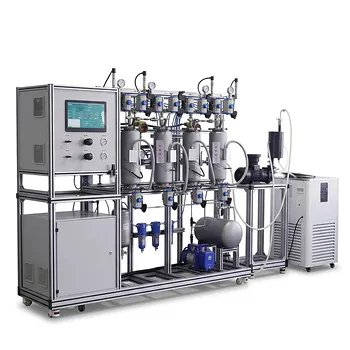
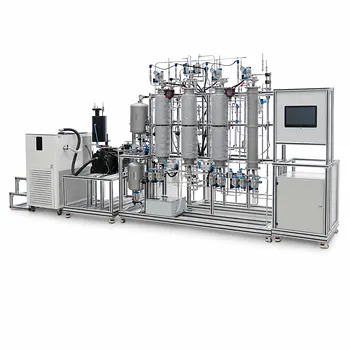
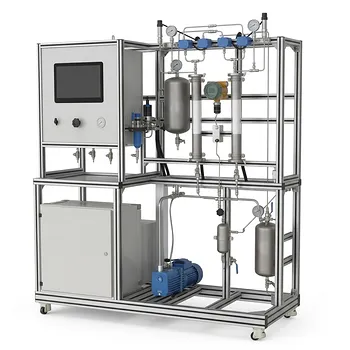
Knowledge Environmental and Water Treatment Education How can membrane separation pilot plants model industrial processes? Elevate engineering education with UF, RO & PV.
Author avatar

Tech Team · LABPARK

Updated 1 month ago

How can membrane separation pilot plants model industrial processes? Elevate engineering education with UF, RO & PV.


“Membrane separation pilot plants are the closest students can get to an industrial facility without leaving the lab.”
Ultrafiltration (UF) pilot units demonstrate size-exclusion for simulating wastewater treatment and protein recovery, reverse osmosis (RO) units model seawater desalination and ultrapure water production, and pervaporation systems offer a low-energy route to solvent dehydration and VOC removal. Together, they form a hands-on curriculum that connects fundamental transport phenomena to real-world process design, preparing students to think like industrial process engineers.

These pilot-scale systems bridge the gap between textbook theory and industrial practice, allowing students to manipulate live process variables and directly observe how membrane selection, pressure, and temperature dictate separation efficiency. The result is a deep, intuitive understanding of when and why to choose a membrane process over conventional alternatives—and how to integrate it into a complete flowsheet.


The Three Pillars of Membrane Education: UF, RO, and Pervaporation

Ultrafiltration: Size-Exclusion at Low Pressure

UF membranes with pores of 0.01–0.1 µm selectively retain macromolecules like proteins, fats, and polysaccharides while allowing salts and sugars to pass.
In a pilot plant, students can model industrial clarification of fermentation broths, paint recovery, and dairy processing.
By varying feed flow rate and transmembrane pressure, they observe real-time changes in permeate flux and rejection, making the concept of size-exclusion separation concrete and measurable.

Reverse Osmosis: Ionic Rejection Under Pressure

RO teaches pressure-driven separation at the molecular level.
Pilot units demonstrate how applied pressure overcomes osmotic pressure to reject ions, simulating seawater desalination or boiler feed water production.
Students gain a tangible feel for the energy demands of high-pressure operation and the critical role of pre-treatment to avoid membrane fouling—directly modeling ultrapure water systems in electronics and pharmaceutical plants.

Pervaporation: Vapor Pressure Difference for Selective Separation

Unlike UF and RO, pervaporation relies on a vapor pressure gradient across the membrane, causing a phase change on the permeate side.
Pilot plants equipped with hydrophilic PVA membranes teach students how to break azeotropes—for example, dehydrating ethanol to 99.8%—without the energy cost of distillation.
By swapping to hydrophobic silicone-rubber membranes, the same unit removes volatile organic compounds (VOCs) from wastewater.
Students adjust feed temperature and permeate vacuum to map mass transfer flux and enrichment factors, seeing how a vapor pressure difference becomes a powerful design lever for energy-efficient separation.


Bridging Theory and Practice: What Pilot Plants Teach

Connecting Mass, Heat, and Momentum Transfer

Operating these pilot units gives students a physical testbed for transport phenomena.
They can measure how feed viscosity, temperature, and flow rate directly impact mass transfer coefficients.
Observing concentration polarization or flux decline makes textbook equations tangible and reveals why industrial units include spacers and periodic cleaning cycles.

Integrated Process Design: Membranes Are Not Islands

Industrial processes rarely use membranes alone.
Pilot plants that combine UF or RO with distillation columns or catalytic reactors teach students to think in complete process flowsheets.
For example, using RO to pre-concentrate brines before thermal crystallization reduces overall energy use, while pairing a pervaporation unit with a distillation column for ethanol recovery demonstrates hybrid separation logic.
This integrated approach shows how membrane selection interacts with upstream and downstream unit operations—exactly as it does in a refinery or chemical plant.

Real-Time Parameter Control and Optimization

Modern pilot plants allow students to manipulate feed pressure, flow rate, temperature, and permeate vacuum from a central control panel.
They learn to interpret data trends and optimize for a target—maximum product purity, minimum energy consumption, or highest recovery rate.
This iterative experimentation is the closest proxy to process engineering in an industrial operating environment.


Understanding the Trade-offs: What Pilot Plants Cannot Teach

The Gap Between Lab and Plant

Pilot plants operate at small scale with clean feeds and controlled conditions.
They cannot replicate long-term membrane fouling from complex industrial streams, variable feed compositions, or the economic constraints of a 24/7 production schedule.
Flux data from a pilot run must be scaled up cautiously, using validated membrane module designs and fouling models that account for real-world variability.

Oversimplification of Energy and Cost Analysis

While a pervaporation pilot plant demonstrates lower thermal energy than distillation, the full energy picture includes vacuum pump work, condensation loads, and membrane replacement costs.
Pilot-scale experiments often skip auxiliary equipment inefficiencies, so educators must frame energy comparisons with careful boundary definitions.
Without this context, students may overestimate the savings and underestimate the total cost of ownership.

Maintenance and Operational Realities

Pilot plants require meticulous cleaning and membrane storage.
If poorly maintained, performance degrades, and students lose confidence in their data.
This hidden lesson mirrors industrial reality—improper clean-in-place (CIP) can ruin a membrane system—but it must be addressed explicitly in lab manuals so it becomes a learning opportunity rather than a frustration.


Making the Right Choice for Your Educational Goal

Based on your curriculum focus, leverage these pilot plants accordingly:

  • If your primary focus is environmental engineering: Prioritize UF and pervaporation with hydrophobic membranes to model wastewater treatment, VOC removal, and water reuse. Use RO to teach desalination and water recycling.
  • If your primary focus is process design and optimization: Combine membrane units with distillation or reactor pilot plants to demonstrate hybrid separations and teach students how to balance separation cost with product purity.
  • If your primary focus is fundamentals of transport phenomena: Use UF as the simplest system to isolate the effect of viscosity, pressure, and pore size on flux, then graduate to RO for osmotic pressure theory and pervaporation for coupled mass and heat transfer.
  • If your primary focus is sustainable manufacturing: Focus on pervaporation as an energy-efficient alternative to distillation and RO as a low-thermal-energy concentration step, emphasizing life-cycle energy analysis and the role of ambient-temperature separations.

When used thoughtfully, membrane separation pilot plants transform abstract equations into an engineer’s instinct for what works, at what cost, and under what conditions.

Summary Table:

Membrane Technology Separation Mechanism Key Industrial Simulation Core Educational Focus
Ultrafiltration (UF) Size-exclusion (0.01–0.1 µm pores) Wastewater treatment & dairy processing Transmembrane pressure & feed flux
Reverse Osmosis (RO) Pressure-driven ionic rejection Desalination & ultrapure water production Osmotic pressure & fouling mitigation
Pervaporation Vapor pressure gradient Azeotrope dehydration & VOC removal Mass/heat transfer & energy efficiency

Bring Real-World Process Engineering to Your Lab

Equip your students and researchers with the practical tools they need to master industrial processes. LABPARK offers premium Educational and Vocational Unit Operations Pilot Plants tailored for universities, research institutes, and enterprises.

Our advanced systems span chemical engineering, bioprocess & biotech, and environmental & water treatment, transforming abstract transport phenomena equations into hands-on operating experience.

Ready to upgrade your laboratory capabilities? Contact LABPARK today to find the perfect pilot plant solution for your curriculum!

Related Products

People Also Ask

Related Products

Multi-Functional Membrane Separation Educational Pilot Plant for Unit Operations Lab

Multi-Functional Membrane Separation Educational Pilot Plant for Unit Operations Lab

The Multi-functional Membrane Separation Educational Unit Operations Pilot Plant is an integrated bench-scale laboratory system designed for teaching undergraduate engineering education. It features Ultrafiltration, Nanofiltration, and Reverse Osmosis modules in a compact, mobile unit for practical hands-on learning.

Photocatalytic Membrane Separation and Degradation Unit Operations Pilot Plant

Photocatalytic Membrane Separation and Degradation Unit Operations Pilot Plant

Bench-scale pilot plant integrating photocatalytic degradation with membrane separation for engineering education. Study advanced oxidation, microfiltration, and hybrid processes using industrial sensors. Features safety light-blocking curtain, low-noise compressor, and durable stainless-steel construction.

Ultrafiltration Membrane Separation Educational Pilot Plant

Ultrafiltration Membrane Separation Educational Pilot Plant

This ultrafiltration membrane separation educational pilot plant enables undergraduate students to process PVA solutions, study hollow fiber membrane dynamics, and perform quantitative analysis with spectrophotometry for hands-on learning of unit operations and industrial maintenance and membrane cleaning protocols.

Multifunctional Membrane Separation Educational Pilot Plant with Ultrafiltration, Nanofiltration, Reverse Osmosis

Multifunctional Membrane Separation Educational Pilot Plant with Ultrafiltration, Nanofiltration, Reverse Osmosis

An integrated laboratory bench-scale membrane separation system for higher education engineering labs combining Ultrafiltration, Nanofiltration, and Reverse Osmosis processes. Features industrial PLC control with touch-screen HMI, transparent piping, and academic assessment software. Ideal for chemical and environmental engineering curricula.

Hollow Fiber Ultrafiltration Membrane Separation Educational Pilot Plant

Hollow Fiber Ultrafiltration Membrane Separation Educational Pilot Plant

Explore our hollow fiber ultrafiltration membrane separation educational pilot plant for hands-on learning of industrial ultrafiltration processes, flux analysis, fouling mitigation, and process control. Compact, customizable, and built for engineering labs.

Multi Functional Membrane Crystallization Educational Unit Operations Pilot Plant

Multi Functional Membrane Crystallization Educational Unit Operations Pilot Plant

Integrated bench-scale membrane crystallization pilot plant for engineering education. Provides hands-on training in advanced separation technologies, combining membrane distillation crystallization and process intensification. Features variable scaling vessels, industrial-grade flow control, and interactive digital data acquisition. Customizable for university labs.

Alkaline Membrane Water Electrolysis Educational Pilot Plant Unit Operations Training System

Alkaline Membrane Water Electrolysis Educational Pilot Plant Unit Operations Training System

Hands-on educational pilot plant for alkaline membrane water electrolysis hydrogen production, integrating unit operations training with industrial PLC control, real-time data logging, customizable design, durable 316L stainless steel construction, explosion-proof safety, and modern 5G connectivity for university laboratories.

Multi-Component Gas Pressure Swing Adsorption Pilot Plant for Unit Operations Education

Multi-Component Gas Pressure Swing Adsorption Pilot Plant for Unit Operations Education

Multi-component gas pressure swing adsorption pilot plant designed for unit operations education. Features four-tower configuration, IoT touchscreen control, dual regeneration, and real-time breakthrough curve analysis for engineering training with safety interlocks and mobile frame simulates industrial PSA processes.

Gas-Solid Heterogeneous Separation Demonstration Educational Unit Operations Pilot Plant

Gas-Solid Heterogeneous Separation Demonstration Educational Unit Operations Pilot Plant

Comprehensive visual transparent gas-solid separation pilot plant for chemical engineering labs. Demonstrates gravity settling inertial settling cyclone and bag filter technologies. Enables real-time analysis of fluid-particle mechanics pressure drop and collection efficiency. Ideal for undergraduate unit operations courses.

Hot Filtration Educational Unit Operations Pilot Plant Laboratory System

Hot Filtration Educational Unit Operations Pilot Plant Laboratory System

This integrated laboratory bench-scale hot filtration pilot plant enables students to study solid-liquid separation under thermal conditions, featuring a stainless steel vessel, removable heating jacket, and multi-layer filter plates for unit operations education, ideal for chemical engineering laboratory curriculum.

Multimodal Absorption and Desorption Pilot Plant for Unit Operations Training

Multimodal Absorption and Desorption Pilot Plant for Unit Operations Training

Multimodal absorption and desorption pilot plant for higher education labs. Bridges theory and industrial practice with transparent packed columns, three operational modes (real-material, simulated, semi-physical), and SCADA control. Students explore mass transfer, column hydraulics, and process control. Customizable.

Educational Pressure Swing Adsorption Ethylene Capture Unit Operations Pilot Plant

Educational Pressure Swing Adsorption Ethylene Capture Unit Operations Pilot Plant

Advanced educational pilot plant for pressure swing adsorption ethylene capture provides comprehensive hands-on training in industrial gas separation processes, featuring an eight-column PSA system, real-time data acquisition, and fully customizable design for chemical engineering unit operations laboratories and research.

Pressure Swing Adsorption Educational Unit Operations Pilot Plant

Pressure Swing Adsorption Educational Unit Operations Pilot Plant

Integrated bench-scale pressure swing adsorption pilot plant for hands-on teaching of gas-solid separation, mass transfer, and process optimization using nitrogen-oxygen model, featuring dual-column design, industrial touchscreen control, digital assessment suite, and customizable hardware and software configurations for educational laboratories.

Continuous Sieve-Plate Distillation Pilot Plant for Unit Operations Laboratory Education

Continuous Sieve-Plate Distillation Pilot Plant for Unit Operations Laboratory Education

Integrated pilot-scale teaching system for continuous sieve-plate distillation studies. Visual demonstration of tray hydraulics, flexible feed positions, and automatic reflux control for hands-on unit operations education in engineering labs. Designed for higher education engineering laboratories.

Bio-fermentation Ethanol Production Practical Training Unit Operations Pilot Plant

Bio-fermentation Ethanol Production Practical Training Unit Operations Pilot Plant

Bio-fermentation ethanol production pilot plant for hands-on training in unit operations: fermentation, solid-liquid filtration, membrane separation, and distillation. Bridges theory with industrial practice using industrial-grade components, customizable for university labs. Hybrid automated and manual control for comprehensive learning.

Fixed-Bed Chemical Reaction and Gas Dust Tar Removal Unit Operations Pilot Plant

Fixed-Bed Chemical Reaction and Gas Dust Tar Removal Unit Operations Pilot Plant

Integrated educational pilot plant for studying catalytic gas-solid reactions and downstream gas purification. Features dual fixed-bed reactor, three-stage heating, and touchscreen control for hands-on engineering training. Ideal for chemical and environmental engineering curricula.

Natural Product Extraction Unit Operations Training Pilot Plant

Natural Product Extraction Unit Operations Training Pilot Plant

Integrated natural product extraction pilot plant for chemical engineering training bridges theory and industrial practice with modular extraction and evaporation/concentration units, hybrid touchscreen and manual control, realistic process simulation, and self-contained softened water and vacuum utilities.

Multi-Reactor Educational Pilot Plant for Reaction Engineering Unit Operations

Multi-Reactor Educational Pilot Plant for Reaction Engineering Unit Operations

Integrated bench-scale educational pilot plant for chemical engineering teaching featuring fixed bed fluidized bed and stirred tank reactors with web-based digital twin controls and safety interlocks for hands-on unit operations and reaction engineering comparative studies in one compact system.

Dual-Mode Rectification Pilot Plant for Practical Training Unit Operations

Dual-Mode Rectification Pilot Plant for Practical Training Unit Operations

Industrial-scale dual-mode rectification pilot plant for chemical engineering practical training. Features real-material and simulated-material operation modes, sieve-plate column with sight glasses for visual observation of hydrodynamics, and customizable SCADA control for safe, hands-on learning of unit operations and mass transfer.

Bench Scale Dual Column Gas Separation and Capture Educational Pilot Plant

Bench Scale Dual Column Gas Separation and Capture Educational Pilot Plant

This dual-column educational pilot plant provides hands-on teaching of gas adsorption, separation, and capture processes. It features stainless steel columns, regeneration up to 400°C, and a 15.6-inch touchscreen PLC for TSA and PSA studies in chemical engineering curricula, process simulation.


Leave Your Message