Knowledge Chemical Engineering Education How to manage flow misalignment & yaw deviation in velocity probes? Achieve precise fluid measurements.
Author avatar

Tech Team · LABPARK

Updated 5 days ago

How to manage flow misalignment & yaw deviation in velocity probes? Achieve precise fluid measurements.


Misaligned velocity probes can silently sabotage your flow measurements. When a probe's sensing ports don’t face perfectly into the oncoming stream, the pressure readings drift—and so does your calculated velocity. In fluid flow demonstration units, the practical fix is to select a probe that forgives yaw-angle deviation without any active correction. A standard Prandtl tube (combined pitot‑static tube) keeps the error negligible for yaw angles up to ±15°, while a Kiel probe extends that tolerance to over ±50° by guiding the flow into the sensor.

The core strategy is not to eliminate misalignment, but to make the probe insensitive to it. For most demonstration units, a Prandtl tube has built‑in error cancellation that covers typical alignment imperfections. When the flow angle routinely exceeds ±15°, a Kiel probe’s shroud mechanically straightens the stream, delivering stagnation‑pressure accuracy within 1 % of the dynamic pressure up to ±54°.

The Root of the Problem: Why Yaw Angle Matters

How Misaligned Flow Fools a Velocity Probe

A velocity probe measures two pressures: stagnation pressure (from the tip facing the flow) and static pressure (from side‑wall tappings).
When the flow is off‑axis, the stagnation port under‑reads and the static tappings over‑read—or vice versa—depending on the angle.
These individual errors compound, turning a straightforward velocity calculation into a significant systematic uncertainty.

The Prandtl Tube’s Self‑Correcting Design

A Prandtl tube is engineered so that the stagnation‑pressure error and the static‑pressure error grow in opposite directions but at roughly the same rate.
When you subtract the two pressures to obtain dynamic pressure, these errors almost perfectly cancel each other out for moderate yaw.
This geometric balancing act is what gives the Prandtl tube its forgiving nature.

Your Go‑To Tool for Mild Off‑Axis Flow (±15°)

The Built‑in Error Balancing Act

In a typical laboratory demonstration unit, flow lines are rarely perfectly parallel to the probe stem.
The Prandtl tube’s compensation works because the stagnation port’s sensitivity to yaw is matched to the static‑hole arrangement on the side of the tube.
The net result: for deviation angles within ±15°, the velocity reading remains highly accurate without any additional correction or realignment.

When the Prandtl Tube Falls Short

Once the flow angle exceeds about 15°, the error‑cancelling mechanism breaks down.
Beyond that point, the stagnation pressure drops too fast, and the static pressure offset can no longer be reliably subtracted.
In demonstration units with deliberate swirl, sharp bends, or recirculation zones, a Prandtl tube alone will produce misleading low‑velocity readings.

Stepping Up: The Kiel Probe’s Shrouded Solution

How a Shroud Tames Stagnation Pressure

A Kiel probe surrounds its stagnation‑sensing tip with a venturi‑shaped shroud.
This shroud takes an incoming skewed stream and gradually straightens it before it reaches the impact port.
Essentially, the probe creates its own local flow that is always near‑normal to the tip, even when the bulk flow is severely off‑axis.

Pushing the Limits Up to ±54°

Thanks to the shrouded design, a Kiel probe can maintain stagnation‑pressure accuracy within 1 % of the dynamic pressure for yaw angles as steep as ±54°.
This makes it the probe of choice when a demonstration unit involves high‑swirl elements, flow‑separation studies, or traverses where the local angle is unpredictable.
With a Kiel probe, you stop worrying about perfect alignment and can focus on the flow physics.

Balancing Accuracy Against Practical Limits

The Prandtl Tube – Simple but Fragile to Yaw

The Prandtl tube is compact, robust, and requires no extra static‑pressure source—it’s a single‑piece instrument.
Yet its ±15° tolerance is a hard boundary; beyond it, errors escalate quickly. In a demonstration unit where the flow angle is unknown, relying on a Prandtl tube can hide real flow features.

The Kiel Probe – Tolerant but More Complex

A standard Kiel probe only senses stagnation pressure; you must pair it with a separate static pressure tap or a combined probe that includes a static port.
Its shroud makes it bulkier, which can disturb the flow in small test sections, and it tends to be more expensive.
In return, you gain yaw immunity that lets you map flows with high angularity—where the Prandtl tube would be useless.

Don’t Let Static Pressure Become the Weak Link

When you switch to a Kiel probe, remember that velocity still depends on both stagnation and static pressure.
If your static‑pressure source is itself sensitive to yaw or blockage, the improved stagnation reading won’t rescue the final velocity accuracy.
For high‑angle flows, locate the static tapping in a region where the flow is known to be well‑aligned, or use a wall‑static ring on the test section.

Making the Right Choice for Your Demonstration Unit

Every flow demonstration rig has its own tolerance for probe‑induced disturbance and its own range of flow angles. Match the probe strategy to that reality.

  • If your primary focus is ease of setup and you can keep the probe axis within ±15°: Stick with a standard Prandtl tube. Its self‑compensating design gives you reliable velocities with no extra plumbing.
  • If your experiment includes swirl generators, sharp turns, or uncertain local flow angles: Upgrade to a Kiel probe for stagnation pressure. Pair it with a carefully placed static tap to handle angles up to ±54° without significant loss.
  • If you only occasionally encounter high yaw: Consider a quick‑swap probe holder. Use a Prandtl tube for most traverses and insert a Kiel probe only when you enter the high‑angle region.

Choose the probe that makes the misalignment a non‑issue, and your velocity data will reflect the true flow—not the probe’s orientation.

Summary Table:

Feature / Probe Type Prandtl Tube (Pitot-Static) Kiel Probe
Yaw Angle Tolerance Up to ±15° Up to ±54°
Error Correction Self-compensating (stagnation & static errors cancel) Venturi-shaped shroud mechanically straightens flow
Setup Complexity Simple (single-piece, no extra static source) Higher (requires separate static tap/sensor)
Best Used For Mild off-axis flows, parallel streams High-swirl elements, flow separation, unknown angles

Optimize Your Fluid Mechanics Labs with LABPARK

Ensure absolute accuracy in your fluid dynamics experiments. LABPARK provides premium Educational and Vocational Unit Operations Pilot Plants in chemical engineering, bioprocess & biotech, and environmental & water treatment. Designed specifically for universities, research institutes, and enterprises, our systems deliver reliable, industry-grade data for teaching and research.

Ready to upgrade your laboratory capabilities? Contact LABPARK today to explore our custom pilot plant solutions!

Related Products

People Also Ask

Related Products

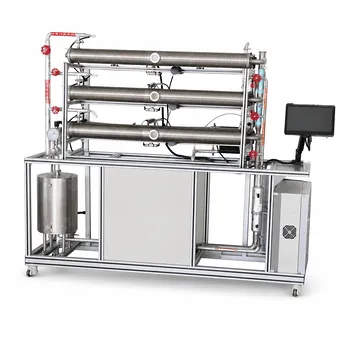
Three-Tube Heat Transfer Educational Pilot Plant for Unit Operations Training

Three-Tube Heat Transfer Educational Pilot Plant for Unit Operations Training

Three-tube heat transfer pilot plant for studying convective heat transfer enhancement and condensation. Allows comparison of smooth, corrugated, turbulent tubes, verifying empirical correlations. Ideal for chemical engineering education with safety and closed-loop steam recovery.

Tubular Reactor Flow Characteristics Determination Educational Unit Operations Pilot Plant

Tubular Reactor Flow Characteristics Determination Educational Unit Operations Pilot Plant

Educational pilot plant for investigating tubular reactor flow characteristics and residence time distribution Features adjustable recycle for plug flow and backmixing studies industrial touchscreen interface and real-time data acquisition Ideal for chemical engineering unit operations laboratory training and education

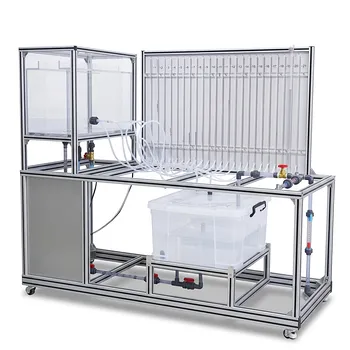
Bernoulli Equation Demonstration Unit Operations Pilot Plant

Bernoulli Equation Demonstration Unit Operations Pilot Plant

Laboratory pilot plant for Bernoulli's equation demonstration with transparent PVC pipes, 23 piezometer tubes for pressure measurement, and hands-on experiments. Designed for engineering education to study energy conservation, hydraulic grade line, and localized losses in fluid steady-flow systems.

Educational Unit Operations Pilot Plant for Intraparticle Diffusion Effective Factor Measurement

Educational Unit Operations Pilot Plant for Intraparticle Diffusion Effective Factor Measurement

Designed for chemical engineering university labs, this pilot plant allows hands-on determination of catalyst particle intraparticle diffusion effective factors and gas-solid reaction kinetics using a fixed-bed tubular reactor with industrial touchscreen control, bridging theory and practical reactor design.

Shell and Tube Heat Exchanger Heat Transfer Coefficient Determination Educational Pilot Plant

Shell and Tube Heat Exchanger Heat Transfer Coefficient Determination Educational Pilot Plant

LABPARK's shell and tube heat exchanger pilot plant enables students to investigate heat transfer coefficients, LMTD, co-current vs counter-current flow, bridging theory and industrial practice. Customizable for chemical, mechanical, environmental engineering curricula. Ideal for unit operations and process engineering labs.

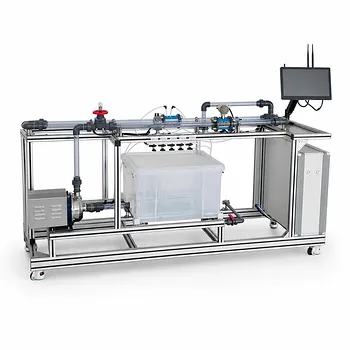
Orifice and Venturi Flowmeter Calibration Educational Pilot Plant for Fluid Mechanics Laboratory

Orifice and Venturi Flowmeter Calibration Educational Pilot Plant for Fluid Mechanics Laboratory

Enhance fluid dynamics education with the Orifice and Venturi Flowmeter Calibration Educational Unit Operations Pilot Plant, featuring transparent orifice and Venturi meters, industrial sensors, touchscreen interface for real-time data analysis and automatic coefficient calculations in engineering student laboratories.

Rising and Falling Film Evaporation Educational Unit Operations Pilot Plant

Rising and Falling Film Evaporation Educational Unit Operations Pilot Plant

Hands-on educational pilot plant for studying rising and falling film evaporation, flow regimes, and heat transfer. Customizable for university labs with industrial instrumentation and data acquisition. Enables comparative evaluation of evaporation modes and energy efficiency.

Multi Functional Catalytic Reaction and Reactor Evaluation Educational Unit Operations Pilot Plant

Multi Functional Catalytic Reaction and Reactor Evaluation Educational Unit Operations Pilot Plant

Bench-scale educational pilot plant for catalytic reaction and reactor evaluation, integrating fixed bed, fluidized bed, and stirred tank reactors. Students compare reactor designs, evaluate catalysts, and study reaction kinetics and hydrodynamics. Perfect for unit operations labs in chemical engineering curricula.

Residence Time Distribution and Reactor Flow Characteristics Determination Educational Pilot Plant

Residence Time Distribution and Reactor Flow Characteristics Determination Educational Pilot Plant

This versatile educational pilot plant is designed for comprehensive study of residence time distribution and reactor flow characteristics, featuring multiple CSTRs in series, a tubular reactor, variable recycle loop, and automated real-time data acquisition, perfect for hands-on chemical engineering education.

Comprehensive Heat Transfer Coefficient Determination Educational Unit Operations Pilot Plant

Comprehensive Heat Transfer Coefficient Determination Educational Unit Operations Pilot Plant

Advanced industrial-grade educational pilot plant for comprehensive heat transfer coefficient determination. Enables quantitative convective heat transfer analysis, evaluates double-pipe and shell-and-tube exchanger configurations, and includes digital data acquisition. Customizable for engineering curriculum. Ideal for engineering unit operations labs.

Multi-Stage Stirred Tanks in Series Residence Time Distribution and Mixing Performance Determination Educational Pilot Plant

Multi-Stage Stirred Tanks in Series Residence Time Distribution and Mixing Performance Determination Educational Pilot Plant

Explore residence time distribution and mixing performance in series stirred tanks with this educational pilot plant. Real-time conductivity sensors, interactive 3D simulation, and industrial-grade PC for chemical engineering lab training. Customizable to curricula.

Throttling Effect Determination Educational Unit Operations Pilot Plant

Throttling Effect Determination Educational Unit Operations Pilot Plant

Investigate the Joule-Thomson throttling effect with this educational unit operations pilot plant. Designed for engineering students, it enables hands-on comparative analysis of adiabatic gas expansion using precise process control, interactive digital interface, and eco-friendly operation, ensuring safe repeatable thermodynamic experiments.

Plate Column Hydrodynamics Tray Demonstration Educational Pilot Plant

Plate Column Hydrodynamics Tray Demonstration Educational Pilot Plant

Advanced transparent educational pilot plant for chemical engineering labs demonstrates plate column hydrodynamics with industrial sieve bubble cap serrated valve trays for visual observation of gas-liquid contact pressure drop measurement and operational limit analysis including flooding weeping entrainment

Comprehensive Fluid Mechanics Educational Unit Operations Pilot Plant

Comprehensive Fluid Mechanics Educational Unit Operations Pilot Plant

Hands-on fluid mechanics pilot plant for engineering education covering over 13 principles including pipe flow, minor losses, flowmeter calibration, and pump performance with industrial-grade components, smooth and rough piping, venturi and orifice flowmeters, and centrifugal pump testing and analysis.

Centrifugal Pump Performance and Orifice Flowmeter Calibration Educational Pilot Plant

Centrifugal Pump Performance and Orifice Flowmeter Calibration Educational Pilot Plant

This versatile educational pilot plant enables engineering students to conduct centrifugal pump performance tests, orifice flowmeter calibration, and fluid mechanics experiments using a transparent flow loop, industrial HMI, and 3D virtual simulation for a comprehensive hands-on learning experience.

Continuous Batch Extractive Distillation Educational Pilot Plant

Continuous Batch Extractive Distillation Educational Pilot Plant

Versatile pilot plant for continuous, batch, and extractive distillation training. High-borosilicate glass column for visualizing hydraulics, 15.6-inch touchscreen with data logging, precise reflux ratio control 1-99, and durable corrosion-resistant frame. Ideal for chemical engineering education and process research.

Two Phase Flow Pattern Velocity Resistance Measurement Educational Pilot Plant

Two Phase Flow Pattern Velocity Resistance Measurement Educational Pilot Plant

Benchtop educational pilot plant for university labs studying gas-liquid two-phase flow patterns, velocity, and resistance across circular, square, and rectangular conduits. Features 15.6-inch touchscreen, 5G connectivity, differential pressure sensors, safe water-air operation. Supports chemical engineering curricula.

Constant Pressure Filtration Educational Unit Operations Pilot Plant

Constant Pressure Filtration Educational Unit Operations Pilot Plant

Hands-on educational pilot plant for constant pressure filtration. Classic plate and frame filter press allows students to study kinetics, determine specific cake resistance, perform cake washing and evaluate washing rates. Ideal for chemical engineering curriculum. Mobile, customizable, safety-compliant design.

Carbon Dioxide PVT Curve Determination Educational Unit Operations Pilot Plant

Carbon Dioxide PVT Curve Determination Educational Unit Operations Pilot Plant

Enable hands-on learning of thermodynamic principles with this carbon dioxide PVT curve determination pilot plant. Students visualize critical opalescence, phase transitions, and generate P-V isotherms across liquid, gas, and supercritical regions. Robust safety features, adaptable for university engineering labs.

Multi-Functional Special Distillation Educational Pilot Plant

Multi-Functional Special Distillation Educational Pilot Plant

Versatile multi-functional special distillation pilot plant for chemical engineering education. Supports continuous, vacuum, azeotropic, reactive, extractive distillation. Transparent glass columns enable real-time visual observation of hydrodynamics and separation processes.


Leave Your Message