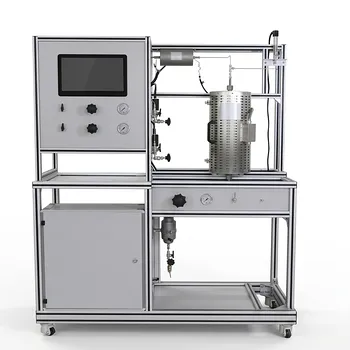
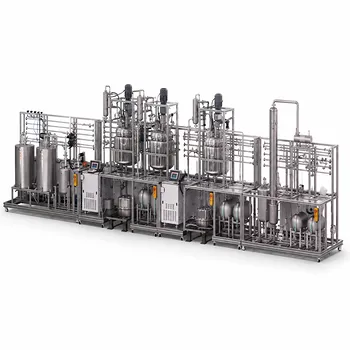
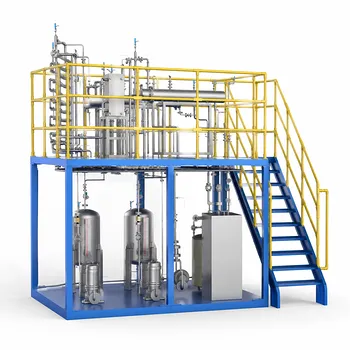
FMEA transforms pilot plant hazards into a structured curriculum, making safety a hands-on, analytical skill rather than a set of rules.
By systematically evaluating every valve, pump, sensor, and procedure, an FMEA team calculates a Risk Priority Number (RPN) for each potential failure. Corrective actions are triggered whenever the RPN crosses a critical threshold—typically 100 on a 1–10 intensity scale. This analysis both eliminates latent design weaknesses and teaches students how to anticipate, rate, and mitigate process risks before they ever touch the hardware.
A well-executed FMEA on an educational pilot plant serves two inseparable goals: it uncovers hidden failure modes that jeopardize operator safety, and it converts every identified hazard into a teachable moment. The result is not just a safer facility but a generation of engineers who instinctively think in terms of severity, occurrence, and detection.
How FMEA Hardens Pilot Plant Safety
Building a Multidisciplinary Safety Net
A robust FMEA begins by assembling a team of instructors, lab engineers, and process safety specialists.
Together they scrutinize each unit operation—distillation columns, reactors, heat exchangers—and list plausible failure modes: pump cavitation, valve misalignment, temperature runaway, sensor drift.
The RPN: Turning Gut Feel Into Numbers
For every failure mode, the team rates three factors: Severity (SEV) of consequences, Occurrence (OCC) probability, and Detection (DET) difficulty.
Multiplying these values yields the Risk Priority Number.
If the RPN exceeds 100, mandatory design changes, procedural updates, or additional safeguards are enforced before student operation.
Embedding the Layers of Protection
FMEA findings directly inform the multi-layered safety concept expected in industrial plants.
- Inherent Safety: The analysis may reveal that a hazardous intermediate can be eliminated through chemistry choice, avoiding risk at the source.
- Basic Process Control Systems: Feedback loops for temperature, pressure, and flow are validated as critical barriers.
- Critical Alarms & Human Intervention: The study identifies which deviations must trigger immediate operator response.
- Automatic Shutdown Interlocks: Hardwired trips are installed when failure modes could lead to equipment rupture.
- Pressure Relief Systems: Relief valves and rupture discs are sized based on worst-case scenarios uncovered in the FMEA.
This hierarchy ensures that even if a student makes an error, multiple independent layers prevent a catastrophic outcome.
Scope Discipline: Why 50 Hazards Is a Minimum
A comprehensive FMEA for a standard educational pilot plant should identify at least 50 distinct hazard checkpoints.
A shorter list usually means the analysis was superficial.
For instance, a single distillation column may present failure modes related to feed pump failure, reboiler overheating, reflux ratio drift, flooding, and condenser coolant loss—each demanding its own RPN score and action plan.
Transforming Hazard Assessment Into Student Training
From Passive Learners to Risk Analysts
Instead of handing students a static operating procedure, instructors use FMEA worksheets as active learning tools.
Students learn to brainstorm failure modes such as flow rate drift or reactant mixing inaccuracies and score their potential impact on product purity, yield, and equipment integrity.
This exercise mirrors the industrial practice of process hazard analysis and ingrains the habit of questioning “what could go wrong.”
Simulating Failures in a Controlled Environment
Once failure modes are cataloged, pilot plants become live laboratories for consequence demonstration.
Under close supervision, trainees can induce a mild pump cavitation or a deliberate temperature overshoot (within safe, pre-evaluated boundaries) and observe the real-time effects on process stability.
They then apply experimental strategies—like univariate step tests or multivariate design-of-experiments—to confirm that mitigation measures work, bridging theory and practice.
Integrating Human Error and System Weaknesses
FMEA dovetails with human error analysis to pinpoint exactly where operator mistakes are most likely: a confusing control panel layout, a poorly labeled valve, or a step that requires simultaneous actions.
By redesigning displays and adding foolproof interlocks, the pilot plant becomes a model of intuitive, mistake-minimizing design, while students learn to recognize and address human factors.
Scaling Safety Lessons from Benchtop to Pilot Plant
Many chemical engineering curricula rely on fume hoods for hazardous syntheses.
When the same reaction moves to an instrumented pilot plant, FMEA ensures that built-in gas scrubbers, automatic dosing pumps, and real-time pH/temperature monitoring are all rated and verified against failure scenarios.
Students discover how industrial containment, automated emergency shutdowns, and integrated relief systems function—knowledge that transfers directly to plant operations.
Understanding the Trade-offs and Common Pitfalls
Time-Intensive and Expertise-Dependent
A thorough FMEA can demand days of workshop time and requires a facilitator who understands both the process and the methodology.
In an academic setting, scheduling these sessions around teaching loads can be challenging, and a poorly facilitated FMEA risks becoming a box-ticking exercise.
Qualitative, Not Quantitative
FMEA remains a qualitative risk screening tool.
It does not provide numerical failure frequencies or consequence models.
For complex scenarios—especially those involving common-cause failures or dependent events—a complementary fault tree analysis or HAZOP study is necessary to achieve a full risk picture.
RPN Thresholds Are Heuristic
The widely used RPN > 100 trigger is a practical rule, not a scientifically derived limit.
In some processes, a failure mode with RPN 80 might still merit urgent action if Severity is extreme.
Teams must avoid treating the RPN as a rigid “pass/fail” metric and instead use expert judgment to reprioritize.
Static Nature Without Living Updates
An FMEA performed once during design will become obsolete as modifications occur.
Effective programs embed FMEA into a Management of Change (MOC) process, re-evaluating risks whenever a new pump, valve, or control logic is introduced.
Without this discipline, the analysis offers a false sense of security.
Making the Right Choice for Your Program
Your approach to integrating FMEA should align with the primary goal you want to achieve in your unit operations pilot plant.
- If your primary focus is operational safety: Perform a full-scope FMEA before any student enters the lab. Enforce the RPN > 100 rule rigorously and ensure that all resulting corrective actions—hardware interlocks, relief sizing, control modifications—are implemented and verified.
- If your primary focus is hands-on student training: Embed the FMEA workshop into the pre-lab curriculum. Have students themselves lead parts of the analysis under guidance, then correlate identified failure modes with the safety layers they see on P&IDs.
- If your primary focus is meeting accreditation or industrial partnership standards: Document the number of hazard checkpoints (target ≥50), link each to an RPN score, and show how the findings updated your operating procedures and safety system design. Combine FMEA with periodic HAZOP reviews to demonstrate a lifecycle safety management system.
An FMEA that is taken seriously will turn a routine educational pilot plant into a catalyst for authentic process safety thinking—equipping every student with the mental checklist to design out failure before it designs itself into the plant.
Summary Table:
| Focus Area | Key Actions / Metrics | Safety & Educational Benefits |
|---|---|---|
| Risk Assessment | Calculate RPN (SEV × OCC × DET) > 100 | Eliminates design weaknesses before student operation. |
| Safety Layers | BPCS, interlocks, pressure relief | Teaches students industrial safety concept hierarchy. |
| Active Learning | 50+ hazard checkpoints analyzed | Shifts students from passive learners to risk analysts. |
| Human Factors | Error analysis & display redesign | Minimizes operational mistakes through intuitive design. |
Elevate Safety and Practical Training in Your Labs
At LABPARK, we help universities, research institutes, and enterprises bridge the gap between theory and industrial safety standards. Our high-quality Educational and Vocational Unit Operations Pilot Plants in chemical engineering, bioprocess & biotech, and environmental & water treatment are designed for seamless FMEA integration, ensuring absolute operational safety and hands-on risk analysis training.
Ready to upgrade your lab's training capabilities? Contact LABPARK today to customize the perfect pilot plant solution for your program!
Related Products
- Carbon Dioxide Hydrogen Methanol Synthesis Educational Unit Operations Pilot Plant
- Multi Pump Fluid Transport Process Piping Unit Operations Training Pilot Plant
- Natural Product Extraction Unit Operations Training Pilot Plant
- Multi-Modal Distillation Unit Operations Training Pilot Plant
- Multi-Reactor Educational Pilot Plant for Reaction Engineering Unit Operations
People Also Ask
- How do temp & pressure affect methanol synthesis pilot plants? Optimize equilibrium and catalyst performance.
- Why is a purge system necessary when operating a gas recirculation loop in a methanol synthesis pilot plant? (Guide)
- Why do modern methanol pilot plants operate at lower pressures? Catalyst & Feed Requirements Explained
- What are the operational requirements for catalyst activation? Safe Methanol Pilot Plant Operation
- Why is the chemical plant startup schedule crucial? De-risk scale-up with pilot plants.