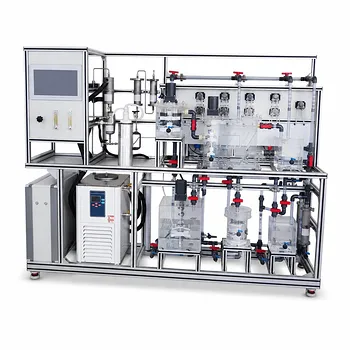
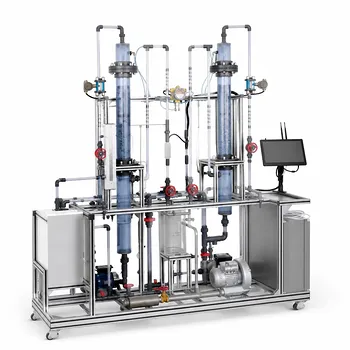
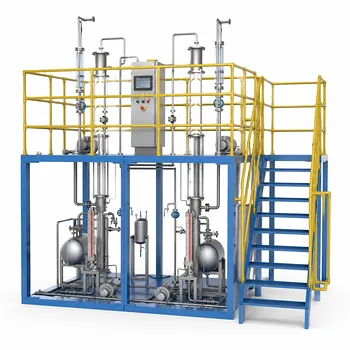
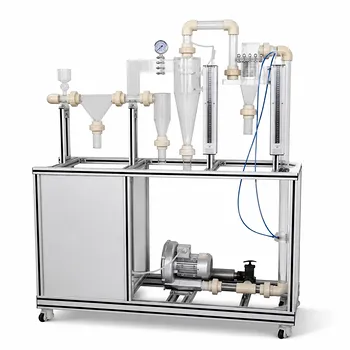
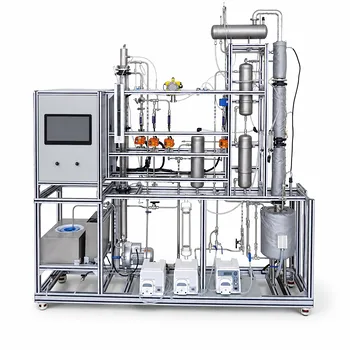
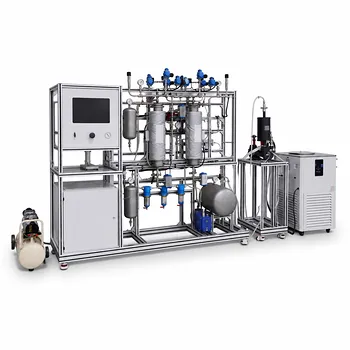
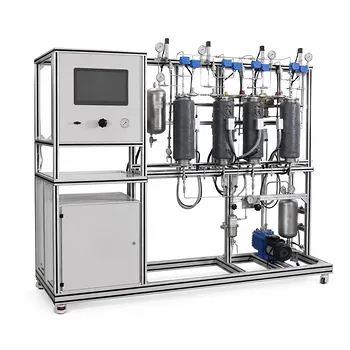
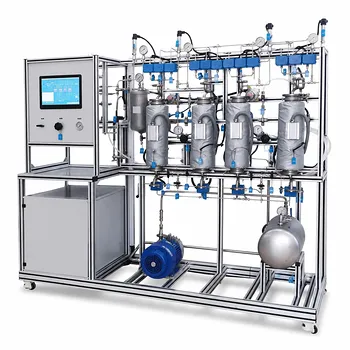
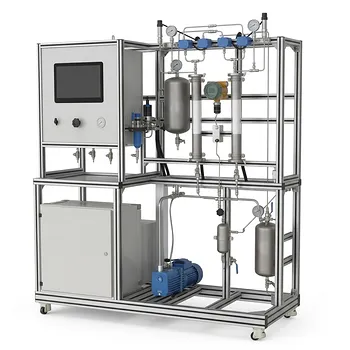
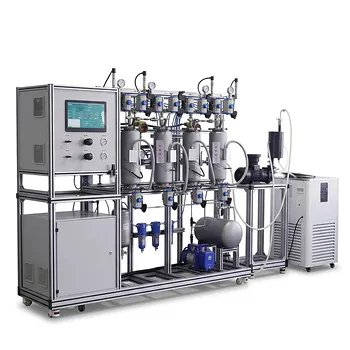
The Claus process can be effectively demonstrated in an environmental gas treatment pilot plant by physically recreating its two-stage reaction sequence and the critical feedback control loop. Students observe the high-temperature partial oxidation of H₂S in a furnace, followed by catalytic conversion over an alumina bed to produce elemental sulfur, all while learning to maintain the stoichiometric H₂S-to-SO₂ ratio by adjusting combustion air in real time.
Pilot-scale Claus units transform a fundamental thermodynamic equilibrium into a tangible exercise in process dynamics. The core insight is not merely how sulfur is recovered, but how a single control variable—the air feed rate, governed by continuous tail gas analysis—determines recovery efficiency, emission compliance, and operational safety.
Replicating the Claus Process at Bench Scale
A teaching pilot plant must physically separate the thermal and catalytic stages to mirror industrial configurations. This exposes students to the distinct unit operations and the steep temperature gradients that drive conversion.
The Thermal Stage: Partial Oxidation in a Furnace
Acid gas containing H₂S is partially combusted with a controlled air stream in a refractory-lined furnace. Temperatures exceed 1300 K to ensure the highly exothermic reaction proceeds spontaneously and to destroy trace contaminants.
The furnace outlet stream generates the SO₂ required for the downstream catalytic step. Importantly, the pilot plant’s air supply valve is the primary manipulated variable for the entire process—a direct demonstration of how a single input disturbance propagates through both thermal and catalytic sections.
The Catalytic Stage: Low-Temperature Conversion
After cooling the furnace off-gas, the stream enters a fixed-bed reactor containing an alumina-based catalyst. Operation at approximately 520 K promotes the equilibrium-limited reaction between the remaining H₂S and the generated SO₂ to form elemental sulfur and water.
Students can observe that temperature must be held within a narrow window: too low, and kinetics become rate-limiting; too high, and the equilibrium conversion drops or the catalyst risks deactivation from sulfation or thermal sintering.
Sulfur Condensation and Product Handling
The pilot plant’s condenser-separator unit operation chills the reactor effluent, converting gaseous sulfur to a collectible liquid. This step visually reinforces the yield of the process and highlights the practical requirement of keeping downstream lines heated to prevent solidification.
Process Control as the Core Teaching Objective
Once the hardware is understood, the pilot plant’s true pedagogical value emerges: it becomes a dynamic platform for mastering the control strategy that governs sulfur recovery.
The 2:1 H₂S-to-SO₂ Ratio as the Central Control Target
The Claus reaction stoichiometry demands exactly two moles of H₂S for every mole of SO₂. Any deviation—excess air leading to excess SO₂, or insufficient air leaving unconverted H₂S—immediately lowers recovery and increases tail gas emissions.
The pilot plant’s supervisory loop is designed around this ratio. Students measure the tail gas composition using an online analyzer or grab samples and manually adjust combustion air flow to drive the ratio toward the 2:1 setpoint. This manual or semi-automated loop teaches the dead time, process gain, and sensitivity inherent in composition control.
Air Feed as the Primary Manipulated Variable
Nearly all advanced process control strategies revolve around the air demand signal. A pilot plant demonstrates that this single variable controls not only the thermal stage temperature but also the entire stoichiometric balance across the catalytic reactors. A cascade loop can be implemented where tail gas ratio analysis resets the air flow controller, giving students hands-on experience with cascade, ratio, and feedforward control schemes.
Linking Recovery Efficiency to Environmental Compliance
Students can correlate tail gas composition data with calculated recovery efficiency (typically 95–97% for a two-stage Claus unit). By deliberately disturbing the air flow or furnace temperature, they witness why even a small control drift can cause SO₂ or H₂S breakthroughs that exceed emission limits. This links process control directly to regulatory reporting.
Operational Challenges and Kinetic Insights
Beyond steady-state operation, the pilot plant allows exploration of transient behaviors and equipment limitations that are invisible in textbooks.
Managing the Temperature Window
The Claus furnace must stay above 1300 K to ensure flame stability and complete destruction of ammonia or hydrocarbons. In the catalytic beds, temperatures around 520 K are ideal; however, the exothermic reaction causes an adiabatic temperature rise that forces operators to consider interstage cooling—a concept explored in the supplementary references through multiple fixed-bed reactors with intermediate quenching, similar to SO₂ oxidation plants.
A pilot plant with only one catalytic bed will reach limited conversion. Students learn to quantify this limitation and understand why industrial units use two or three beds with condensers in between to shift equilibrium and push overall recovery above 97%.
Catalyst Deactivation and Sulfur Condensation
Pilot runs can intentionally introduce oxygen excess or temperature excursions to observe catalyst deactivation over time. Students learn to recognize symptoms such as rising reactor pressure drop or declining conversion. Meanwhile, the sulfur condenser teaches the importance of temperature control to avoid solidification in transfer lines—a common operational failure in full-scale plants.
Understanding the Trade-offs
Pilot-scale demonstrations inherently simplify industrial reality, and instructors must highlight these gaps to avoid misleading conclusions.
- Scale-down compromises: Pilot plant reactors often operate adiabatically or with simplified heat management. True industrial Claus trains use multiple catalytic stages with interstage sulfur removal, and heat recovery steam generators that alter the temperature profile. Students must recognize that the 95–97% recovery observed at pilot scale may not reflect the ultimate 98%+ possible with three-stage processes plus tail gas treatment.
- Instrumentation lag: Small-scale analyzers may have different response times than industrial photometric or gas chromatographic systems, potentially masking the true control difficulty caused by long sample transport delays.
- Safety and material constraints: Handling toxic H₂S and high temperatures in a teaching environment demands rigorous interlocks and gas detection. The pilot plant’s safety mechanisms can obscure the open-loop risk that plant operators manage daily.
- Kinetic versus thermodynamic limitations: The supplementary references highlight that while many reactions are thermodynamically spontaneous, they require catalysts and high temperatures. A Claus pilot plant demonstrates this directly: without the catalyst, the desired reaction would proceed too slowly at practical temperatures. Students must design experiments with this kinetic limitation in mind to avoid misattributing poor performance.
Making the Right Choice for Your Learning Objectives
How you use a Claus pilot plant depends entirely on the skills you aim to build. The same hardware can serve vastly different curriculum goals when the experimental plan is crafted accordingly.
- If your primary focus is process engineering and plant design: Design experiments that map conversion versus temperature profiles for different catalyst volumes. Use this data to estimate kinetic parameters and propose a multi-bed reactor configuration with interstage cooling to push overall recovery beyond 97%.
- If your primary focus is industrial process control and automation: Implement a cascade ratio control scheme where the tail gas analyzer sends a correction signal to the air flow controller. Characterize the loop’s dynamics (dead time, time constant) and compare the performance of manual versus automatic ratio control under feed rate disturbances.
- If your primary focus is environmental compliance and emission monitoring: Deliberately operate away from the 2:1 ratio and quantify the resulting SO₂/H₂S slip in the tail gas. Have students calculate the required size and operating cost of a downstream tail gas treatment unit to meet a hypothetical emission limit, connecting pilot-plant data to capital cost trade-offs.
- If your primary focus is operator training and troubleshooting: Introduce common faults—such as a blocked sulfur drain, a gradual air blower malfunction, or catalyst hot spots—and have trainees diagnose the problem using only pressure, temperature, and tail gas composition trends before taking corrective action.
The true power of an environmental gas treatment pilot plant lies not just in making yellow sulfur appear, but in turning a seemingly straightforward stoichiometric reaction into a rich canvas for exploring control dynamics, equipment constraints, and the reality that 95% recovery is not an endpoint but a benchmark to be improved through disciplined engineering.
Summary Table:
| Stage / Operation | Process Action & Chemistry | Key Control Target / Variable |
|---|---|---|
| Thermal Stage | Partial oxidation of $H_2S$ in furnace ($>1300\text{ K}$) | Combustion air feed rate |
| Catalytic Stage | $H_2S$ & $SO_2$ reaction over alumina catalyst ($\sim 520\text{ K}$) | Temperature window management |
| Condensation | Liquid sulfur separation | Condenser temperature above solidification |
| Tail Gas Control | Continuous gas composition analysis | Stoichiometric $2:1$ $H_2S$-to-$SO_2$ ratio |
Bring Industrial Process Dynamics to Your Lab
Provide your students and researchers with hands-on training in complex chemical and environmental processes. LABPARK designs and supplies industry-grade Educational and Vocational Unit Operations Pilot Plants in chemical engineering, bioprocess & biotech, and environmental & water treatment.
Whether you are a university upgrading your engineering curriculum, a research institute investigating catalytic processes, or an enterprise looking for reliable operator training solutions, our custom-engineered systems bridge the gap between theory and industrial reality.
Contact LABPARK today to discover how we can customize a pilot plant solution for your lab!
Related Products
- Fixed-Bed Chemical Reaction and Gas Dust Tar Removal Unit Operations Pilot Plant
- Thermal Desorption Exhaust Gas and Tail Water Treatment Educational Pilot Plant
- Absorption and Desorption Educational Unit Operations Pilot Plant
- Dual-Mode Gas Absorption and Desorption Unit Operations Training Pilot Plant
- Methane Cracking Educational Unit Operations Pilot Plant
People Also Ask
- When to transition from PID to adaptive control in pilot plants? Key process indicators.
- How do deviations in estimating latent heat impact pilot plant thermal systems? Avoid hardware mis-sizing.
- Why Compare Predicted and Experimental Excess Enthalpy? Key to Accurate Pilot Plant Scale-up
- How to study gasification in pilot plants? Compare exit gas composition & efficiency
- Why Use PTFE & Hastelloy in Chemical Pilot Plants? Prevent Corrosion & Ensure Safety