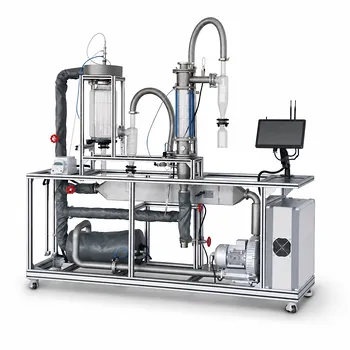
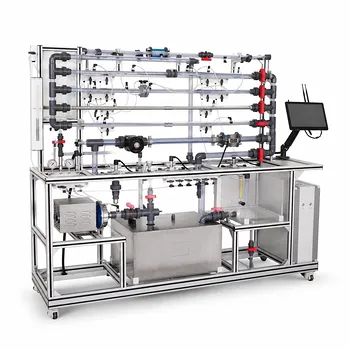
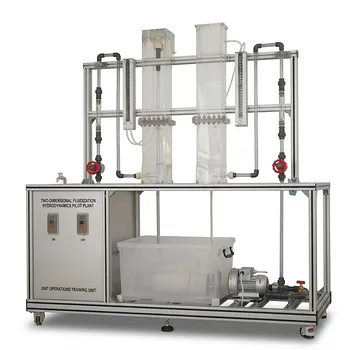
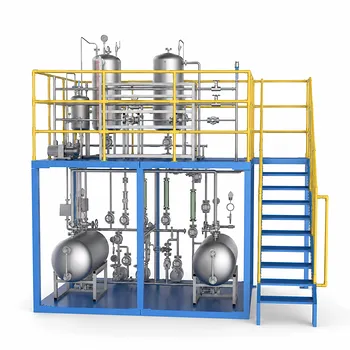
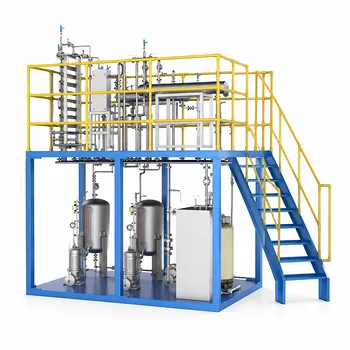
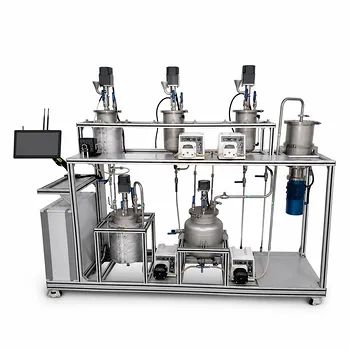
The difference between equality and inequality constraints becomes unforgettable when a student’s hands are on a pilot-plant valve.
Educational unit operations pilot plants answer this question by embodying constraints as physical reality: equality constraints are the unbreakable laws of mass and energy conservation that govern every stream, while inequality constraints are the flexible yet firm operational boundaries—like temperature limits, purity specs, and flood points—that define where the process can safely and profitably run. By adjusting real knobs and watching real consequences, students grasp how degrees of freedom are squeezed and why the economic optimum almost always sits right on the boundary of an inequality constraint.
The core insight: Equality constraints are non‑negotiable book‑keeping—they balance what goes in and what comes out. Inequality constraints are the paint on the floor, the redlines on a gauge, and the specs on a product; they create a feasible region, and teaching with pilot plants lets students feel why the most profitable operating point is usually pressed hard against one of those lines.
The Physical Manifestation of Constraints in Unit Operations
Why a Distillation Column Is a Living Equation
A pilot‑scale distillation column is a transparent lecture hall for equality constraints. Every tray, every reflux stream, and every heating duty is locked into a mass balance, an energy balance, and a phase‑equilibrium relationship. When students measure feed flow, distillate flow, and bottom flow, the conservation of mass dictates that the sum of outputs must equal the input—no exceptions. The moment they open a valve too far and the column goes out of balance, the equality constraint becomes a physical impossibility they can see in level gauges and pressure drops.
The Boundaries That Define the Danger Zone
Inequality constraints turn the same column into a negotiation with reality. Students encounter a maximum allowable temperature (≤ 900 °F), a minimum product purity (≥ 99.99 %), or a downcomer flood point that cannot be crossed without destroying separation. These are not balances—they are thresholds. By operating the pilot plant, they learn that the column can run anywhere inside these fences, but every inch toward a boundary trades safety, quality, or environmental compliance for better yield or lower energy cost.
From Theory to Practice: Teaching the “Optimum at the Boundary”
When Profitability Sits on the Edge of a Specification
Real‑world optimization rarely finds its best point in the middle of the feasible region. The primary reference nails the lesson: the optimum frequently lies on the boundary of an inequality constraint. In a pilot plant, students prove this by trying to maximize throughput. They push reflux ratios down until purity just barely meets specification—if they go one step further, product is off‑spec and valueless. That line, where a constraint binds, is exactly where an operator would run a real column to save energy and maximize profit.
Sensing the Cost of a Violation
Pilot plants also make the consequences of violating an inequality constraint visceral. A student who raises steam pressure too high triggers a pressure relief valve—or worse, simulates a downcomer flood that dumps liquid into overheads. These are the same failure modes that Failure Mode and Effects Analysis (FMEA) is designed to prevent. The hands‑on experience teaches that inequality constraints are not arbitrary numbers; they are backed by safety incidents, product loss, and environmental fines.
Navigating the Degrees of Freedom
How Constraints Reduce the “Knobs You Can Turn”
Every unit operation starts with a certain number of degrees of freedom—measured variables a student can adjust, like feed rate, reflux ratio, or coolant flow. Equality constraints (mass and energy balances) consume some of those degrees immediately, locking variables into relationships. Inequality constraints then carve out a feasible operating window. In the pilot plant, students discover that after satisfying all balances, they might have only one or two independent levers left, and every turn of those knobs must respect the remaining safety and quality limits. This is the mathematical concept of degrees‑of‑freedom analysis made tangible.
Understanding the Trade‑offs
The Inevitable Tension Between Safety, Quality, and Profit
Pilot plants do not let students have it all. Pushing a column to its maximum throughput may flirt with the downcomer flooding limit. Raising temperature to boost a reaction rate edges closer to the metallurgical limit of the vessel. The facility exists to show that operational optimization is a multi‑objective struggle. A design that looks perfect on paper for maximum economic return can, in practice, be impossible to operate safely, inflexible to feedstock changes, or nearly impossible to start up. The pilot plant forces the recognition that a design must respect physical installation constraints—height limitations, support loads, and pressure drop ceilings—alongside raw economic metrics.
The Design vs. Operational Divide
Students often come with the idea that optimization is a one‑time exercise. The pilot plant reveals two distinct battles: process design optimization sets the physical boundaries of the equipment, while operational optimization finds the best daily operating point within those boundaries. An inequality constraint like maximum allowable working pressure is set during design and cannot be violated; an inequality constraint like target yield is an operational target that you constantly chase. Running the unit teaches that operational excellence means living inside a set of hard walls while maximizing what can be controlled.
Making the Abstract Tangible: A Guide for Educators
How you use a unit operations pilot plant should align with the specific concept you want to burn into your students’ minds.
- If your primary focus is demonstrating the mathematics of optimization: Use the distillation column or heat exchanger to show how equality constraints eliminate variables and how inequality constraints define a feasible region. Let students manually map the boundaries by “hunting” for the exact point where a purity spec or a temperature limit is reached.
- If your primary focus is teaching process safety: Deliberately design an experiment that forces students to operate near a safety limit (e.g., maximum pressure). Use the moment a pressure relief activates or a temperature alarm sounds as the ultimate proof that an inequality constraint is a non‑negotiable line, not a suggestion.
- If your primary focus is bridging design and operational thinking: Assign a multi‑step process like reaction‑crystallization‑drying. Let students experience how the bottleneck stage (the inequality constraint on cycle time) dictates the makespan of the entire batch, forcing them to balance inventory, idle time, and schedule flexibility.
- If your primary focus is instilling economic intuition: Have students minimize energy consumption while maintaining product purity. The lesson lands when they realize the cheapest steady‑state operation is the one teetering precisely at the minimum purity specification—the active inequality constraint.
By transforming mathematical symbols into physical limits, the pilot plant gives students an intuitive touchstone for everything from degree‑of‑freedom algebra to economic trade‑offs—a foundation that sticks long after the equations fade.
Summary Table:
| Constraint Type | Physical Meaning | Example in Distillation Column | Student Takeaway |
|---|---|---|---|
| Equality Constraints | Conservation laws (mass & energy balance) | Feed flow rate = Distillate + Bottoms flow rate | Non-negotiable physical laws that reduce degrees of freedom. |
| Inequality Constraints | Operational boundaries & safety thresholds | Maximum allowable column pressure or minimum purity spec | Defines the feasible operating region; optimum is often on the boundary. |
Bring process optimization theory to life in your laboratory. LABPARK provides state-of-the-art Educational and Vocational Unit Operations Pilot Plants in chemical engineering, bioprocess & biotech, and environmental & water treatment. Designed specifically for universities, research institutes, and enterprises, our pilot plants transform abstract mathematical constraints into safe, tangible, and unforgettable learning experiences.
Contact LABPARK today to discuss how we can upgrade your engineering curriculum and equip your students with practical optimization skills!
Related Products
- Multi-Reactor Educational Pilot Plant for Reaction Engineering Unit Operations
- Polymerization Granulation and Pellet Processing Educational Unit Operations Pilot Plant
- Multi-Functional Drying Educational Unit Operations Pilot Plant
- Comprehensive Fluid Mechanics Educational Unit Operations Pilot Plant
- Electrolytic Hydrogen Production Educational Unit Operations Pilot Plant
People Also Ask
- How do educational unit operations pilot plants address safety and waste management when scaling up?
- How do educational unit operations pilot plants bridge theory and design? Bridge the Engineering Gap
- Why Compare Predicted and Experimental Excess Enthalpy? Key to Accurate Pilot Plant Scale-up
- How to study gasification in pilot plants? Compare exit gas composition & efficiency
- Why Use PTFE & Hastelloy in Chemical Pilot Plants? Prevent Corrosion & Ensure Safety