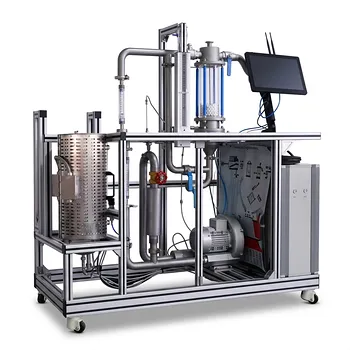
Configuring a double-jacketed glass reactor with precise thermostatic control, high-torque agitation, and integrated isolation modules is the safest, most instructive way to demonstrate SCO composite synthesis.
For temperature-sensitive spin-crossover (SCO) polymer composites, the core demonstration unit must pair a double-jacketed glass reactor with a recirculating thermostatic bath. This handles the critical coordination and dispersion phases while letting students observe everything directly. A high-torque stirrer keeps the active iron-triazole complex uniformly suspended in the increasingly viscous PVA matrix. Finally, built-in vacuum filtration and drying stations turn the process into a closed, safe teaching loop.
Core Takeaway: A safe educational SCO demonstration hinges on three interdependent systems—ultra-precise thermal regulation, agitation designed for viscosity shifts, and contained powder handling—all backed by industrial-grade safety interlocks. The configuration must let students visualize kinetics and phase behavior without ever compromising thermal or chemical safety.
Precise Temperature Control: The Non-Negotiable Foundation
Spin-crossover behavior and the stability of the coordination complex both collapse outside a narrow thermal window. The reactor configuration must lock in that window with zero drift.
Double-Jacketed Glass for Visibility and Control
A double-jacketed glass reactor provides the transparency students need while the jacket’s constant fluid circulation—from a recirculating thermostatic bath—holds the reaction mixture at the exact setpoint. Even minor excursions can quench the SCO transition or trigger unwanted side reactions, so the bath must offer ±0.1 °C stability.
Multi-Stage Temperature Profiling
The synthesis often requires a sequence of low-temperature coordination followed by a controlled warm-up for polymer dispersion. A programmable PID loop on the bath or a dedicated PLC lets you pre-program these ramps, demonstrating how industry handles thermally fragile processes. The same logic helps students correlate temperature shifts with real-time color or viscosity changes.
Thermal Safety Interlocks
Borrowing from high-pressure pilot plant design, you should install over-temperature alarms and an automated shut-off that cuts heating if the reactor exceeds the safe limit. A cooling jacket co-feed or emergency cooling bypass can quench an unintended exotherm, much like the inter-stage cooling strategies used in exothermic MTBE units but applied here to protect product quality and student safety.
Managing Viscous Polymerization with High-Torque Agitation
As the polymer matrix thickens, standard magnetic stirring fails, leaving unmixed zones where the complex settles and degrades locally. The configuration must counteract this from the first moment of dispersion.
High-Torque Overhead Stirring
A high-torque mechanical stirrer with a PTFE or stainless-steel impeller is mandatory. It maintains a uniform suspension even when the solution transitions from a low-viscosity fluid to a gel-like state. Variable speed control lets students map the torque increase to the progress of polymerization, turning a processing challenge into a measurable learning outcome.
Shear-Sensitive Impeller Design
Spin-crossover complexes can denature under extreme shear. The impeller should be a low-shear anchor or gate type that sweeps the vessel walls, preventing hot spots near the jacket while gently folding the matrix. This mirrors the principle of "gentle but complete" mixing often used in pilot-scale enzymatic or shear-sensitive resin processes.
Integrated Isolation and Safety Modules
The demonstration isn’t finished once the reaction stops. The product must be isolated without exposing students to fine thermochromic powders or solvent vapors.
Closed-Loop Vacuum Filtration
An integrated vacuum filtration module, directly attached to the reactor’s bottom valve, captures the composite as soon as it is discharged. This eliminates manual transfer, contains any volatile organic auxiliaries, and gives students a direct look at solid-liquid separation principles. A catch pot with a vapor return line can be added to illustrate closed-system handling.
Controlled Drying Under Inert Atmosphere
The filtered powder often needs drying at a specific temperature to lock in the desired SCO state. A dedicated drying station—a jacketed vessel with inert gas purge (N₂) and temperature readout—prevents thermal overshoot and moisture reabsorption. This is not a separate experiment; it’s a downstream unit operation that completes the teaching loop.
Industrial-Grade Safety Systems Adapted for the Lab
Drawing on lessons from high-pressure pilot plants (hydrothermal, Haber), every configuration should include automated pressure relief valves (even at near-ambient conditions, as a precaution against unexpected gas evolution), temperature interlocks, and hard-wired emergency stops. A PLC with a touchscreen HMI lets students monitor trends and set alarm limits, reinforcing the culture of safe, instrumented operation that industry demands.
Understanding the Trade-offs
While a fully instrumented double-jacketed reactor train is ideal, it comes with constraints every educator should weigh.
Cost and Footprint: High-precision baths, PLCs, and integrated modules multiply the per-unit cost. If budget limits you, prioritize the double-jacketed glass reactor and thermostatic bath above all else—these directly prevent the most likely failure mode (thermal drift). A simple, well-designed stirring and filtration setup can follow later.
Throughput vs. Demonstration Fidelity: Smaller reactor volumes (100–500 mL) give faster heat transfer and better temperature fidelity, but they limit the amount of product students can isolate. If the goal is hands-on material testing, scale slightly up but accept slightly slower response times.
Manual vs. Automated Control: A fully automatic sequence is safer but can obscure the learning. A middle ground uses PLC with manual override—students set the ramp, observe, and intervene under supervision. This mirrors how operators manage real-world exothermic and equilibrium-limited reactions, where automation handles routine stability but humans manage exceptions.
Making the Right Choice for Your Learning Goal
Exactly how you configure the unit should follow the primary pedagogical objective of your lab.
- If your primary focus is demonstrating thermodynamic and kinetic principles: Prioritize the double-jacketed glass reactor with a programmable thermostat and a visible torque vs. time readout. This gives students a live plot of the thermal and rheological evolution of the SCO composite.
- If your primary focus is safe powder handling and process integration: Ensure the reactor configuration includes the closed vacuum filtration and inert drying modules. This turns the unit into a mini pilot plant and teaches containment as a core unit operation.
- If your primary focus is industrial safety and automation: Invest in a PLC-controlled system with cascaded temperature and pressure interlocks, an emergency cooling loop, and a complete HMI alarm log. This replays the same safety architecture found in high-pressure fixed-bed or autoclave systems, but applied to a sensitive, room-pressure reaction where the cost of failure is product degradation, not explosion.
Match the configuration to the deep lesson you want students to carry forward, and you’ll have a reactor unit that is as safe as it is instructive.
Summary Table:
| System Component | Key Configuration | Educational & Safety Value |
|---|---|---|
| Thermal Regulation | Double-jacketed glass reactor & ±0.1°C recirculating bath | Ensures process visibility and prevents thermal quenching of delicate SCO complexes. |
| Agitation System | High-torque mechanical stirrer with low-shear anchor impeller | Handles high-viscosity matrix transitions without destroying shear-sensitive polymers. |
| Safety & Isolation | Integrated vacuum filtration & automated PLC safety interlocks | Prevents chemical/powder exposure and demonstrates real-world industrial process safety. |
Bring Industrial-Grade Safety and Precision to Your Chemical Engineering Labs
At LABPARK, we design and supply state-of-the-art Educational and Vocational Unit Operations Pilot Plants tailored for universities, research institutes, and enterprises. Whether you are demonstrating complex bioprocesses, teaching environmental water treatment, or configuring advanced chemical reactors for temperature-sensitive polymerizations, our systems ensure maximum safety, visibility, and control.
Why partner with LABPARK?
- Precision Control: Achieve ±0.1°C thermostatic stability and robust agitation for high-viscosity materials.
- Safety-First Architecture: Integrated PLC interlocks, emergency bypass systems, and closed-loop filtration protect students and operators.
- Tailored Integration: Custom-configured pilot plants designed to match your specific academic curriculum and research needs.
Ready to elevate your laboratory training systems? Contact our engineering experts today to discuss your pilot plant requirements!
Related Products
- Tubular Reactor Flow Characteristics Determination Educational Unit Operations Pilot Plant
- Multi-Reactor Educational Pilot Plant for Reaction Engineering Unit Operations
- Fixed Bed Gas Solid Catalytic Reaction Educational Pilot Plant
- Solid Spherical Heat Transfer Coefficient Determination Educational Chemical Engineering Pilot Plant
- Fixed-Bed Chemical Reaction and Gas Dust Tar Removal Unit Operations Pilot Plant
People Also Ask
- How to apply Simpson's rule to tracer test data? Reactor Characterization Guide
- When configuring a reactor unit operations pilot plant for highly exothermic reactions, how to prevent thermal runaway?
- How do educational unit operations pilot plants address safety and waste management when scaling up?
- How do educational unit operations pilot plants bridge theory and industrial process development? Hands-On Learning
- How do unit operation requirements differ between traditional chemical processes and bioprocesses? Build Better Pilot Plant Curricula