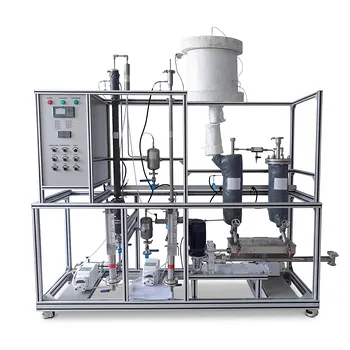
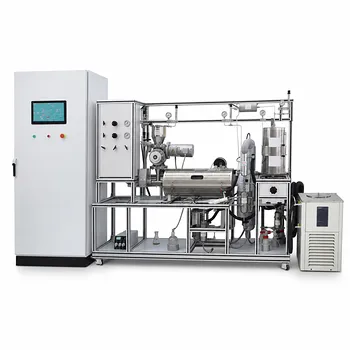
The core of simulating industrial methane steam reforming (MSR) in a pilot plant lies in replicating the exact catalyst system and aggressive operating window.
To do this, the plant must house a commercial-grade nickel catalyst—typically 10–20% NiO on an α‑Al₂O₃ or MgAl₂O₄ carrier—and run the reactor at 400–1000 °C with pressures up to 3.0–5.0 MPa. Under these conditions, the pilot unit becomes a faithful scaled-down model of an industrial reformer, allowing direct study of catalyst activity, heat transfer efficiency, and structural durability.
Core Takeaway
The key to a meaningful simulation is not just high temperature and pressure, but precise control over the commercial Ni-based catalyst and its support. Without this industrial‑grade catalyst in a reactor that can sustain severe endothermic conditions, the pilot plant cannot reflect the real deactivation mechanisms (sintering, coking) or heat-management demands that define large‑scale methane steam reforming.
The Foundation of Industrial SMR Simulation
Why the Catalyst Must Match the Plant
The industrial MSR catalyst is not a generic formulation. Most industrial units use 10–20% NiO supported on α‑alumina (α‑Al₂O₃) or spinel (MgAl₂O₄) carriers. These carriers are chosen for their high thermal stability and resistance to sintering at the 800–900 °C window that reformers routinely hit. A pilot plant that settles for a different support or nickel loading will misrepresent the metal‑support interactions that govern both activity and deactivation.
When the pilot reactor runs the same commercial catalyst, operators can directly observe how sintering and coke deposition progress under load. They can test whether the Al₂O₃ or MgAl₂O₄ support truly stabilizes the nickel crystallites against coalescence and whether the chosen support’s oxygen‑storage ability (if CeO₂ is added as a promoter) mitigates carbon fouling. Without this parity, the pilot study becomes a chemistry demonstration, not an industrial simulation.
Operating Conditions: Temperature, Pressure, and Heat Flux
Industrial methane steam reforming is highly endothermic and thrives only when the reactor delivers sustained heat at 500–900+ °C. The pilot plant must therefore be built to handle 400–1000 °C and pressures of 3.0–5.0 MPa, matching the commercial range. This aggressive envelope is not just a checklist item—it directly determines reaction kinetics, equilibrium conversion, and the rate of catalyst deactivation.
Heat management is the unsung hero. A small‑scale reactor loses proportionally more heat to the surroundings, so the pilot plant must incorporate multi‑zone electric heating or an integrated combustor to mimic the heat flux of a full‑scale furnace. Only then can the temperature profile along the catalyst bed resemble that of an industrial tube reactor, allowing meaningful measurement of heat transfer efficiency and coking hotspots.
Translating Theory to Pilot‑Scale Reality
Modular Design and Parameter Control
Pilot plants that effectively simulate MSR are built as modular unit operations. A typical train includes a feedstock pre‑treatment section, the catalytic reforming reactor, product separation (e.g., condensation, membranes), and recycle loops. This modularity lets researchers vary space velocity, steam‑to‑carbon ratio, and feed flow rate independently, observing how each tweak alters conversion and product distribution.
Crucially, the control system must hold a tight temperature gradient across the reactor. Because MSR consumes heat, any cold spot can quench the reaction and cause rapid carbon accumulation. Advanced pilot units use multi‑zone temperature controllers with independent heating elements, replicating the heat‑flux profile of an industrial side‑fired or top‑fired furnace. This hardware is what separates a teaching apparatus from a true process‑simulation tool.
Feedstock and Catalyst Stability
Methane is the feedstock of interest, but the pilot plant’s design must also acknowledge that the high C‑H bond strength demands severe conditions. At the same time, the nickel catalyst is vulnerable to coking if the steam‑to‑carbon ratio is too low or if temperature excursions occur. A well‑designed simulation therefore runs on‑line gas analysis (GC or mass spectrometry) to detect early signs of deactivation—CO breakthrough, a drop in H₂ yield, or an increase in CH₄ slip—and allows rapid adjustment of the steam ratio.
Supplementary references stress that the support material is the first line of defense against coking. In a pilot plant, operators can test advanced carriers side‑by‑side with the commercial baseline: ZrO₂‑stabilized Ni for higher hydroxyl coverage, CeO₂ for oxygen‑storage‑assisted carbon removal, or MgAl₂O₄ for pure thermal resistance. This direct comparison is only possible when the plant can run at industrial‑grade temperature and pressure with precise control.
Understanding the Trade‑offs
Limitations of Small‑Scale Simulation
No pilot plant reproduces every industrial nuance. Heat‑loss effects are exaggerated at small diameters, making it harder to sustain a uniform radial temperature profile. The pressure drop across a short bed may be too low to mimic the gas velocity profiles of a 12‑meter reformer tube, potentially altering mass‑transfer limitations. These discrepancies mean that catalyst lifetime predictions from a pilot run must be treated as relative indicators, not absolute guarantees.
Coke formation can also be amplified in a pilot unit if the control system lags behind temperature fluctuations. In industry, the massive thermal inertia of the furnace smothers such swings. In a small reactor, a momentary drop in steam flow can lead to runaway coking that is not representative of a well‑operated plant. The simulation designer must therefore build in safety margins on the steam‑to‑carbon ratio and use in‑situ regeneration cycles to avoid misleading deactivation data.
Scale‑Up and Educational Value
Despite these trade‑offs, pilot plants remain irreplaceable for catalyst screening, kinetic modelling, and training. The ability to change a catalyst cartridge in hours—rather than shutting down a multimillion‑dollar reformer—allows head‑to‑head comparisons that are impossible at scale. For educational settings, the pilot plant bridges the gap between textbook thermodynamics and the gritty reality of load‑following and fouling. It teaches students that temperature control is a dynamic battle, not a set‑point, and that catalyst formulation is a compromise among activity, stability, and cost.
How to Design Your Pilot Study for MSR Simulation
The right pilot‑plant configuration depends entirely on your objective. Align the hardware and catalyst choice with your primary goal.
- If your primary focus is catalyst screening: Use a single‑tube reactor that can hold small charges (20–100 g) of commercial Ni/Al₂O₃ or Ni/MgAl₂O₄ and can reach 900 °C at 3 MPa; equip it with rapid online gas analysis to compare conversion and coking rates across formulations.
- If your primary focus is process optimization: Integrate the reforming reactor with downstream separation (e.g., a pressure‑swing adsorption skid) and recycle loops, and program your control system to vary steam‑to‑carbon ratio, space velocity, and pressure in automated sequences.
- If your primary focus is education or workforce training: Install a modular unit with transparent glass sections for flow visualization and a simplified control interface, but still insist on a commercial catalyst and a multi‑zone furnace so that the data mirror industrial expectations.
The most powerful simulation is one that treats the pilot plant not as a scaled‑down replica but as a dynamic test bed capable of reproducing the kinetic, thermal, and deactivation‑challenged environment that defines industrial methane steam reforming. When the catalyst and the operating severity match the real process, every observation becomes a faithful preview of what will happen at the gigawatt scale.
Summary Table:
| Key Parameter | Industrial Target | Pilot Plant Simulation Strategy |
|---|---|---|
| Catalyst System | 10–20% NiO on $\alpha$-Al₂O₃ or MgAl₂O₄ | Use exact commercial-grade catalysts to replicate coking & sintering |
| Temperature | 500–900+ °C | 400–1000 °C range via multi-zone electric heating |
| Operating Pressure | 3.0–5.0 MPa | High-pressure reactor tubes matching industrial kinetics |
| Heat Management | High heat flux from furnace | Multi-zone temperature control to counteract heat loss |
Scale Up Your Research and Training with LABPARK Pilot Plants
Replicating complex industrial processes like MSR requires highly reliable, precision-engineered equipment. LABPARK designs and manufactures premium Educational and Vocational Unit Operations Pilot Plants tailored for chemical engineering, bioprocess & biotech, and environmental & water treatment.
Whether you are a university training the next generation of engineers, a research institute testing novel catalysts, or an enterprise scaling up operations, our customizable pilot plants provide the exact control, safety, and durability you need to achieve reliable data.
Contact our expert team today to discuss your pilot plant requirements!
Related Products
- Steam Methane Reforming Hydrogen Production and Purification Educational Pilot Plant
- Dual-Mode Rectification Pilot Plant for Practical Training Unit Operations
- Methanol Synthesis and Catalyst Performance Evaluation Educational Unit Operations Pilot Plant
- Methane Cracking Educational Unit Operations Pilot Plant
- Carbon Dioxide Hydrogenation Methanol Synthesis Educational Unit Operations Pilot Plant
People Also Ask
- How Do Temp, Pressure & S:C Ratio Affect Methane Reforming? Optimize Your Pilot Reactor
- How to Integrate WGS & Purification in Steam Reforming Pilot Plants to Protect Fuel Cells from CO Poisoning
- What are the differences between steam reforming and ATR in pilot plants? Key Design Guide
- How is carbon deposition controlled in steam reforming? The Critical Role of S/C Ratio
- What is the difference between allothermal and autothermal steam reforming in pilot plants?