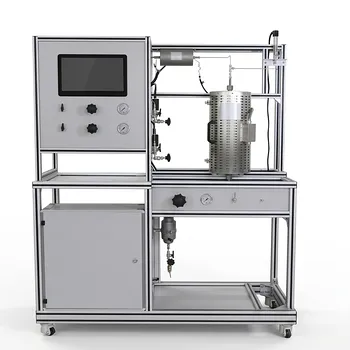
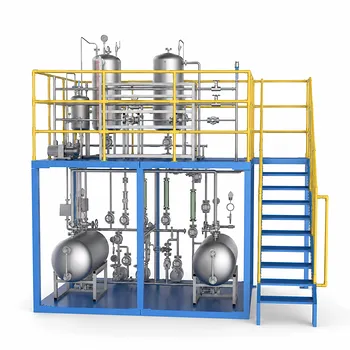
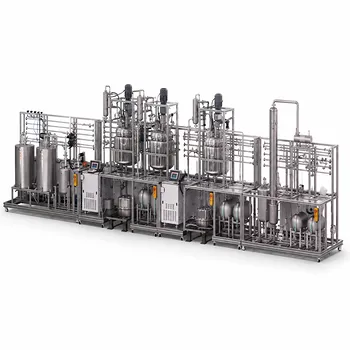
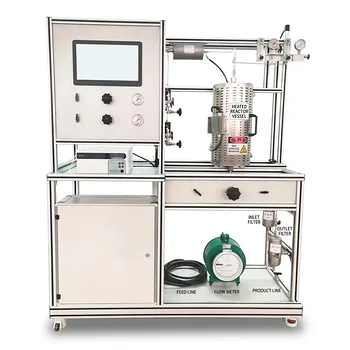
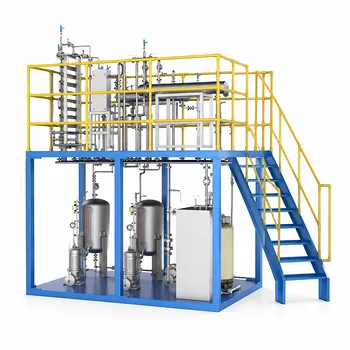
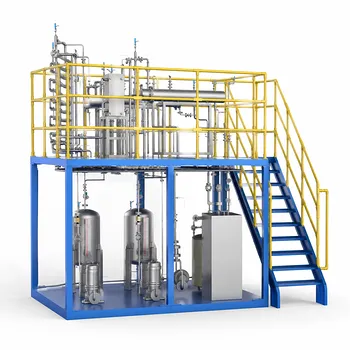
The textbook defines it. The pilot plant reveals it. Chemical engineering unit operations pilot plants are the physical proving ground where abstract formulas for reaction enthalpy and rate laws become tangible engineering problems. By manipulating real valves, heaters, and mixers in a scaled-down industrial environment, students directly observe how thermodynamic equilibria and kinetic rates manifest—enabling them to perform energy balances, calculate yields, and optimize for cost and safety. This is the moment when a student stops being a theorist and starts thinking like a process engineer.
Chemical engineering unit operations pilot plants bridge the critical gap between academic theory and industrial practice. They force students to confront non-ideal heat losses, scale-dependent mixing, and real-time process data, transforming textbook principles into the practical skills needed for safe, efficient, and economical plant design.
From Equation to Reality: The Pilot Plant Advantage
Academic chemistry courses teach thermodynamics and kinetics through idealized models—predicting reaction direction using Gibbs free energy or calculating rates with Arrhenius parameters. A pilot plant makes these models accountable to physical reality.
Observing Thermodynamics in Action
In a lecture, you solve for the adiabatic flame temperature or standard heat of reaction using Hess’s Law. In a pilot-scale jacketed reactor equipped with flow meters and temperature sensors, you measure the actual temperature profile of an exothermic neutralization.
The difference between theory and measurement immediately introduces concepts like heat loss, the heat capacity of the vessel, and non-ideal mixing. You learn that a perfect energy balance rarely holds, and you must account for where the energy really goes.
Kinetics Beyond the Beaker
Reaction kinetics are often taught by integrating rate laws in an ideal batch reactor. In a pilot plant, you control residence time by adjusting continuous feed flow rates, observe selectivity changes due to imperfect temperature control, and see how side reactions become significant.
You are no longer just calculating a rate constant; you are developing the intuition to manage reaction pathways under industrial constraints.
Bridging Scales: From Molecular to Macroscopic
Chemical process technology operates across three scales: the micro/nanolevel (kinetics and catalysis), the mesolevel (reactor and unit operation), and the macrolevel (process design and control). A unit operations pilot plant is the physical bridge that connects molecular behavior to macroscopic process variables like separator efficiency or column pressure drop. It makes scale-dependent phenomena—like mixing time and heat transfer limitations—visible and measurable.
The Hands-On Toolbox: Material and Energy Balances
The systematic calculation of mass and energy flows is the bedrock of chemical engineering. A pilot plant transforms this exercise from a tidy homework problem into an act of detective work.
Confronting Non-Ideal Conditions
Students map the process flow diagram, select a calculation basis (e.g., kg per hour), and then collect live data on stream temperatures, pressures, and compositions. When they close the energy balance and find a 5% discrepancy, the real learning begins.
They must trace the loss: is it convective heat loss from an uninsulated pipe, a vented vapor stream, or an unreacted residue? Accounting for these real-world losses is the essence of process engineering, and no textbook can replicate this experience.
Data-Driven Process Optimization
A pilot plant allows you to change one variable—like feed temperature or catalyst loading—and immediately observe the effect on yield and product purity. This creates a direct feedback loop for learning process optimization.
Students begin to understand that the most “theoretically efficient” operating point is not always the most economical or safe. They learn to balance competing goals using real-time data, a skill that directly translates to plant design and operation.
Developing Industrial Intuition: Safety, Scale-up, and Control
Operating a pilot plant develops a form of engineering “Spidey sense”—the ability to anticipate problems before they happen.
Reactor Design and Heat Management
A coffee-cup calorimeter teaches the heat of neutralization; a pilot-scale reactor teaches you how to remove that heat at a rate that prevents a runaway. Students gain hands-on experience with jacketed heating/cooling systems, internal coils, and precise temperature control loops.
They study how reactor design (stirred tank, fixed-bed, or loop) affects heat dissipation and flow patterns, linking the fundamental thermodynamics of reaction enthalpy to the practical skill of reactor configuration.
From Trial-and-Error to Predictive Engineering
Modern industry is shifting away from expensive, iterative scale-up runs and toward predictive engineering using mathematical models. Pilot plants play a dual role here: they generate the data needed to validate those models and they teach students the physical intuition needed to judge when a model is likely to fail.
By studying transport phenomena at the pilot scale, students learn how fluid dynamics and heat transfer fundamentally change as you move from a glass flask to a 100-liter reactor, preparing them for a career that relies on both simulation and practical sense.
Understanding the Trade-offs: Limits of Educational Pilot Plants
While invaluable, pilot plants are not a perfect replica of a commercial facility. It’s crucial to understand their boundaries.
The Cost and Maintenance Reality
Educational pilot plants require significant capital investment, regular maintenance, and dedicated safety oversight. This can limit the frequency and variety of experiments, and institutions must budget for dedicated technical support staff to prevent equipment downtime from becoming the primary lesson.
Safety Constraints Limit Exploration
For clear safety reasons, student-operated pilot plants cannot explore the true hazardous boundaries of a process. Reactions that are highly exothermic, involve toxic intermediates, or are prone to thermal runaway are typically avoided. The training is realistic but necessarily sanitized, focusing on safe operating envelopes rather than worst-case scenario management.
The Scale-Up Gap Remains
A 20-liter reactor is still not a 20,000-liter reactor. Multiphase mixing patterns, surface-to-volume ratios, and flow maldistribution can manifest very differently at commercial scale. Students must learn to use pilot plant data as a critical input for a larger predictive model, not as a direct miniature copy of the final plant.
How to Integrate Pilot Plants into an Effective Curriculum
After a dense introductory lecture, the pilot plant should be deployed strategically. It’s not a replacement for theory but its most powerful complement.
- If your primary focus is foundational thermodynamics: Use the pilot plant to show that real systems have heat capacity and heat loss. A simple heat balance on a jacketed stirred reactor after a neutralization experiment makes “ΔU = Q + W” viscerally real.
- If your primary focus is chemical kinetics and reactor design: Run the same reaction in a continuous mode at different flow rates. Let students calculate residence time and compare conversion to the ideal model, then ask them to diagnose why the real data falls short.
- If your primary focus is process control and safety: Task students with designing a control loop to maintain a setpoint temperature during an exothermic reaction. The experience of tuning a PID controller and seeing the process oscillate teaches more about dynamics than any simulation.
- If your primary focus is scale-up and economic evaluation: Have students calculate the yield and separation efficiency of a distillation column, then perform a basic cost analysis based on their own collected material balance data. It connects unit operation performance directly to business viability.
The ultimate goal is not to produce a technician who can run a specific rig, but an engineer who can think critically about any process. A pilot plant is the most effective tool we have to transform a student who calculates an answer into a professional who solves a problem.
Summary Table:
| Theoretical Concept | Pilot Plant Reality | Key Learning Outcome |
|---|---|---|
| Thermodynamics (Ideal Heat Balances) | Real jacketed reactors with heat dissipation | Accounting for heat loss, vessel capacity, and non-ideal mixing |
| Chemical Kinetics (Ideal Rate Laws) | Continuous flow manipulation & heat variance | Managing residence time, selectivity changes, and side reactions |
| Process Scale-up (Idealized Beakers) | Multi-scale transport phenomena | Validating mathematical models for larger commercial systems |
Bring Industrial Reality to Your Laboratory with LABPARK
Bridge the gap between textbook formulas and physical engineering. LABPARK provides premium Educational and Vocational Unit Operations Pilot Plants in chemical engineering, bioprocess & biotech, and environmental & water treatment.
We help universities, research institutes, and enterprises equip future engineers with the hands-on experience, process safety skills, and data-driven optimization capabilities required in modern industry.
Ready to upgrade your curriculum? Contact LABPARK today to discuss your project needs.
Related Products
- Carbon Dioxide Hydrogen Methanol Synthesis Educational Unit Operations Pilot Plant
- Multi Pump Fluid Transport Process Piping Unit Operations Training Pilot Plant
- Natural Product Extraction Unit Operations Training Pilot Plant
- Multi-Modal Distillation Unit Operations Training Pilot Plant
- Multi-Reactor Educational Pilot Plant for Reaction Engineering Unit Operations
People Also Ask
- How do temp & pressure affect methanol synthesis pilot plants? Optimize equilibrium and catalyst performance.
- Why is a purge system necessary when operating a gas recirculation loop in a methanol synthesis pilot plant? (Guide)
- Why do modern methanol pilot plants operate at lower pressures? Catalyst & Feed Requirements Explained
- What are the operational requirements for catalyst activation? Safe Methanol Pilot Plant Operation
- Why is the chemical plant startup schedule crucial? De-risk scale-up with pilot plants.