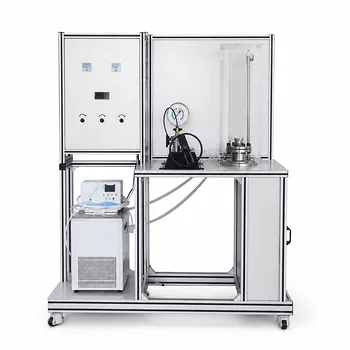
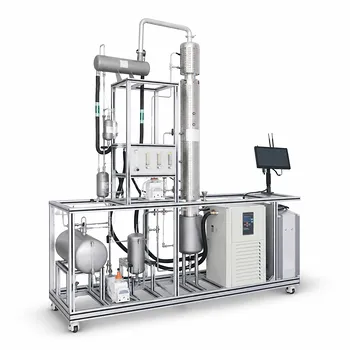
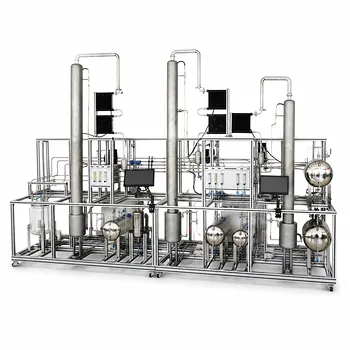
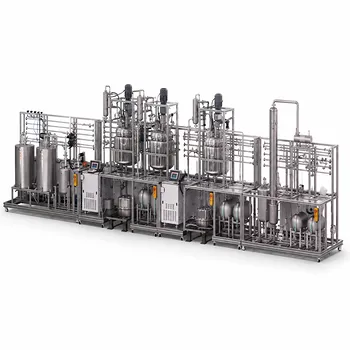
The answer lies in direct physical experimentation.
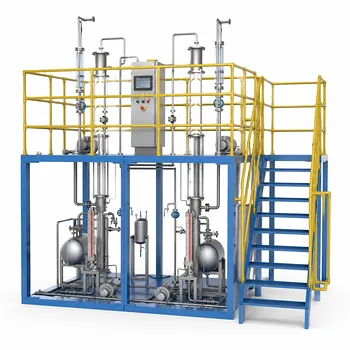
Unit operations pilot plants, particularly vapor-liquid equilibrium (VLE) setups and distillation columns, allow students and researchers to precisely measure the phase behavior of carbon dioxide/hydrocarbon mixtures under controlled temperatures and pressures. By generating empirical data for systems like CO₂/ethane (a positive azeotrope) or CO₂/acetylene (a negative azeotrope driven by opposing quadrupole moments), a team can directly test whether a thermodynamic model predicts the azeotropic composition within 1% or the bubble-point pressure within 0.1 bar. This physical evidence transforms theoretical perturbation theories and activity-coefficient models from educated guesses into reliable engineering tools.
Thermodynamic models for azeotropic CO₂/hydrocarbon systems are powerful, but they remain approximations until validated by real-world measurements. A unit operations pilot plant doesn’t just confirm a model’s output—it provides the calibrated data and operational insight needed to close the gap between molecular-scale theory and safe, cost-effective industrial separations.
Why Thermodynamic Models Alone Fall Short
The Inherent Complexity of Azeotropic CO₂/Hydrocarbon Mixtures
Systems containing carbon dioxide and light hydrocarbons often exhibit sharp nonideality and can form either positive or negative azeotropes. A positive azeotrope, such as CO₂/ethane, boils at a lower temperature than either pure component, while a negative azeotrope, like CO₂/acetylene, boils at a higher temperature due to specific quadrupolar interactions.
Predicting these behaviors from first-principles alone is risky. Equations of state (e.g., Peng‑Robinson) and activity-coefficient models (e.g., NRTL, UNIQUAC) use fitted binary interaction parameters that can wander outside their validated range, especially near critical regions or when strong polar forces dominate.
Why “Validated on Literature” Isn’t Enough
Even well‑known models can produce erratic predictions within their supposedly safe operating window. Relying solely on published parameters or software simulations introduces process uncertainty that can derail scale‑up, because the original data rarely matches the exact composition, pressure, and temperature range of your specific separation.
The Indispensable Role of the Pilot Plant
Creating a Physical Learning Environment for Phase Behavior
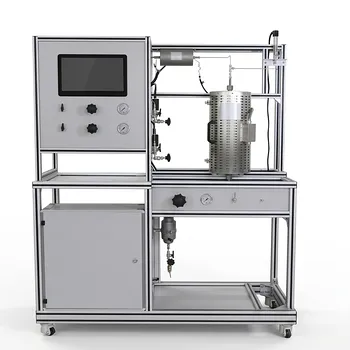
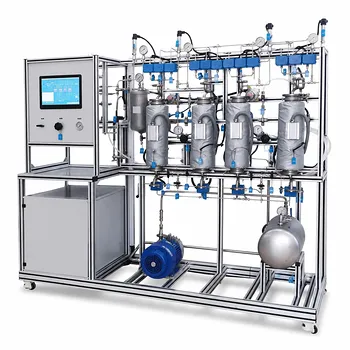
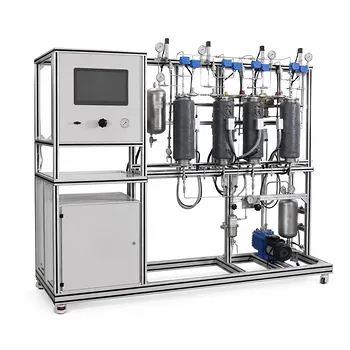
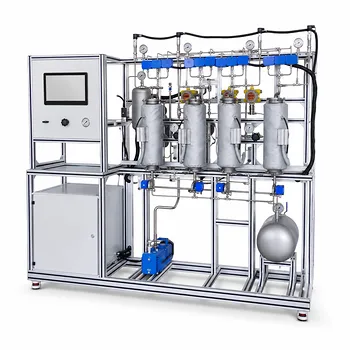
A VLE‑focused unit operations pilot plant provides a controlled, instrumented space where students and researchers can manipulate pressure, temperature, and feed composition while safely handling high‑pressure CO₂. In a batch‑distillation or circulating‑still apparatus, the mixture reaches equilibrium, and samples of the liquid and vapor phases are extracted for precise compositional analysis.
This hands‑on operation turns an abstract azeotrope diagram into a measurable reality. Instead of trusting a simulation’s red curve, you see the temperature plateau, sample the identical vapor/liquid compositions, and record the exact pressure at which the azeotrope forms.
Connecting Molecular Interactions to Observable Data
For the CO₂/acetylene system, a model might attribute the negative azeotrope to opposing quadrupole moments, but only pilot‑plant data can confirm whether that microscopic explanation translates into the predicted shift in boiling temperature. By comparing the measured P‑x‑y isotherms with a perturbation‑theory model, researchers validate whether the underlying physics truly captures the interaction.
Validating Multivariate Process Models Safely
Beyond pure VLE cells, small‑scale distillation and absorption pilot plants let the team test multivariate designs and deliberately introduce process upsets—like a pressure swing or a change in solvent ratio—to see if the azeotropic separations remain feasible. This experimental freedom uncovers hidden failure modes, such as composition pinches or column flooding, that no steady‑state simulator can fully predict.
From Raw Data to a Trusted Model
Regressing Binary Interaction Parameters
The empirical stream samples collected from a pilot distillation column are a gold mine for model refinement. Researchers feed the measured compositions, temperatures, and flow rates back into a process simulator and regress the binary interaction parameters (e.g., UNIQUAC’s τij) until the simulation matches reality. This turns a generic database model into a process‑specific, calibrated tool that can be confidently used for full‑scale design.
Closing the Gap Between Theory and Industrial Scale
Physical validation addresses the real‑world constraints that simulations oversimplify: heat loss through poorly insulated lines, fouling from trace impurities, and non‑uniform flow distribution. A pilot plant captures the actual mass and energy balances, allowing engineers to adjust model parameters and safety margins before committing to a commercial unit.
Building a Bedrock of Practical Knowledge
For students, the value extends beyond the numbers. Operating a pilot plant to validate an azeotrope prediction teaches them to interpret discrepancies, manage non‑ideal mixing, and appreciate why even a “perfect” model still needs a physical reality check—skills that no purely software‑based exercise can deliver.
Navigating the Challenges of Pilot‑Scale Validation
The Cost and Time Investment
Running a pilot plant for high‑pressure CO₂ systems requires specialized equipment and rigorous safety protocols, which consume budget and schedule. These experiments can take days to reach steady state, and multiple runs are often needed to cover the desired pressure‑temperature envelope.
Measurement Uncertainty and Scale‑Up Gaps
Even a well‑built VLE cell has analytic errors in gas chromatography or gravimetric analysis that can obscure a close‑fitting model. Additionally, pilot‑scale hydrodynamics—like tray weeping or distributor maldistribution—introduce effects that differ from industrial towers, so the validated model may still need corrections when scaling up by a factor of 100.
The Danger of Over‑Regressing a Single Data Set
If a model is fit too tightly to one pilot‑plant run, it can lose predictive power for slightly different conditions. Researchers must balance the desire for a perfect match with the need to keep the model robust across the intended operating range.
How to Leverage Pilot Plants for Your Research
Goal‑driven experiment design ensures that pilot‑plant time yields the maximum learning.
- If your primary focus is purely academic azeotrope verification: Operate a high‑precision VLE still at multiple isotherms. Use the measured vapor‑liquid compositions to directly test whether the model predicts the azeotropic point within your acceptance criteria, and publish the raw data for community use.
- If your primary focus is designing a commercial CO₂/hydrocarbon separation: Run a continuous distillation pilot unit with the actual feed composition. Collect steady‑state tray samples and regress binary interaction parameters to calibrate your simulation, then stress‑test the column with deliberate disturbances to map its true operating window.
- If your primary focus is educational skill‑building: Let students identify the azeotrope by changing the reflux ratio and sampling the overhead and bottoms. Use the hands‑on troubleshooting of a real column—fouling, heat losses, sensor drift—to cement the lesson that simulated perfection never tells the full story.
When you let a unit operations pilot plant transform a theoretical azeotrope curve into a set of measured, defended data points, you stop hoping a model is right and start knowing it.
Summary Table:
| Azeotrope Type | Example System | Phase Behavior | Validation Approach |
|---|---|---|---|
| Positive | CO₂ / Ethane | Boils below pure component temperatures | Measure bubble-point pressure within 0.1 bar |
| Negative | CO₂ / Acetylene | Boils above pure component temperatures | Verify quadrupole interaction models via VLE |
Ready to bridge the gap between thermodynamic theory and real-world process engineering? LABPARK provides state-of-the-art Educational and Vocational Unit Operations Pilot Plants in chemical engineering, bioprocess & biotech, and environmental & water treatment.
Designed specifically for universities, research institutes, and enterprises, our pilot plants deliver the precise, calibrated physical data you need to validate complex thermodynamic models and scale up processes with confidence.
Contact LABPARK today to discover how we can elevate your research, teaching, and training capabilities!
Related Products
- Carbon Dioxide Hydrogen Methanol Synthesis Educational Unit Operations Pilot Plant
- Multi-Functional Special Distillation Educational Pilot Plant
- Carbon Dioxide Hydrogenation Methanol Synthesis Educational Unit Operations Pilot Plant
- Carbon Dioxide Capture and Utilization Educational Pilot Plant for Unit Operations
- Natural Product Extraction Unit Operations Training Pilot Plant
People Also Ask
- How do temp & pressure affect methanol synthesis pilot plants? Optimize equilibrium and catalyst performance.
- Why is a purge system necessary when operating a gas recirculation loop in a methanol synthesis pilot plant? (Guide)
- Why do modern methanol pilot plants operate at lower pressures? Catalyst & Feed Requirements Explained
- What are the operational requirements for catalyst activation? Safe Methanol Pilot Plant Operation
- Why is the chemical plant startup schedule crucial? De-risk scale-up with pilot plants.