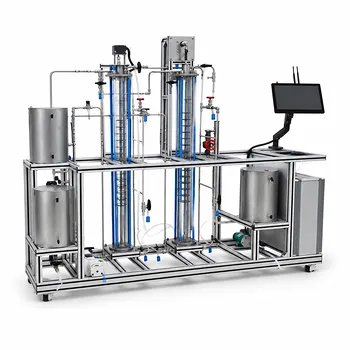
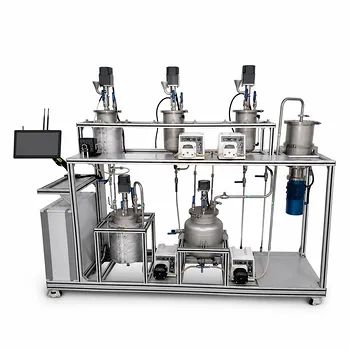
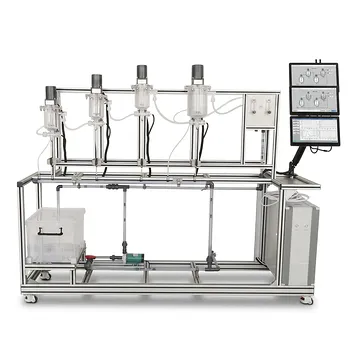
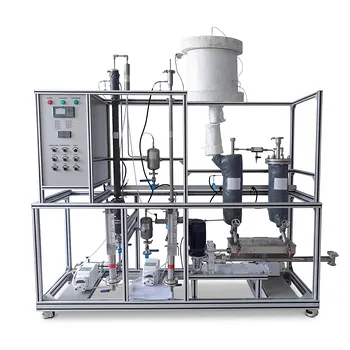
Pilot plants demonstrate the thermodynamic reality behind in-situ shale oil retorting by physically recreating a vertical temperature gradient in a packed-bed column. These scaled-down units allow you to track how hot gases preheat cold feed material, drive pyrolysis in a central retort zone, and then condense valuable liquid products as they rise through the unretorted rock above. By instrumenting the system with arrays of temperature and flow sensors, you can map idealized profiles, adjust recycle gas ratios, and directly measure the energy balance that defines process efficiency.
In-situ retorting is a self-sustaining thermal wave in a moving solid bed. Chemical engineering pilot plants turn this abstract concept into a tangible experiment, using packed-bed reactors or heat-integrated columns to reveal the four critical zones—preheat, combustion, retort, and condensation—and to quantify the path-dependent heat and mass transfer that determines oil yield and gas heating value.
The Thermal Anatomy of In-Situ Retorting
A successful in-situ retort operates on a controlled vertical temperature wave. To understand it, you need to see how heat and mass move in a moving or fixed bed of rock. A unit operations pilot plant lets you physically separate and study each zone.
The Preheating Zone: Recovering Heat from Hot Gases
In the field, cold air or recycle gas enters the top of a fractured shale column, passes downward, and is gradually heated by the spent, hot rock below. In the pilot plant, a packed-bed column with multiple thermocouples shows this counter-current heat exchange directly. You measure inlet gas temperature, track the temperature ramp along the bed, and calculate the rate of sensible heat transfer from solids to gas. The data lets you plot the gas preheat segment of the temperature profile, confirming how well the system recovers thermal energy.
The Retorting Zone: Pyrolysis in Action
The heart of the process occurs where heated gas reaches the pyrolysis temperature of kerogen (450–500°C). In the pilot plant, a centrally heated zone or an exothermic reaction front mimics this retort zone. You see a steep temperature plateau where solid organic matter decomposes into oil vapor, water vapor, and permanent gas. By measuring the inlet and outlet gas composition simultaneously, you can close a material and energy balance over that zone, calculating the heat consumed by the endothermic pyrolysis reaction. This is a direct demonstration of chemical thermodynamics applied to a reactive solid.
The Condensation Zone: Product Recovery Through Cold Shale
As hot product vapors rise toward cooler, unretorted shale above, they condense. The pilot plant simulates this by forcing the hot gas stream through a section of cold packing material. You place temperature sensors along this upper zone and watch the effluent temperature drop while collecting liquid in a separator. This visualizes how a natural condensation front forms, driven purely by heat transfer to the cold rock. You can then quantify the thermal duty needed to condense the oil and water, directly linking mass transfer and heat transfer principles.
Bridging Theory and Practice: Why a Pilot Plant?
Retorting thermodynamics can be described by formulas for heat capacities, heats of reaction, and heat transfer coefficients. But textbook equations alone rarely give you intuition about scale-up sensitivity or profile stability. Unit operations pilot plants bridge that gap.
From Microscale to Mesoscale
Lab beaker tests cannot duplicate the continuous, counter-current contacting of gas and granular rock that defines in-situ retorting. A pilot-scale packed bed does. You can run steady-state experiments that mirror the industrial temperature wave, capturing temperature profiles across 10–50 bed lengths. This intermediate scale makes it possible to see how axial heat dispersion and wall losses affect the ideal gradient predicted by plug-flow models.
Heat Transfer Limitations When Scaling Up
A critical lesson from supplementary references is that larger vessels have a much lower surface-area-to-volume ratio. That means heat transfer through the walls becomes disproportionately slow, and internal temperature gradients can escape control. By operating a pilot plant with similar internal flow patterns but manageable thermal mass, you run mock heat transfer evaluations—calculating UA values from start-up and shut-down curves. Those experiments teach the same principle: if you double the bed diameter, you cannot simply double the heating power. You’ll see how the retort front can become uneven, leading to unproductive heating or partial pyrolysis.
Direct Measurement of Key Thermodynamic Quantities
With a well-instrumented pilot plant, you collect real-time flow rates, pressures, and temperatures at multiple points. You then apply systematic energy balances using a known mass of shale-simulant packing. Comparing the measured enthalpy in the product streams to the heat input lets you calculate the process heat loss and the true enthalpy change of the retorting reaction. This closes the loop between the first law of thermodynamics and a tangible, irreversible process—something no lecture slide can fully convey.
Trade-offs and Inherent Limitations
A pilot plant is a simplification of a geologic formation. It cannot replicate the heterogeneity of natural fractures, the true permeability of oil shale, or the complex mineral decomposition that occurs underground. Your packed bed is an idealization that isolates the thermal wave from groundwater intrusion, overburden pressure, and large-scale heat losses to surrounding rock.
Moreover, you typically use surrogate solids—such as crushed ceramic or pre-processed shale—to avoid handling raw, potentially oily rock. This means the actual pyrolysis kinetics and the heat of reaction may differ from the field. The pilot plant demonstrates the principles of the thermal gradient and heat recovery, but it does not guarantee that the same temperature profile will sustain itself exactly in a 100-meter-thick formation. Understanding these limitations is essential for interpreting your data honestly.
Making the Right Choice for Your Goal
To get the most from a unit operations pilot plant in this context, align your experimental setup with the specific learning outcome you need.
- If your primary focus is visualizing the temperature wave: Install thermocouples every few centimeters along the bed axis and record transient profiles during start-up. The goal is to watch the retort front stabilize.
- If your primary focus is optimizing energy efficiency: Vary the recycle gas ratio and measure the resulting gas heating value and preheat temperature. The goal is to find the operating point that minimizes external fuel demand.
- If your primary focus is understanding scale-up risks: Run the same experiment in two columns of different diameters and compare the time required to reach steady-state and the uniformity of the temperature gradient. The goal is to observe the non-linear impact of vessel size on heat transfer.
- If your primary focus is teaching material and energy balances: Force a full mass and heat balance closure by measuring all inlet and outlet streams. The goal is to quantify losses and see how the irreducible gap between theory and reality drives better engineering.
The power of a chemical engineering pilot plant lies not in perfectly replicating a commercial retort, but in distilling the underlying thermodynamic choreography—the preheat, the pyrolytic reaction, and the controlled condensation—into a measurable, repeatable experiment that turns complex field phenomena into clear physical principles.
Summary Table:
| Retorting Zone | Pilot Plant Simulation | Key Principle Demonstrated |
|---|---|---|
| Preheating | Gas passing through spent hot rock | Counter-current sensible heat transfer |
| Retorting | Kerogen pyrolysis in a heated zone | Endothermic reaction & energy balance |
| Condensation | Hot vapors rising through cold packing | Vapor-liquid phase change & thermal duty |
Bring Thermodynamic Theories to Life in Your Lab
Are you looking to bridge the gap between textbook equations and hands-on engineering? LABPARK provides premium Educational and Vocational Unit Operations Pilot Plants in chemical engineering, bioprocess & biotech, and environmental & water treatment.
Designed specifically for universities, research institutes, and enterprises, our pilot plants enable students and researchers to visualize thermal waves, manage heat transfer limits, and perform precise mass and energy balances.
Contact LABPARK today to find the perfect pilot plant solution for your institution!
Related Products
- Dual-Mode Rectification Pilot Plant for Practical Training Unit Operations
- Natural Product Extraction Unit Operations Training Pilot Plant
- Multi-Functional Special Distillation Educational Pilot Plant
- Continuous Batch Extractive Distillation Educational Pilot Plant
- Comprehensive Liquid-Liquid Extraction Pilot Plant for Engineering Education
People Also Ask
- How does polyphosphate hydrolysis affect scale and corrosion in pilot plants? Essential Monitoring Guide
- How do predictive thermodynamic models integrate into pilot plants? Bridging Theory and Practice
- Which cross-validation strategy should be selected for pilot plant time-series & batch data? Avoid Data Leakage
- Why Use Center Points in Process Analyzer Calibration? Key Benefits Explained
- How can process control schemes be configured to teach basic and advanced control?