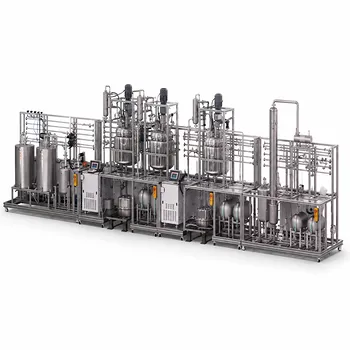
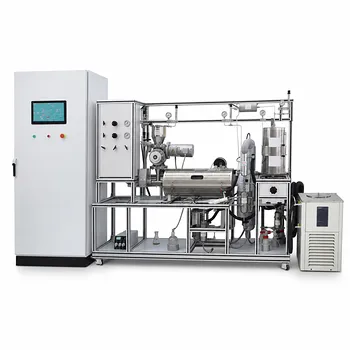
Mixing isn't just a background detail—it's a kinetic control knob. Chemical engineering unit operations pilot plants demonstrate the impact of fluid dynamics and mixing on reaction yields by letting you physically manipulate flow rates, mixer geometries, and feed strategies while measuring the resulting conversion and product distribution. The pilot plant transforms abstract equations like micromixing limits and residence-time distributions into a visual, measurable cause-and-effect relationship: change the lamination width in a split-and-recombine mixer, and you'll watch the byproduct peak shrink in real time.
For non-linear reactions, the way molecules meet matters just as much as how fast they react. Pilot plants close the gap between idealized reactor models and real-world mixing physics by making the invisible mixing scale visible through yield changes, showing that micromixing—not just residence time—dictates performance.
The Deep Problem: Why Mixing Alters Yield, Not Just Speed
Chemical yield is not only a function of temperature and concentration; it’s a spatial and temporal puzzle. When multiple reactions compete, the local environment where molecules collide—lamination thickness, eddy size, segregation intensity—determines which pathway dominates.
The Micromixing–Kinetics Connection
For second-order or complex reaction networks, the reaction rate depends on the instantaneous proximity of reactants. If mixing is slow relative to reaction, concentration gradients form, leading to local hot spots of one species that favor side reactions.
A pilot plant with adjustable micromixers (like split-and-recombine units) makes this tangible. By reducing the lamination width from millimetres to microns, you force the reactants into thinner striations, increasing the interfacial area and diffusion speed. The direct result: higher conversion to the desired product in competitive consecutive reactions.
Residence-Time Distribution Isn't Enough
In a first-order reaction, conversion depends only on how long molecules spend in the reactor, described by the residence-time distribution (RTD). But for non-linear kinetics—the majority of industrial chemistry—the RTD alone is insufficient, because the sequence of mixing and reaction history changes the local concentration landscape.
Pilot plants can simultaneously measure RTD (via tracer tests) and product distribution under controlled stirring speeds or feed arrangements. You’ll see yield change even when the macroscopic RTD stays the same, proving that micromixing patterns—segregated versus ideal—govern non-linear reactions.
How Pilot Plants Translate Theory into Observable Results
A well-instrumented pilot plant acts as a microscope for fluid dynamics. It gives you control over three powerful levers and the sensors to capture their impact on yield.
1. Manipulating Flow Rates and Feed Segmentation
By varying the total flow rate or the ratio of side feeds into a tubular reactor, you change the initial lamination thickness. In a teaching pilot plant, students can inject a dye stream and see the striation width change with flow velocity, then measure the reaction yield online. A smaller initial lamination width reduces the diffusion path, promoting a faster approach to homogeneity and, for a consecutive reaction, a higher selectivity to the intermediate.
2. Changing Mixing Configurations
Pilot reactors often support interchangeable mixer elements—simple tees, static split-and-recombine mixers, or mechanically agitated cells. Testing these configurations side by side with the same chemistry reveals the mixing-performance hierarchy.
For example, a competitive-consecutive reaction (like a bromination) will show a marked drop in byproduct when switching from a simple T-junction to a structured mixer. The pilot plant’s sampling ports let you plot byproduct yield versus pressure drop, directly linking mixing energy to reaction output.
3. Isolating Mixing from Kinetic Variables
Temperature and catalyst concentration primarily affect the intrinsic reaction rate. Pilot plants with jacketed reactors and precise temperature control allow you to hold kinetics constant while solely varying stirrer speed or static mixer elements. When yield improves with higher stirrer speed but plateaus after a certain rpm, you’ve experimentally identified the mixing-limited regime—hard evidence that fluid dynamics, not just chemistry, controls the outcome.
Understanding the Trade-offs and Pitfalls
Objective use of pilot plants means recognizing what they can—and cannot—reveal about mixing-yield relationships.
The Ideal vs. Segregated Flow Trap
Many textbooks present Zwietering’s bounds: ideal mixing generally gives a higher reactant outlet concentration than segregated flow for non-linear reactions. But real reactors fall between these extremes. Pilot plants show that near-plug flow with intermediate micromixing can actually outperform both extremes for certain yield targets. Over-relying on ideal models without pilot-scale verification often leads to over-designed mixers or yield surprises during scale-up.
When Mixer Pressure Drop Doesn’t Pay Back
Better mixing requires energy. A split-and-recombine mixer with extremely fine lamellae gives near-perfect mixing but imposes a large pressure drop. In a pilot plant, you can measure the pump energy cost alongside the yield gain. This reveals the economic optimum—the mixing intensity where every extra Pascal delivers a diminishing return in product value. Industrial decisions must balance fluid dynamics with process economics, and the pilot plant is the only place to generate that multi-variable data safely.
Scale-Dependent Mixing Mechanisms
The mixing mechanism that works in a lab microreactor—pure diffusion—often fails at production scale where turbulent eddies and convection dominate. Pilot plants at bench-to-pilot volumes let you investigate how the mixing regime shifts with scale. By running the same reaction in geometrically similar reactors of increasing size, you can quantify the yield loss due to slower relative mixing and define the scale-up criteria before committing to full construction.
Making the Right Choice for Your Demonstration or Research Goal
Apply these insights based on what you most need from your pilot plant experiments.
- If your primary focus is teaching the mixing-yield link: Choose a simple competitive-consecutive reaction (like iodide-iodate or a dye-based system) with visual feed streams and online spectrophotometry. Let students vary the lamination width and mixer type to build intuition before introducing mathematics.
- If your primary focus is validating a kinetic model: Use the pilot plant to decouple mixing from kinetics by running in a well-characterized ideal reactor (e.g., a well-stirred CSTR with high agitation). First determine the rate law, then introduce segregated feed conditions to see if the model fails—proving the need for a mixing sub-model.
- If your primary focus is optimizing an industrial reactor: Perform parallel experiments with product-capable pilot equipment, recording yield, selectivity, and pressure drop across a range of mixing energies. Use the data to find the mixing-kill curve and select the configuration that maximizes economic return.
- If your primary focus is scale-up risk reduction: Operate the pilot plant at multiple scales or with multiple mixer designs to map out how micromixing time changes relative to reaction time. Use these dimensionless numbers to predict start-up performance at full scale.
Every time you adjust a stirrer or swap a static mixer and watch the product spectrum shift, you’re witnessing the principle that fluid dynamics is not just a transport cost—it’s a design variable for reaction yield itself.
Summary Table:
| Mixing Parameter | Impact on Reaction Yield | Pilot Plant Demonstration Method |
|---|---|---|
| Micromixing (Lamination) | Determines reactant proximity; prevents side reactions in non-linear kinetics. | Varying flow rates and testing interchangeable mixers (e.g., T-junctions vs. static mixers). |
| Residence-Time (RTD) | Governs first-order conversion, but is insufficient alone for complex kinetics. | Conducting tracer tests while holding macroscopic RTD constant and varying stirring speeds. |
| Scale-up Regimes | Shifts from diffusion to turbulence; potential yield loss during scale-up. | Running identical chemistry in geometrically similar reactors of increasing sizes. |
| Energy & Pressure Drop | High mixing efficiency increases yield but incurs high pumping energy costs. | Plotting byproduct yield against pressure drop to find the optimum economic return. |
Bring Fluid Dynamics Theory to Life with LABPARK
Bridging the gap between textbook equations and real-world chemical engineering requires hands-on experimentation. LABPARK provides premium Educational and Vocational Unit Operations Pilot Plants across chemical engineering, bioprocess & biotech, and environmental & water treatment.
Specially designed for universities, research institutes, and enterprises, our pilot systems empower students and researchers to physically manipulate fluid dynamics, visualize mixing regimes, and optimize reaction yields.
Ready to upgrade your laboratory's training and research capabilities? Contact us today to find the perfect pilot plant solution!
Related Products
- Carbon Dioxide Hydrogen Methanol Synthesis Educational Unit Operations Pilot Plant
- Multi Pump Fluid Transport Process Piping Unit Operations Training Pilot Plant
- Natural Product Extraction Unit Operations Training Pilot Plant
- Multi-Modal Distillation Unit Operations Training Pilot Plant
- Multi-Reactor Educational Pilot Plant for Reaction Engineering Unit Operations
People Also Ask
- How do temp & pressure affect methanol synthesis pilot plants? Optimize equilibrium and catalyst performance.
- Why is a purge system necessary when operating a gas recirculation loop in a methanol synthesis pilot plant? (Guide)
- Why do modern methanol pilot plants operate at lower pressures? Catalyst & Feed Requirements Explained
- What are the operational requirements for catalyst activation? Safe Methanol Pilot Plant Operation
- Why is the chemical plant startup schedule crucial? De-risk scale-up with pilot plants.