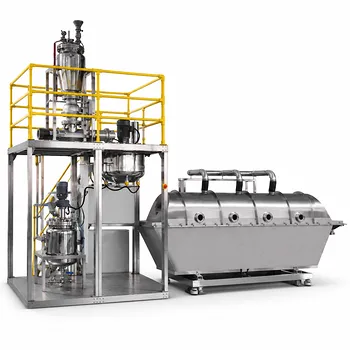
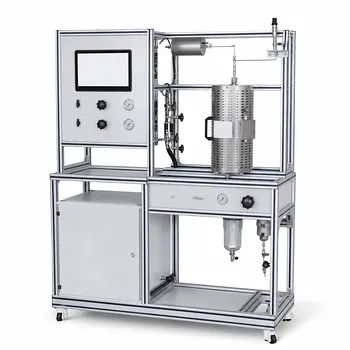
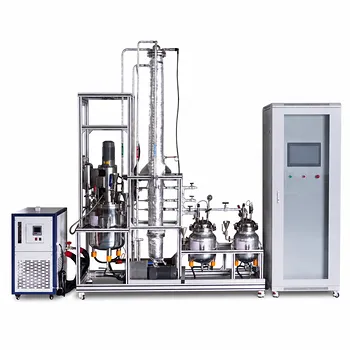
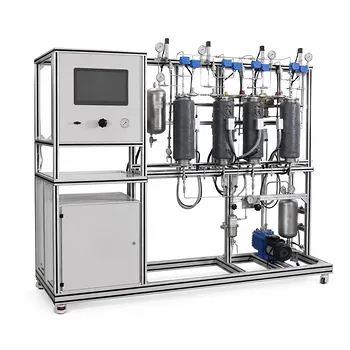
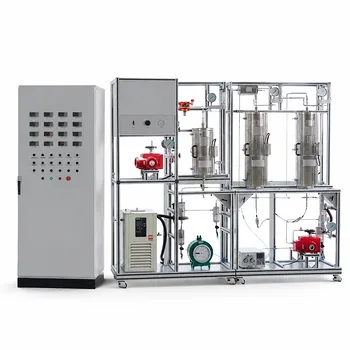
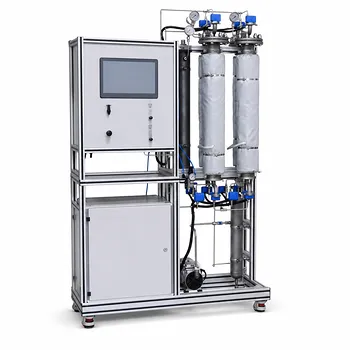
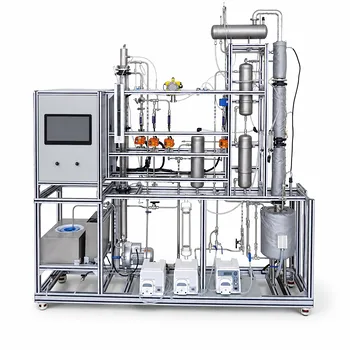
Pilot plants are the definitive tool for translating hazardous polycarbonate chemistry into a controlled, comparative learning environment. They do this by physically decoupling the most dangerous steps, substituting model chemistries, and isolating key unit operations—allowing students and researchers to safely dissect how the phosgene interfacial and melt transesterification mechanisms behave, differ, and respond to process variables.
The core challenge isn’t just showing two chemical routes; it’s managing radically different hazard profiles while still letting the underlying polymerization mechanism reveal itself through data. Pilot plants solve this by compartmentalizing risk and focusing the comparison on measurable outcomes like kinetics, mass transfer, and molecular weight control.
The Two Polymerization Routes: A Snapshot of Contrasting Mechanisms
The phosgene interfacial method reacts bisphenol A (BPA) in an alkaline aqueous phase with phosgene gas dissolved in a chlorinated organic solvent, creating polymer at the liquid-liquid interface. The process is inherently fast but generates highly toxic phosgene and requires intensive downstream washing, precipitation, and solvent recovery.
The melt transesterification method is a solvent-free step-growth reaction between BPA and diphenyl carbonate (DPC) carried out in the melt at high temperature (180–300 °C) under deep vacuum (130–400 Pa). The equilibrium is driven forward by continuously removing phenol, a volatile byproduct.
These two chemistries cannot be safely compared in a standard fume hood. Each demands its own engineered safety envelope and a system that makes the invisible—kinetics, mass transport, and phase behavior—visible.
Designing a Safe Pilot Plant Strategy for Each Route
A responsible comparison doesn’t require replicating an industrial plant. It requires modular pilot units that selectively focus on the mechanism-defining steps while substituting or containing the hazards.
Phosgene Interfacial Route: Containing the Hazard and Extracting the Lesson
Industrial interfacial polymerization uses gaseous phosgene, a severely toxic and lethal compound. In an educational or research pilot plant, the primary reference’s approach is to simulate the process using safer model reactions or to shift the focus to the separation unit operations that follow the reaction.
Model reaction substitution. Instead of phosgene, a less hazardous diacid chloride or a chloroformate can be used in a liquid-liquid dispersion with BPA–NaOH solution. This retains the interfacial condensation mechanism—where the nucleophilic attack occurs at the organic–aqueous boundary—without the gas-handling and scrubbing burden.
Spotlighting downstream processing. The real pedagogical value often lies in what happens after polymerization. Pilot-scale liquid-liquid extraction columns, stirred washing tanks, and filtration units can then demonstrate how catalyst residues, unreacted monomer, and salt are removed. Because product purity directly impacts polymer color and stability, students can measure conductivity or residual chloride in wash water to trace separation efficiency.
Supplementary references confirm that in a full-scale phosgene process, rigorous gas scrubbing and containment are mandatory. By limiting the pilot-scale reaction to a benign model and instead running the purification train at full fidelity, you keep the mechanistic insight while eliminating the inhalation risk.
Melt Transesterification Route: Engineering for High Temperatures and Deep Vacuum
This route is inherently lower in acute toxicity because it avoids phosgene and chlorinated solvents. However, safety must be re-engineered for the thermal and pressure extremes.
Hardware requirements. A pilot reactor for melt transesterification needs a high-temperature thermal oil jacket, a deep-vacuum pump (capable of < 100 Pa), and a high-torque anchor or helical agitator to handle the rapidly increasing melt viscosity as molecular weight grows. An overhead distillation column and a chilled phenol trap allow for quantitative collection of the byproduct.
Why this works safely. There is no toxic gas to leak, and the sealed vacuum system contains any volatile organics. The primary reference stresses that the pilot plant here demonstrates vacuum control, high-viscosity agitation, and phenol removal in one integrated unit. Supplementary sources add that this is why many academic pilot plants favor the melt route—the hazards are thermal and pressure-related, both of which can be managed with engineered safety interlocks far more easily than a phosgene cloud.
Demonstrating the Polymerization Mechanisms Through Pilot Plant Experimentation
With the safety architecture in place, the pilot plants become instruments for mechanistic comparison. The goal is to let students see that the two routes differ not just in temperature, but in their rate-limiting steps and kinetic profiles.
Kinetic Studies: Revealing the Rate-Limiting Step
The melt transesterification reaction is a classic step-growth polymerization with second-order kinetics in the early stages. By running a batch pilot reactor and withdrawing samples over time, students can plot 1/[DPC] versus time and obtain a linear relationship—the hallmark of equimolar second-order kinetics. The slope directly yields the rate constant k. More advanced pilot units with online viscometers or near-infrared probes allow real-time tracking of end-group concentration, reinforcing the link between molecular weight and conversion.
The interfacial route, through its model reaction, often exhibits transport-limited behavior. At a flat, unstirred interface, the reaction rate depends less on monomer concentration and more on the interfacial area and the diffusivity of the BPA anion into the organic phase. By running the same model reaction in a jacketed stirred vessel with a liquid-liquid extraction configuration and varying the impeller speed, the rate of polymer formation can become directly proportional to interfacial area, not to reactant concentration. This visually demonstrates a mass-transfer-controlled mechanism—a sharp contrast to the kinetically controlled melt process. Supplementary references on interphase mass transfer reinforce this: the pilot plant shows how a concentration gradient at the phase boundary dictates the overall rate.
Visualizing Equilibrium Shifts and Process Drivers
In the melt process, phenol removal is the thermodynamic engine. A pilot plant’s vacuum gauge and phenol collection vessel make this tangible. As the pressure is lowered, phenol evaporates more rapidly, shifting the equilibrium toward high polymer. By measuring phenol mass collected versus time and correlating it with molecular weight (via intrinsic viscosity or GPC from samples), students observe Carothers’ equation in action: molecular weight rises sharply only when the stoichiometric imbalance is minimized.
The interfacial model, by contrast, has no equivalent equilibrium shift. Instead, the driving force is solubility and phase partitioning. A pilot liquid-liquid extraction unit operating in countercurrent mode can show how the polymer repeatedly undergoes extraction, salting out, and precipitation, making purity a direct function of the number of theoretical stages. This reframes the mechanism not as a kinetic contest, but as a separation-limited process.
Bridging to Product Quality and Molecular Weight
Through comparative runs, the pilot data tell a clear story. In melt transesterification, molecular weight and color are exquisitely sensitive to temperature uniformity and vacuum level. A 10 °C hot spot or a vacuum leak causes irreproducible polymer chains. In the interfacial model, molecular weight often saturates early, and the critical quality parameter becomes residual salt and solvent, directly tied to the washing efficiency demonstrated in the downstream pilot train. The primary reference emphasizes that this comparative analysis is what lets students understand why industry has moved toward the solvent-free melt route despite its tougher operating envelope.
Understanding the Trade-Offs and Practical Pitfalls
A robust educational comparison must also acknowledge where pilot-scale simulations fall short or require careful interpretation.
Phosgene model fidelity. A safe model reaction (e.g., an acid chloride) will not perfectly replicate the reaction enthalpy or the side reactions of phosgene. The kinetics may be faster or slower, and the interfacial pH change will differ. This must be explicitly communicated as a model, not a replica.
Viscosity limitations. Small pilot reactors often lack the torque to stir a melt polymer beyond a moderate molecular weight (e.g., intrinsic viscosity ~0.5 dL/g). This can trivialize the demonstration of the final stage of polycondensation where polymer build-up is most dramatic. Supplementary references note that high-pressure rheology studies show how viscosity spikes—pilot units without proper high-torque drives will simply stop mixing, artificially limiting the observable mechanism.
Materials compatibility. Even the interfacial model uses chlorinated or organic solvent mixtures that can attack standard gaskets. The melt process demands seals rated for 300 °C and deep vacuum. A single modular unit rarely handles both; two separate pilot systems are the practical norm.
Data richness vs. industrial realism. The controlled pilot environment allows for much more instrumentation (online analytics, sampling ports) than an industrial reactor. While this provides superior mechanistic insight, the resulting rate constants must be scaled with caution, as heat- and mass-transfer regimes differ from those of a production-scale vessel.
Making the Right Choice for Your Teaching or Research Goal
How you configure and emphasize these pilot plant demonstrations depends entirely on the learning outcome you prioritize.
- If your primary focus is safe, hands-on experience with full polymerization kinetics: Choose the melt transesterification route as the core demonstration. Its second-order profile, vacuum-equilibrium coupling, and compatibility with online sensors deliver the richest reaction engineering data without the extreme toxicity.
- If your primary focus is process safety, containment, and downstream purification: Pivot to the model interfacial route and invest heavily in the liquid-liquid extraction, washing, and solvent-recovery pilot modules. The mechanistic insight then comes through mass-transfer limitations and separation efficiency, not raw kinetics.
- If your goal is a true head-to-head mechanistic comparison: Deploy two modular pilot systems. Use the model interfacial setup on the bench scale, and a separate high-temperature, high-vacuum reactor for the melt route. Unify the narrative through common metrics: molecular weight build vs. conversion, removal efficiency of byproduct or salts, and energy consumption per kilogram of polymer.
- If your audience is industry-facing (operators, distributors): Frame the pilot plant study around product purity, lot-to-lot consistency, and process robustness. Highlight how the melt route’s lack of solvent eliminates residual chloride and how the pilot plant’s vacuum monitoring predicts final color and optical clarity—information that directly translates to material quality and supply chain confidence.
Ultimately, a chemical engineering unit operations pilot plant transforms two abstract, hazardous polymerization mechanisms into a safe, data-rich comparison that no textbook can replicate. By intelligently substituting hazards, isolating critical unit operations, and capturing real-time process signatures, you empower the next generation of engineers to see not just what reacts, but how the react ion itself can be designed and controlled.
Summary Table:
| Parameter | Phosgene Interfacial Route (Model) | Melt Transesterification Route |
|---|---|---|
| Mechanism | Mass-transfer-controlled (at phase boundary) | Kinetically controlled (step-growth) |
| Key Hazards | Highly toxic phosgene, chlorinated solvents | High temperatures (180–300 °C), deep vacuum |
| Safety Strategy | Substitute with safer model reactions; focus on downstream washing | Sealed vacuum system, thermal oil jacket, phenol trap |
| Process Driver | Solubility, extraction, and phase partitioning | Volatile byproduct (phenol) removal to shift equilibrium |
| Key Equipment | Extraction columns, washing tanks, filtration | High-torque agitators, vacuum pump, heating jacket |
Bring Advanced Process Technology to Your Facility with LABPARK
To safely demonstrate complex chemical kinetics and separation processes, academic and research labs require robust, scaled-down solutions. LABPARK provides premium Educational and Vocational Unit Operations Pilot Plants in chemical engineering, bioprocess & biotech, and environmental & water treatment tailored for universities, research institutes, and enterprises.
Ready to enhance your hands-on curriculum and research capabilities? Contact us today to discuss your pilot plant requirements!
Related Products
- Polymerization Granulation and Pellet Processing Educational Unit Operations Pilot Plant
- Carbon Dioxide Hydrogen Methanol Synthesis Educational Unit Operations Pilot Plant
- Carbon Dioxide Hydrogenation Methanol Synthesis Educational Unit Operations Pilot Plant
- Methanol Synthesis and Catalyst Performance Evaluation Educational Unit Operations Pilot Plant
- Ethyl Acetate Synthesis Unit Operations Pilot Plant for Practical Training
People Also Ask
- How do educational unit operations pilot plants address safety and waste management when scaling up?
- How do educational unit operations pilot plants bridge theory and design? Bridge the Engineering Gap
- Why Compare Predicted and Experimental Excess Enthalpy? Key to Accurate Pilot Plant Scale-up
- When to transition from PID to adaptive control in pilot plants? Key process indicators.
- Why Use PTFE & Hastelloy in Chemical Pilot Plants? Prevent Corrosion & Ensure Safety