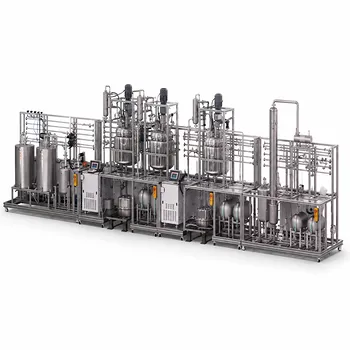
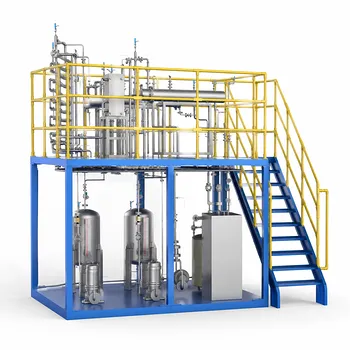
The core challenge of by‑product recovery is not whether it’s technically possible, but whether the extra purification step pays for itself. A unit operations pilot plant provides the missing link: empirical data on the real costs and efficiencies of that added separation. By physically running the process at a small scale—using distillation, extraction, or filtration—engineers can accurately measure utility consumption, separation efficiency, and the capital needed for the extra equipment, validating the economic model before committing to full‑scale investment.
The economic feasibility of recovering a by‑product boils down to a single question: does the net revenue (sales income plus avoided waste disposal costs) exceed the extra processing costs? A pilot plant answers that question by turning theoretical assumptions into measured realities for the additional separation step.
The Economic Equation for By‑product Recovery
A by‑product stream typically has value only if you can sell it at a required purity—and that purity almost always demands an extra separation process. This adds both capital (CAPEX) for the equipment and operating costs (OPEX) for energy, solvents, and maintenance. The economic viability is therefore a simple but unforgiving balance.
The “+ side” includes by‑product sales revenue and any avoided waste treatment costs. The “– side” totals additional operating expenses and the annualized cost of the extra capital investment. If the plus side is larger, the project makes sense.
The problem is that the extra separation step’s costs are often unknown at the design stage. Textbook efficiencies and simulations give a starting point, but real‑world behavior with your specific feed composition can shift costs dramatically.
Why the Separation Step Creates the Largest Uncertainty
Most chemical processes are designed around the main product. The by‑product stream is often an afterthought—a side cut with variable composition and contaminants that are not well documented. Predicting how many separation stages you need, what solvent ratio works, or how much energy you will consume becomes guesswork without physical testing.
This uncertainty can lead to two equally dangerous outcomes: under‑estimating the costs and losing money after full‑scale investment, or over‑estimating the costs and prematurely killing a profitable recovery scheme.
How Pilot Plants Provide the Missing Data Points
Measuring Actual Utility Consumption and Separation Efficiency
A unit‑operations pilot plant allows you to run the exact separation you intend to use—distillation, liquid‑liquid extraction, absorption, or membrane filtration—on a representative by‑product stream. That physical run yields hard numbers.
You measure the steam, electricity, cooling water, and solvent consumption directly. You determine the true number of theoretical stages required to hit the target purity. You also see whether the separation is stable, how much fouling occurs, and how product purity fluctuates with minor feed changes.
Quantifying the Extra Equipment Cost with Realistic Sizing
Pilot‑scale data directly feed into the sizing of the full‑scale unit. With measured throughput, pressure drop, heat duty, and stage efficiency, you can size the column, heat exchanger, or extraction vessel with confidence. The capital cost estimate moves from a rough order‑of‑magnitude to a defensible figure based on real engineering data.
Even small changes in stage efficiency or reboiler duty can significantly alter the required equipment size. A pilot plant eliminates the risk of over‑design (wasted capital) or under‑design (failed performance).
Validating Product Quality and Marketability
It’s not just about purity; it’s about whether the recovered by‑product meets a market specification. A pilot plant produces enough material to send samples to potential buyers and confirm that trace impurities don’t cause odour, colour, or stability issues. This avoids the trap of assuming that “99% purity” is acceptable when the buyer actually needs specific impurity profiles.
From Data to Decision: Economic Metrics Validated
Simple Payback Period and ROI
Once you have the pilot‑plant numbers, you can calculate the payback period (PBP) by dividing the total permanent investment by the incremental annual cash flow (extra revenue plus avoided disposal cost minus new operating costs). An ROI can be expressed as (annual net benefit / total investment) × 100%.
For example, if a yield improvement demonstrated in the pilot plant saves a known quantity of raw material annually, that saving is compared directly against the investment. A PBP of less than two or three years often triggers management approval.
Discounted Cash Flow (NPV and DCFROR)
For a more rigorous evaluation, pilot‑plant data feed into a Discounted Cash Flow analysis. The initial fixed asset investment, variable operating costs, and by‑product revenue are known with far less uncertainty. You can calculate the Net Present Value (NPV) and the Discounted Cash Flow Rate of Return (DCFROR) and compare that to the company’s capital cost hurdle rate. This is the language that corporate finance trusts.
Incremental ROI for Process Upgrades
If you are not building a full new plant but adding a recovery module to an existing facility, the Incremental ROI is the most relevant metric. It’s calculated as (Incremental Profit / Incremental Investment) × 100%. Pilot‑plant tests that validate a lower pressure drop in a new column design or reduced steam consumption directly become the incremental profit line in that equation.
Understanding the Trade‑offs
Pilot plants themselves cost money and take time. There is always a temptation to skip them and rely on simulation alone, especially for “simple” separations like a binary distillation. But the cost of a pilot study is a fraction of the financial impact of a mis‑sized full‑scale unit.
Another trade‑off is representativeness. The pilot plant must operate with a feed that truly reflects the future full‑scale stream—ageing, variation, and all. A test with an idealized, steady‑state feed can still lead to optimistic conclusions. The pilot‑plant program should include runs with worst‑case feeds to test the resilience of the economic case.
Finally, by‑product recovery adds complexity. Introducing an extra separation step creates new failure points, additional operator training, and potential scheduling constraints. The economic model must account for a realistic capacity factor and maintenance downtime, not just the lab‑bench efficiency.
Making the Right Choice for Your Project
The decision to invest in pilot‑plant evaluation depends on the potential financial impact and the uncertainty of the separation step. Use the following guidelines to framework your approach.
- If your primary focus is a quick, low‑risk screen: Run a limited pilot‑plant test to get the key separation parameters (stages, utility consumption) and calculate a simple payback period. If it falls well inside your comfort zone, you can proceed with higher confidence.
- If your primary focus is a full‑scale, capital‑intensive project: Invest in a comprehensive pilot‑plant campaign to generate the detailed inputs required for a NPV/DCFROR analysis. This is non‑negotiable when the extra equipment cost is significant.
- If your primary focus is retrofitting or debottlenecking an existing plant: Use the pilot plant to validate the incremental utility savings and calculate the Incremental ROI. This ensures you’re truly upgrading profitability, not just spending money on a simulation’s promise.
- If your primary focus is training and research: Use the pilot plant as a teaching tool that bridges the gap between theoretical yield calculations and the hard reality of energy bills and equipment costs. The simple payback example—seeing how a 5% yield lift drops to the bottom line—cements understanding permanently.
Empirical data turns an economic feasibility question from a scary unknown into a confidently structured business case. By letting the pilot plant answer the critical cost questions, you remove the guesswork and make by‑product recovery a calculable, bankable decision.
Summary Table:
| Economic Metric | Data Provided by Pilot Plant | Business/Decision Impact |
|---|---|---|
| CAPEX / Equipment Cost | Real throughput, stage efficiency, and sizing data | Prevents over- or under-design; secures accurate asset costs |
| OPEX / Utility Cost | Measured steam, electricity, water, & solvent use | Predicts true operating expenses and margin impact |
| NPV / ROI | Validated yield improvements and cost savings | Provides bankable data for corporate finance approval |
| Marketability | Purified sample volume for customer validation | Ensures product meets buyer specifications before scale-up |
Ready to Validate Your Process Economics?
Transform theoretical designs into bankable realities. LABPARK provides state-of-the-art Educational and Vocational Unit Operations Pilot Plants in chemical engineering, bioprocess & biotech, and environmental & water treatment. Designed for universities, research institutes, and enterprises, our pilot plants deliver the precise empirical data needed to evaluate feasibility, optimize scale-up, and minimize investment risks.
Contact LABPARK Today to discuss your pilot plant requirements and accelerate your research or production goals!
Related Products
- Carbon Dioxide Hydrogen Methanol Synthesis Educational Unit Operations Pilot Plant
- Multi Pump Fluid Transport Process Piping Unit Operations Training Pilot Plant
- Natural Product Extraction Unit Operations Training Pilot Plant
- Multi-Modal Distillation Unit Operations Training Pilot Plant
- Multi-Reactor Educational Pilot Plant for Reaction Engineering Unit Operations
People Also Ask
- How do temp & pressure affect methanol synthesis pilot plants? Optimize equilibrium and catalyst performance.
- Why is a purge system necessary when operating a gas recirculation loop in a methanol synthesis pilot plant? (Guide)
- Why do modern methanol pilot plants operate at lower pressures? Catalyst & Feed Requirements Explained
- What are the operational requirements for catalyst activation? Safe Methanol Pilot Plant Operation
- Why is the chemical plant startup schedule crucial? De-risk scale-up with pilot plants.