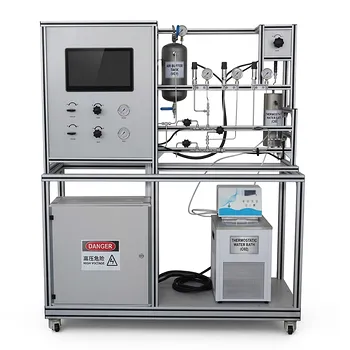
By precisely manipulating a reactor's heating and cooling systems, pilot plants show how to follow an “optimum temperature trajectory” that changes with conversion. This dynamic operation—rather than a single fixed temperature—maximizes the overall reaction rate by resolving the inherent conflict between kinetics (favored at high temperature) and thermodynamics (favored at low temperature) in reversible exothermic systems.
The core of the training is to experience firsthand how continuously shifting the temperature along a conversion-dependent optimum curve boosts space-time yield far beyond what a single isothermal setting can achieve. This directly links reaction engineering theory to the imperative of heat management seen in industrial processes like ammonia synthesis or SO₂ oxidation.
The Fundamental Challenge of Reversible Exothermic Reactions
These reactions release heat and are limited by chemical equilibrium. That combination creates a classic conflict every chemical engineer must master.
The Conflicting Effects of Temperature on Rate and Equilibrium
Higher temperatures accelerate the forward reaction rate exponentially, following the Arrhenius law. However, for an exothermic reaction, the equilibrium constant decreases with temperature, shifting the balance toward reactants.
This means running the reactor too hot can actually slow the net formation of products as the reverse reaction overtakes the forward. Running too cold makes the net rate negligible despite a favorable equilibrium position.
Defining the Optimum Temperature Trajectory
For each percentage of conversion, there is one specific temperature at which the net reaction rate is highest. This point is the optimum temperature (T_opt).
As conversion increases and the product concentration builds, the equilibrium constraint tightens, so T_opt continuously decreases. The line connecting all these T_opt values across conversion levels is the optimum temperature trajectory, a descending curve on a T-X_A diagram.
How Pilot Plants Bring Theory to Life
Well-instrumented unit operations pilot plants transform the abstract T-X_A curve into a controllable, measurable reality.
Dynamic Temperature Profiling and Control
A jacketed reactor with a programmable temperature controller (heating/cooling fluid loop) can be made to follow the exact trajectory. Operators start at a higher temperature to spark a fast initial rate, then gradually lower the temperature as conversion rises.
Students feel the controller compensating for the reaction’s own heat release, actively cooling the jacket to force the temperature down against the natural adiabatic rise. This hands-on tuning demonstrates that the optimum is not a constant setpoint but a living curve.
Real-Time Data Collection for Model Validation
Built-in sensors continuously log temperature, conversion (via analytics), and heat duty. This empirical dataset allows researchers to overlay their actual trajectory on the theoretical one and quantify the deviation.
The pilot plant becomes a testbed for fitting rate constants and validating kinetic models without the risks of a full-scale plant. The data pulled from these runs are exactly what engineers use to design industrial relief systems and confirm safe operating windows.
Observing the Impact on Space-Time Yield
The final proof is in the product. By comparing a run that follows the optimum trajectory against a control run held at a single “best” average temperature, the operator sees a measurable jump in space-time yield (kg product per hour per reactor volume).
This visible, quantified gain cements the economic motivation behind the entire exercise and connects reactor control directly to process profitability.
Practical Implementations in Unit Operations Pilot Plants
There is no single hardware setup; the principle is demonstrated through several classic configurations.
Multi-Stage Reactors with Inter-Stage Cooling
For highly exothermic reactions like SO₂ oxidation, a single adiabatic bed would overheat and ruin equilibrium. A pilot plant mimicking an industrial contact process uses multiple fixed-bed reactors in series with heat exchangers (or cold air quenches) between them.
The gas exits the first bed at a high temperature and limited conversion. By cooling it before it enters the second bed, both the temperature and the equilibrium constraint are reset, allowing the reaction to continue along a new segment of the optimum trajectory. This stepwise cooling approach routinely pushes overall conversion from ~65% to over 98%.
The same principle applies to exothermic, equilibrium-limited syntheses like MTBE production. A pilot plant with multi-bed reactors and inter-stage cooling demonstrates how to balance the high rate needed in early stages with the low temperature needed to secure high final conversion in later stages.
Calorimetric Monitoring and Heat Management
Jacketed pilot reactors frequently operate as calorimeters, measuring the temperature difference between the reaction mixture and the jacket fluid. Combined with an integrated calibration heater, the system continuously calculates the overall heat transfer coefficient and the instantaneous heat of reaction.
This data teaches a critical lesson: the heat removal capacity must match the dynamic trajectory. If the cooling system cannot sink the heat fast enough as the rate peaks, the trajectory control fails and the reactor runs away. The pilot plant experience provides the direct, quantitative link between reaction rate, heat evolution, and equipment limits.
Verifying Thermodynamic and Kinetic Principles
By running the reactor to steady-state at several different temperatures, students can measure equilibrium compositions and confirm the van’t Hoff relationship firsthand. Plotting ln(K_eq) vs. 1/T yields an experimental enthalpy of reaction that anchors the theoretical framework.
They can also design experiments to isolate the opposing trends: one campaign demonstrates how the rate constant rises with temperature, while another demonstrates how the equilibrium conversion collapses at high temperature. Seeing both in a single real system makes the need for an optimum trajectory self-evident.
Understanding the Trade-offs and Limitations
The trajectory is powerful, but it is not a silver bullet. Pilot work reveals hard practical constraints.
Thermal Runaway and Control System Limits
In a perfectly mixed batch or PFR, the optimum trajectory demands cooling as the reaction proceeds. If the jacket cannot remove heat fast enough, the temperature will overshoot, the equilibrium will crash, or worse, a dangerous runaway occurs.
Pilot plants allow safe investigation of these failure modes—pushing the coolant flow to its maximum and mapping the exact point where control is lost. That data defines the ultimate scale-up ceiling.
Sensor and Actuator Delays
Dynamic temperature control requires fast-responding thermocouples and valves. Any lag between measurement and corrective action causes the actual temperature to oscillate around the target, effectively spending time away from the optimum.
Students learn to tune PID parameters and assess the cost of imperfect control: the loss in mean reaction rate when the real system cannot perfectly trace the ideal curve.
Energy and Equipment Cost
The counter-current cooling needed to follow a descending trajectory consumes utility energy and adds capital expense. A pilot plant demonstration often pairs the optimum-trajectory run with a simpler adiabatic or isothermal run to show the trade-off between yield gain and additional cooling cost.
From Pilot Plant to Industrial Design
The pilot plant serves as a miniature version of the scaled problem. The T_opt trajectory discovered and validated here directly informs the number of catalyst beds, inter-stage cooler sizes, and overall reactor dimensions.
By running the pilot at fluid dynamic conditions that mimic the larger plant, researchers can estimate heat transfer coefficients and predict temperature control quality at scale. When the trajectory cannot be held exactly due to equipment limitations, the pilot data quantifies the expected yield loss, allowing a fact-based economic decision on whether incremental cooling investment is justified.
Making the Right Choice for Your Learning or Optimization Goal
Your focus will determine which aspects of the pilot plant exercise deserve the deepest exploration.
- If your primary focus is educational demonstration: Emphasize the direct, visual contrast between a run following the optimum trajectory and one at a constant temperature, using simple calorimetric data and conversion measurements to show which concept wins.
- If your primary focus is kinetic model validation: Use the pilot plant to collect high-quality, transient temperature–conversion data across multiple runs, then rigorously fit rate equations to confirm the Arrhenius parameters and refine the predicted T_opt curve.
- If your primary focus is scale-up and safety: Stress heat removal mapping, control-loop robustness, and the calculation of the adiabatic temperature rise at key conversion levels to size industrial cooling systems and relief devices.
- If your primary focus is process optimization for a specific reaction: Design a pilot campaign that deliberately explores off-optimum trajectories to quantify the loss in space-time yield and then systematically tunes the inter-stage cooling strategy for the best economic balance.
Mastering the optimum temperature trajectory in a pilot plant equips you not just with a reaction principle but with a direct, visceral understanding of how thermodynamics, kinetics, and heat transport must be orchestrated to make a real chemical process profitable and safe.
Summary Table:
| Key Challenge | Pilot Plant Solution | Operational Benefit |
|---|---|---|
| Kinetics vs. Thermodynamics | Dynamic temperature profiling | Maximizes reaction rate & space-time yield |
| Thermal Runaway Risks | Calorimetric monitoring | Validates safety limits & cooling systems |
| Scale-up Uncertainties | Real-time model fitting | Sizes industrial multi-stage reactors accurately |
Bring Chemical Engineering Theory to Life with LABPARK
Looking to demonstrate complex thermodynamic principles like the optimum temperature trajectory in your lab?
LABPARK provides state-of-the-art Educational and Vocational Unit Operations Pilot Plants in chemical engineering, bioprocess & biotech, and environmental & water treatment. Designed for universities, research institutes, and enterprises, our plants offer:
- Precise Control & Monitoring: Advanced heating/cooling loops and real-time data logging for kinetic modeling.
- Hands-on Training: A safe, controlled environment to study thermal runaway and reactor dynamics.
- Reliable Scale-up Data: Accurate process parameters to transition seamlessly from lab to industrial scale.
Ready to upgrade your lab's capabilities? Contact LABPARK today to find the perfect pilot plant solution for your curriculum or research!
Related Products
- Multi-Reactor Educational Pilot Plant for Reaction Engineering Unit Operations
- Tubular Reactor Flow Characteristics Determination Educational Unit Operations Pilot Plant
- Carbon Dioxide Hydrogen Methanol Synthesis Educational Unit Operations Pilot Plant
- Fixed-Bed Chemical Reaction and Gas Dust Tar Removal Unit Operations Pilot Plant
- Natural Product Extraction Unit Operations Training Pilot Plant
People Also Ask
- How do educational unit operations pilot plants address safety and waste management when scaling up?
- How do educational unit operations pilot plants bridge theory and design? Bridge the Engineering Gap
- Why Compare Predicted and Experimental Excess Enthalpy? Key to Accurate Pilot Plant Scale-up
- How to study gasification in pilot plants? Compare exit gas composition & efficiency
- Why Use PTFE & Hastelloy in Chemical Pilot Plants? Prevent Corrosion & Ensure Safety